

If you have recently invested in a partnership, an S corporation, or a real estate syndication, you may have received a tax document that looks far more complicated than a W-2.
Many investors ask us, What is a K1 tax form, and why does it arrive so much later than other tax paperwork? That question is common and important because this form directly impacts how much tax you owe.
At Skyline Financial CPA Houston, we know how confusing Schedule K-1s can be, especially for investors who are new to pass-through entities. This blog walks you through how the K-1 works, what the numbers actually mean for you, and how you can avoid expensive errors.
What is a K1 Tax Form and What It Reports to the IRS
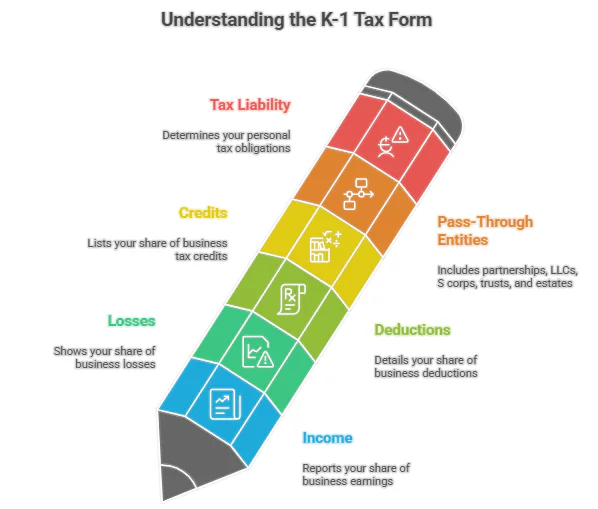
The Schedule K-1 reports your share of income, losses, deductions, and credits from pass-through entities such as partnerships, multi-member LLCs, S corporations, trusts, and estates.
These entities do not pay federal income tax themselves. Instead, their results pass through to you and are reported on your personal return.
At its core, the K-1 answers one question for the IRS: What is your share of this business?
If a partnership earns $200,000 and you own 10%, your Form K-1 will generally show $20,000 allocated to you. That allocation, not the cash you receive, drives your tax liability.
This is why K-1s are more detailed than other tax documents. They don’t just summarize income, but they break it into categories that are taxed differently, including ordinary income, rental income, interest, credits, and more.
How Your Entity Type Affects the K-1 You Receive
To clear up one thing about what is a K1 tax form, you must know that not all K-1s are the same. The version you receive depends on how your entity is structured.
Partnerships and LLCs Issue K-1s From Form 1065
This is the most standard version for real estate investors and private partnerships. It reports your share of business income or loss, rental activity, and guaranteed payments. It also tracks your capital account, which becomes important for basis calculations and future deductions.
This version frequently shows up in investments linked to real estate accounting, where depreciation and passive loss rules become important.
S Corporations Issue K-1s From Form 1120-S
If you are a shareholder in an S Corp, you will receive this version. One major difference is how payroll and distributions are handled. Unlike partnerships, S Corp shareholders generally do not pay self-employment tax on their share of profits.
This distinction is especially relevant when planning around S-Corp tax preparation and shareholder compensation.
Trusts and Estates Issue K-1s From Form 1041
If you are a beneficiary of a trust or estate, your K-1 reports income that was distributed to you, such as interest, dividends, or rental income.
Why Do K-1s Always Arrive Late?
The most frustrating part of figuring out what is a K1 tax form is the timing. K-1s are hardly ready in January.
Because partnerships and S Corps must complete their own tax returns first, many issue K-1s in March or April. Some file extensions, which means your K-1 may not arrive until late summer.
At Skyline Financial Management, we help you plan for this reality. You may need to file an extension for your personal return, but you still must pay any estimated tax due by April 15. Waiting for a K-1 is one of the main reasons high-income investors can’t file early.
Avoid Tax Issues with Accurate Tax Basis Records
Your tax basis represents how much you have invested in the business. It decides how much loss you are allowed to deduct.
Basis generally:
- Starts with your initial investment.
- Increases with income and additional contributions.
- Decreases with losses and distributions.
If your K-1 shows a $30,000 loss but your basis is only $12,000, you can only deduct $12,000. The rest is suspended and carried forward. You can easily trigger an audit if you claim losses beyond your basis.
How K-1 Losses Can Work in Your Favor
Losses reported on a K-1 can be powerful, but they are subject to Passive Activity Loss rules. Unless you actively participate, most K-1 income and losses are considered passive.
Passive losses can offset passive income. If you have multiple investments, a loss from one can reduce income from another. If you don’t have passive income, those losses are carried forward until you do or until you sell the investment.
Review the Entire K-1 to Prevent Any Risk
K1 Form taxes are not determined by one number alone. The footnotes and supplemental schedules often contain critical details.
You may find:
- Section 179 deductions.
- Charitable contribution allocations.
- Qualified Business Income information.
These items can significantly reduce your tax liability, but only if they are identified and applied correctly. We often see missed opportunities when these details are left out.
What Is a K1 Tax Form FAQs
1. Why does my K-1 arrive later than other tax forms?
It arrives late because the entity must file its own return first. K-1s are usually issued later than W-2s and 1099s.
2. Do I owe tax if I didn’t receive cash?
Yes. Taxes are based on allocated income, not distributions.
3. Can K-1 losses offset my salary?
Usually no, unless you materially participate or qualify under specific exceptions.
4. What happens if I don’t report a K-1?
The IRS receives a copy. If you miss it, it can lead to notices, penalties, and interest.
5. Should I keep my K-1s after filing?
Yes. They affect your basis and future tax calculations.
Conclusion
Now that you know what is a K1 tax form, you know the importance of understanding it properly if you are investing in pass-through entities.
These forms are powerful, but only when they are interpreted correctly and aligned with your overall tax strategy.
At Skyline Financial Management, our professional Houston CPA, Zahra Samji, helps investors translate complex K-1 data into clear and actionable decisions. Schedule a consultation with her today if you are looking for confidence, not confusion!

