

These days, how easily you send and receive money is shaped by the convenience of digital tools. You might use peer-to-peer payment apps to split your expenses, pay a friend, or get paid for freelance or business work.
Zelle has become especially popular because it connects directly to your bank and moves money quickly, without having a third-party wallet in between.
As tax season approaches, that convenience often raises questions. Many clients come to us asking the same question: Does Zelle report to IRS authorities? It’s easy to feel confused with so much mixed information about payment apps, 1099-K thresholds, and IRS compliance.
Our tax accountant Houston, Zahra Samji, gives you clear and practical guidance so you understand what Zelle does. She will properly explain to you what’s actually reportable and how you can stay compliant.
So, Does Zelle Report to IRS?
The answer is no. Zelle does not issue a tax form (Form 1099-K), no matter how much money flows through your account.
This can totally surprise you, especially if you have been following the news around the $600 reporting threshold for apps like PayPal, Venmo, and Cash App. Those platforms are constantly mentioned in IRS updates, so it’s natural for you to assume that Zelle works the same way.
Well, it doesn’t. To understand why, we need to look at how the law is written and how Zelle is structured.
Why the IRS Handles Zelle Payments Different From Other Payment Apps
The IRS requires Third-Party Settlement Organizations (TPSOs) to report certain transactions under Internal Revenue Code Section 6050W. These are platforms that:
- Act as intermediaries.
- Hold funds in a digital wallet.
- Settle payments between buyers and sellers.
Zelle doesn’t do any of that.
Zelle is essentially a bank-to-bank messaging service. When someone sends you money, it moves directly from their bank account to yours through existing banking systems like ACH or wire networks.
There is no third-party wallet and no settlement layer. Because of this structure, Zelle is not classified as a TPSO, and that’s why the answer to “Does Zelle report to IRS?” remains no.
Clearing Up the Misconception About No Form and Taxes
This is where we often see people get into trouble.
Even though Zelle doesn’t send a tax form, the IRS still wants you to report all taxable income. If you are a contractor, a freelancer, a landlord, or a small business owner, and you accept payments via Zelle, then those deposits are considered gross receipts.
We often see clients assume that if no 1099-K shows up, they don’t need to report their income. This assumption can trigger audits, penalties, and back taxes.
The IRS Risk in Using Personal vs. Business Zelle Accounts
Another issue we keep noticing at Skyline Financial Management is that many people use a personal Zelle account to receive business payments.
While it feels convenient, this creates what we call commingling, and it’s one of the fastest ways to complicate your taxes.
- It blurs personal gifts and taxable income.
- It makes bookkeeping difficult.
- It weakens your position in an audit.
It becomes your responsibility to prove which deposits were non-taxable if the IRS plans to run an inspection. Without a clear separation, this can be much tougher than most people realize.
How Self-Employed Individuals Should Manage Zelle
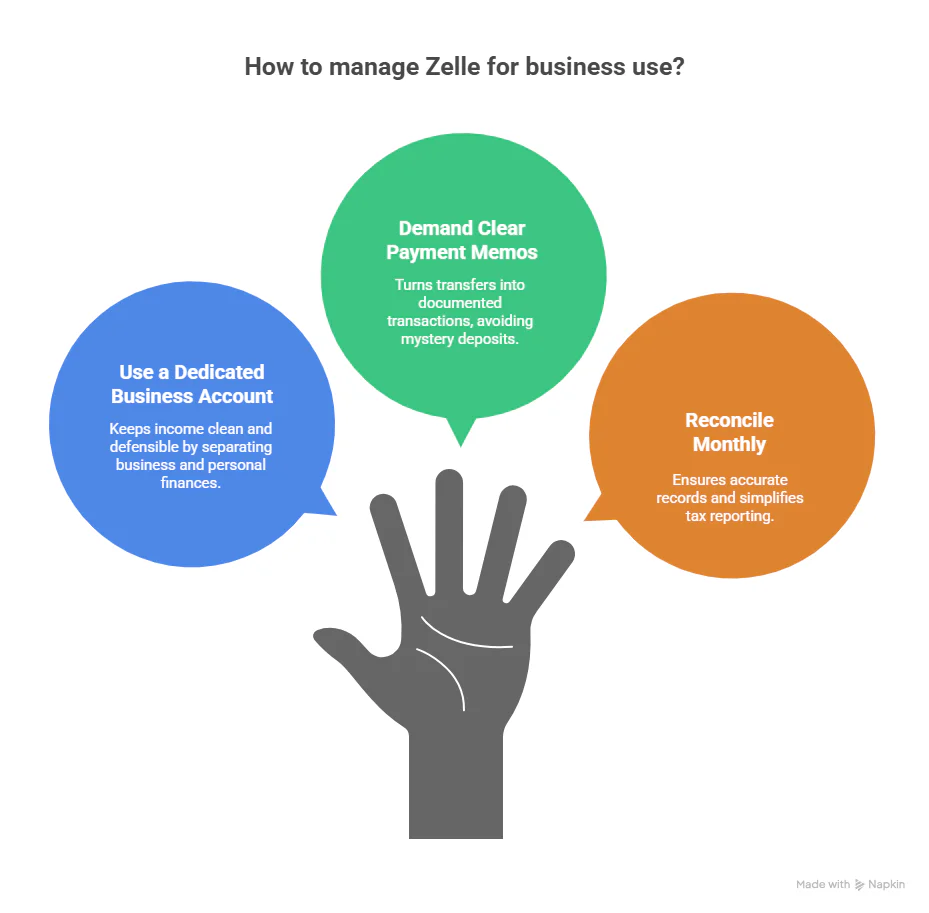
Zelle can work well for business use, as long as you are intentional.
Step 1: Use a Dedicated Business Account
Most major banks offer Zelle for business. You can link it to a separate checking account to keep your income clean and defensible.
Step 2: Demand Clear Payment Memos
Ask your clients to include an invoice number or service description. This turns each transfer into a documented transaction instead of a mystery deposit.
Step 3: Reconcile Monthly
Don’t wait until tax season to figure out what came in. You must categorize Zelle income monthly using accounting software so your records stay accurate year-round. We help our clients automate this so nothing is overlooked.
This approach also makes reporting easier when filing your individual tax preparation, especially if you are a sole proprietor or run a single-member LLC.
When Zelle Transactions Are Not Taxable
Not every Zelle payment needs to be reported. The IRS focuses on income, not the personal movement of your money.
You generally do not report:
- Reimbursements, like splitting shared expenses.
- Gifts, such as money for birthdays, weddings, or holidays.
- Internal transfers between your own accounts.
That said, mixing these with business payments in the same account is what creates confusion. We recommend that you keep separate accounts and separate Zelle profiles.
Why Staying Under the Radar Can Backfire
Some people intentionally use Zelle because they believe it keeps them off the IRS’s radar. In 2026, having this mindset is risky.
The IRS now uses advanced analytics to compare:
- Reported income.
- Bank activity.
- Lifestyle indicators.
If they find that income was intentionally hidden, even without a 1099-K, you could face fraud penalties of up to 75% of the tax you didn’t pay, in addition to interest.
Choosing convenience over compliance can often cost you more in the long run.
Does Zelle Report to IRS FAQs
1. Does Zelle report to IRS at any dollar amount?
No. Zelle does not issue 1099-K forms for any amount.
2. Do I still have to report Zelle income?
Yes. All business income is taxable, whether or not a form is issued.
3. Can the IRS see my Zelle transactions?
Indirectly, yes. They can see your transactions through bank statements and audit requests.
4. Are personal Zelle payments taxable?
No, if they are genuine gifts, reimbursements, or transfers.
5. Should I stop using Zelle for business?
Not necessarily, but you should use it correctly and with proper records.
Final Thoughts
So, does Zelle report to IRS authorities? No, but that’s not the question that protects you. The real question is whether you are reporting your income accurately and legally.
At Skyline Financial Management, we help you understand not just the rules, but how they apply to your real financial life. If you are not sure how Zelle activity affects your taxes or want to clean things up before it becomes a problem, Houston CPA Zahra is here to help you.
Book a consultation with her today and make sure that no risk is coming after you!

