

How the IRS taxes your entity is not just a technical detail when you are running a business. It is something that directly affects your cash flow, planning, and long-term flexibility. If you are thinking about changing your tax classification, you must understand the Form 8832 instructions up front so you can save yourself from costly mistakes later.
Form 8832 gives certain businesses the option to change how they are taxed at the federal level. When you file it correctly, it can support better tax planning. When you file it without context, it can create long-term problems for you that are difficult to reverse.
Below, we will break the process down step by step to help you understand what you need to complete and why it’s important for you.
What Impact Does Form 8832 Have on Your Business
By default, the IRS assigns your tax classification based on your business’s legal structure:
- Single-member LLCs are taxed as disregarded entities.
- Multi-member LLCs are taxed as partnerships.
Form 8832 allows eligible entities to elect a different classification, most commonly, to be taxed as a C Corporation. This election can make sense if you want to retain profits inside your business, plan for growth, or deal with international ownership considerations.
Many business owners assume that this form is related to S-Corp tax preparation, but that election is handled separately. We frequently see confusion between Form 8832 and Form 2553, which is why understanding the purpose behind each form is important before you file.
Essential Rules You Must Know Before You Begin
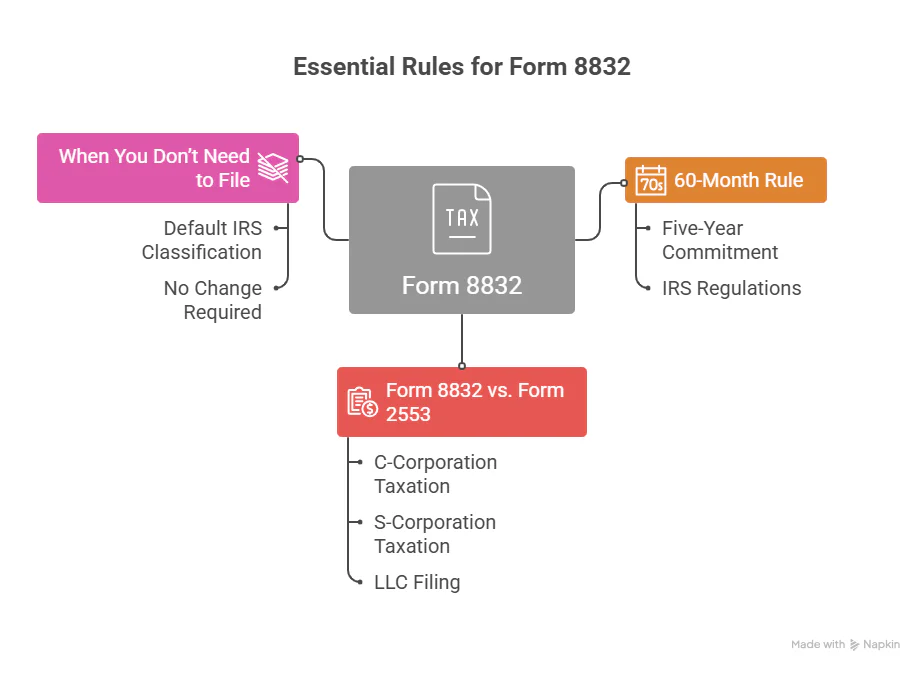
Before you start filling anything out, there are three critical rules you need to be familiar with when applying our Form 8832 instructions. These rules can have a major impact on your overall tax strategy.
The 60-Month Rule
Once you file Form 8832 to change your tax classification, you generally cannot change it again for five years, as per the IRS. This makes your election a long-term commitment, not a short-term experiment.
Form 8832 vs. Form 2553
Form 8832 is not used to elect S-corporation status. It is used to elect C-corporation taxation.
If your goal is S-Corp taxation, Form 2553 is usually the correct form. In some cases, an LLC files Form 8832 first and then Form 2553, but that extra step is often unnecessary and can create confusion if done incorrectly.
When You Don’t Need to File
If you are satisfied with your default IRS classification, there is no reason to file Form 8832. This form is only required when you want to make a change.
How to Complete Form 8832 Instructions in 5 Steps
Step 1: Enter Your Basic Business Information
At the top of the form, you will provide:
- Legal business name.
- Employer Identification Number (EIN).
- Business address.
Our licensed Houston CPA tax preparation, Zahra, shares a tip that your business name must match your EIN confirmation notice (CP 575) exactly. Even small differences, like missing “LLC,” punctuation, or abbreviations, are a common reason the IRS can reject your filings.
Step 2: Complete Part I – Election Information
Line 1: Type of Election
- Choose 1a if this is your first time selecting a tax classification.
- Choose 1b if you are changing a previous election.
Line 2: Previous Elections
If you select 1b to change an election, you will need to confirm whether you are within the 60-month restriction period. In most cases, changes are not allowed unless ownership has changed by more than 50%.
Line 3: Number of Owners
Here, you must indicate whether your business has one owner or multiple owners. This decides which tax classifications are available to you.
Line 4: Parent Corporation
If another corporation owns your business, you must list the parent company’s legal name and EIN.
Step 3: Select Your Tax Classification (Line 6)
This is the core decision point of the form. You will choose one option:
- 6a: Domestic entity choosing to be taxed as a corporation.
- 6b: Domestic entity choosing partnership status.
- 6c: Single-owner entity choosing disregarded status.
Boxes 6d through 6f apply only to foreign entities.
Most clients filing this form are selecting 6a as part of broader tax planning that may later intersect with S-Corporations. It can also impact state-level compliance issues, such as franchise tax preparation obligations.
Step 4: Set the Effective Date (Line 8)
We see the most mistakes at this stage. Getting the timing wrong can disrupt your entire tax year.
- Your effective date cannot be more than 75 days before the filing date.
- It also cannot be more than 12 months after you file.
If you leave this line blank, the IRS will default the effective date to the date they receive your form. This can cause misalignment with payroll, bookkeeping, and estimated taxes.
Step 5: Signatures and Consent
Form 8832 requires a valid consent statement:
- Option A: All owners sign the form.
- Option B: One authorized individual signs on behalf of the business.
If you use Option B, your operating agreement or corporate records must clearly give that person authority to make tax elections.
Final Thoughts
Understanding Form 8832 instructions is about making sure your tax classification actually supports where your business is going. A rushed or misunderstood election can limit your flexibility for years.
If you want clarity before filing or need help correcting a missed or incorrect election, we are here to guide you. At Skyline Financial Management, we help you through tax decisions with accuracy, context, and foresight.
Schedule a time with Houston CPA Zahra Samji today to make sure your business structure aligns with your goals, not your limitations.
Form 8832 Instructions FAQs
1. Is Form 8832 required for S-Corporation status?
No. S-Corporation elections are made using Form 2553, not Form 8832.
2. Can I undo a Form 8832 election?
In most cases, the answer is no due to the 60-month restriction, except when a qualifying ownership change happens.
3. Does Form 8832 affect state taxes?
It can. Some states follow federal classification rules, while others apply separate taxes and compliance requirements.
4. Can I file Form 8832 as a single-member LLC?
Yes, if you want it taxed as a corporation instead of a disregarded entity.
5. Will the IRS confirm my election?
Not always, which is why you need to follow our Form 8832 instructions carefully and submit proper documentation.

