
You must have probably run into a confusing stack of IRS forms if you have recently turned your side hustle into a formal C corporation.
One form you absolutely need to understand, both in importance and complexity, is Form 1120.
At Skyline Financial Management, we see many entrepreneurs treat Form 1120 as just another year-end task. The reality is far different. This form is actually a representation of your business’s financial health. It helps you stay compliant and build a tax-efficient structure that can help your company grow strategically.
In this guide, we will break down what is Form 1120, who needs to file it, and the common traps that can often catch new C Corp owners unprepared.
A Basic Overview of What is Form 1120 for Business Owners
Form 1120, officially called the U.S. Corporation Income Tax Return, is used by domestic corporations to report income, deductions, gains, and credits. It calculates your corporation’s income tax liability.
Here’s the key difference. Unlike a sole proprietorship or partnership, a C corporation is its own tax-paying entity. This means that the company itself calculates profits and pays taxes at the corporate level before any dividends are distributed to shareholders.
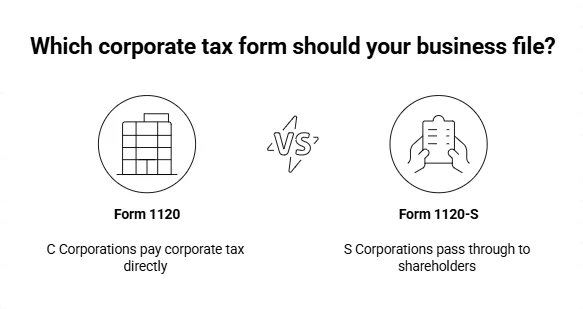
1120 vs. 1120-S
A major error we see often is mixing up Form 1120 and Form 1120-S:
| Form | Who Files | Tax Treatment |
| 1120 | C Corporations | Pays corporate tax directly |
| 1120-S | S Corporations | Pass-through; shareholders pay taxes individually |
If you are an LLC taxed as a corporation but haven’t elected S Corp status, you file Form 1120. Submitting the wrong form can result in penalties, audits, and logistical stress.
Key Things to Know About the Corporate Tax Rate and Double Taxation
As of 2026, the federal corporate tax rate is a flat 21%. At first glance, this seems lower than many individual tax brackets. However, C corporations are liable to “double taxation,” which causes issues if you are a first-time business owner.
Here’s how it works:
- Your corporation earns $100,000.
- Level One: The corporation pays $21,000 in federal tax.
- Level Two: The remaining $79,000 is distributed to you as a dividend.
- You then pay personal income tax on that dividend.
If your goal is to reinvest profits rather than pay dividends, your C Corp can actually be a smart tax strategy. Keeping earnings in the company to hire staff, purchase equipment, or expand operations means you are only taxed at 21%, often far lower than your personal rate.
This is where strategic corporate planning, especially with S-Corp tax preparation, becomes crucial.
How Can You Avoid Technical Errors with Schedule M-1 and M-3
When you ask, “What is Form 1120?”, one section that you might notice is Schedule M-1. This is where many DIY filers get stuck.
Many business owners assume their accounting software’s Profit & Loss statement will match taxable income on Form 1120. It almost never does.
Schedule M-1 reconciles “book income” with “tax income.” Common differences include:
- Depreciation: The IRS may allow faster write-offs via Section 179.
- Meals and Entertainment: Only 50% may be deductible.
- Fines and Penalties: Not deductible even if you logged them as expenses.
Skyline Financial Management makes sure these reconciliations are accurate so your numbers don’t raise red flags with the IRS.
Ensure Compliance with the Corporate Transparency Act
As a business owner, you might miss how Form 1120 interacts with the Corporate Transparency Act (CTA).
While Form 1120 reports your financials, as of 2024 to 2026, corporations must also file Beneficial Ownership Information (BOI) reports with FinCEN. Any mismatch between your 1120 filings and BOI reports can lead to civil or even criminal penalties.
Prevent the April 15th Issue with Proper Estimated Tax Payments
Unlike pass-through entities, your C corporation is responsible for its own taxes throughout the year. Waiting until tax day can cost you a lot.
- Use Form 1120-W to calculate and pay your quarterly estimated taxes.
- Pay the lesser of 100% of last year’s tax or 100% of this year’s estimated liability.
At Skyline, we help our clients set up a “tax vault” system, putting aside 21% of net profits quarterly to avoid unnecessary interest and penalties.
Special Considerations You Must Know for Personal Service Corporations
If you are a doctor, lawyer, consultant, or architect, your C Corp may be classified as a Personal Service Corporation (PSC).
PSCs share the flat 21% rate but face stricter rules:
- They usually must operate on a calendar year.
- They have tighter rules for deducting owner-employee compensation.
If your business falls into this category, it’s essential for you to know what is Form 1120 because the form captures these stricter rules and makes sure that your deductions and corporate structure are in line with regulations.
Why Hoarding Cash Can Trigger Your Accumulated Earnings Tax
The IRS wants corporations to distribute profits that aren’t needed for business operations. If you accumulate earnings beyond a reasonable need, which is generally over $250,000, you may face a 20% Accumulated Earnings Tax.
We help you document the legitimate business reasons for keeping cash, such as:
- Planned expansion.
- Equipment purchases.
- Litigation reserves.
What Is Form 1120 FAQs
1. Who must file Form 1120?
All domestic C Corporations, including LLCs taxed as corporations, must file.
2. Is Form 1120 the same as 1120-S?
No. 1120-S is for S corporations and passes taxes to individual shareholders.
3. How do estimated tax payments work?
Corporations use Form 1120-W to pay quarterly and avoid underpayment penalties.
4. Does Form 1120 affect my personal taxes?
Not directly. The corporation is taxed first, and any dividends you receive could be subject to personal tax, so coordinating with your individual tax preparation strategy is essential.
5. What happens if I file the wrong form?
Filing incorrectly can lead you to face audits, penalties, and amended returns.
Closing Thoughts
What is Form 1120? It is far more than just a compliance requirement. It’s a strategic tool for your C corporation.
From understanding double taxation and M-1 reconciliations to planning for accumulated earnings or shareholder loans, this form touches nearly every aspect of your corporate finances.
At Skyline Financial Management, we work closely with you to ensure Form 1120 is accurate and strategically aligned with your business goals. Don’t leave this crucial part of your business to chance, and schedule a consultation with Houston CPA today!

