
Tax season looks very different depending on whether you are filing as an individual or running a business with employees, contractors, multiple revenue streams, and a structure that has its own tax obligations.
If you have been handling your business taxes on your own, you may be leaving deductions unclaimed and paying more than you legally owe. Working with qualified small business tax preparers changes that equation entirely by applying the kind of structured, compliance-focused approach to your return that your business actually requires.
The Deductions Most Small Business Owners Miss Without Professional Guidance
The tax code offers genuinely useful deductions for small businesses, but many of them require documentation practices and professional interpretation that most owners simply do not have time to develop on their own.
The result is not fraud or error in the traditional sense. It is just money left on the table.
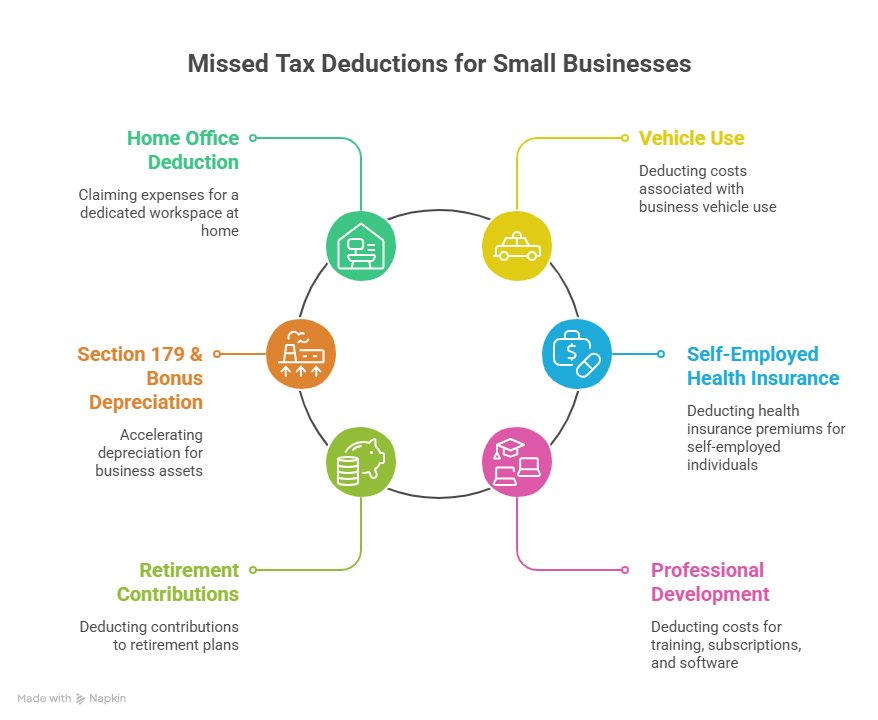
Some of the most consistently overlooked deductions include:
- Home office deduction calculated correctly under the regular and exclusive use standard, rather than guessed at or avoided out of audit fear.
- Vehicle use is documented with mileage logs that support the business-use percentage claimed.
- Section 179 and bonus depreciation on equipment, technology, and qualified property purchased during the year.
- Self-employed health insurance premiums are deductible above the line, even if you did not itemize.
- Retirement contributions through SEP-IRA, SIMPLE IRA, or Solo 401(k) plans that reduce taxable income significantly.
- Professional development, subscriptions, and software that are directly tied to your business operations.
Each of these requires not just awareness but the correct documentation to survive scrutiny. Our qualified CPA, Zahra Samji, does not just enter numbers. She reviews what your business spent, asks the right questions, and structures your return to reflect your actual deductible activity.
Why Your Business Structure Has a Bigger Impact on Your Tax Bill
The entity type your business operates under determines which forms you file, how your income is taxed, and what planning strategies are available to you.
Here is how the most common small business structures handle taxation:
| Business Structure | How Income Is Taxed | Key Tax Form | Notable Consideration |
| Sole Proprietorship | Owner’s personal return | Schedule C | Subject to full self-employment tax |
| Single-Member LLC | Owner’s personal return (default) | Schedule C | Can elect S-Corp treatment |
| Partnership | Pass-through to partners | Form 1065 + K-1s | Each partner reports their share separately |
| S-Corporation | Pass-through with salary split | Form 1120-S + K-1s | Can reduce self-employment tax significantly |
| C-Corporation | Entity-level taxation | Form 1120 | Subject to double taxation on dividends |
How Quarterly Estimated Taxes Affect Your Year-End Position More Than the April Deadline Does
Most discussions focus on the April filing deadline, but your tax position is shaped by year-round actions, especially quarterly estimated payments.
Underpaying estimates can trigger penalties even if you pay the full balance by April 15, as the IRS calculates penalties per quarter.
A tax professional who is engaged with your business during the year, not just at tax time, helps you:
- Calculate accurate quarterly estimated payments based on actual year-to-date income.
- Adjust those estimates as your revenue changes throughout the year.
- Identify deductible purchases or retirement contributions that can reduce your fourth-quarter liability before December 31.
- Avoid the underpayment penalty by meeting either the 100% of the previous year’s tax or 90% of the current year’s tax safe harbor thresholds.
This year-round perspective is one of the most practical reasons to work with small business CPA Houston rather than treating tax as a once-a-year exercise.
What Small Business Tax Preparers Look at That Goes Beyond the Return Itself
The return is the output, but what a qualified tax professional really does is review the inputs that determine it. This means examining your books, payroll records, entity structure, prior-year returns, and current-year activity as a complete picture, not just a stack of documents to enter.
For S-corporations, this includes verifying reasonable compensation, tracking shareholder basis, and structuring distributions to avoid unintended tax issues.
Partnerships require ensuring each partner’s K-1 accurately reflects distributive shares, guaranteed payments, and basis adjustments.
Sole proprietors and single-member LLCs need a Schedule C that reflects real business activity with solid documentation rather than estimates that could draw IRS attention.
This is the work that protects your return long after you file it.
Closing Statement
Your business taxes reflect how well your financial activity is tracked, structured, and reported. Working with qualified small business tax preparers ensures every deductible dollar is captured, your structure works for you, and your return can withstand scrutiny.
At Skyline Financial, Zahra works with small business owners to review their situation and provide clarity for confident filing.
Stop guessing and get the most from your tax return! Schedule a consultation with our licensed Houston CPA today.
Small Business Tax Preparers FAQs
What do small business tax preparers do differently from regular tax software?
Small business tax preparers review your full financial picture, identify deductions you may miss, flag inefficiencies, and ensure your return is accurate. Software only works with the information you enter, while a professional asks the right questions.
How do I know if my LLC should file as an S-Corp for tax purposes?
Electing S-Corp status can make sense when your net profit is high enough that self-employment tax savings outweigh payroll and filing costs. Many start the discussion around $40,000–$50,000, but it depends on your income, expenses, and compensation.
What records should I bring to a tax preparation appointment for my small business?
Bring prior-year returns, year-to-date profit and loss, bank and credit card statements, payroll records, W-2s/1099s, receipts for major purchases, and estimated tax documentation. Read-only accounting software access can speed up the review.
Can small business tax preparers help me if I have not filed returns for previous years?
Yes. They can reconstruct prior-year income and expenses using IRS transcripts, prepare the correct forms, and advise on resolving balances, including payment plans and penalty relief.
What is the difference between a tax preparer and a CPA for small business taxes?
A CPA is licensed, meets continuing education requirements, and is held to professional standards. They offer deeper technical knowledge and advisory support, which is valuable for complex returns, prior-year issues, or entity-level decisions.

