

Knowing how to reduce taxable income is less about finding new deductions and more about making sure existing decisions are structured correctly.
Most of the money business owners leave on the table disappears because the right election was not made, the right account was not funded, or income landed in the wrong year. This blog covers the specific angles most owners miss.
How Your Business Reimburses You for Expenses Determines Whether the Deduction Holds Up
How you document and reimburse yourself for business expenses matters as much as whether the expense qualifies. Two approaches decide the tax outcome:
- Accountable plan: Your business reimburses documented business expenses paid personally. These reimbursements are excluded from taxable wages, meaning no payroll tax on the reimbursed amount.
- Non-accountable plan: Reimbursements without documentation are treated as taxable compensation subject to payroll taxes, which eliminates most of the tax benefit.
If you mix personal and business expenses or reimburse yourself informally, you are overpaying payroll taxes and creating audit risk. Formalizing an accountable plan is a low-effort structural fix with real savings.
An expense reimbursement structure affects both your deductions and your payroll tax exposure. See how Skyline’s small business CPA services help you formalize the right structures before they cost you more than they should.
The Home Office Deduction Works Differently Depending on Your Business Structure
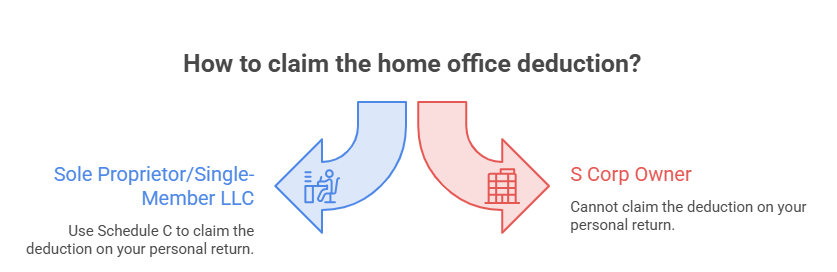
Many owners skip the home office deduction out of concern it attracts scrutiny. That concern is outdated. What matters is whether the space is used regularly and exclusively for business. How you claim it depends on your entity:
- Sole proprietors and single-member LLCs use Schedule C with either the streamlined approach ($5 per sq ft, which can exceed up to 300 sq ft) or the actual expense strategy based on the percentage of home used for business.
- S Corp owners cannot claim it on their personal return. The corporation reimburses the owner under an accountable plan, making it deductible at the entity level.
Using the wrong method for your structure means leaving a deduction unclaimed or claiming it incorrectly.
How to Reduce Taxable Income Through Health Insurance Premiums Most Owners Miss
Health insurance premiums are deductible costs for self-employed individuals, but the rules are entity-specific and easy to apply incorrectly:
- Sole proprietors deduct premiums above the line on Form 1040, reducing adjusted gross income without itemizing.
- S Corp owner-employees must have the corporation pay or reimburse the premium and include it in W-2 Box 1 wages. Missing that inclusion disqualifies the deduction entirely.
- The deduction is capped at net self-employment profit. A business loss eliminates it for that year under this provision.
This requires coordinating payroll reporting and your personal return simultaneously, which is where errors concentrate when handled separately.
Health insurance deductions require coordination between your entity and personal returns. Learn how Zahra’s tax preparation services handle both sides so nothing falls through the gap between your business and personal filings. Start your business tax preparation today.
Vehicle Deductions and Why the Method You Choose in Year One Cannot Be Changed
The method you elect when you first place a vehicle in service is locked in for the life of that vehicle. Your two options:
- Standard mileage rate:5 cents for each mile for 2026 business use. Simple to track but may understate actual cost on newer vehicles.
- Actual expense method: Deduct the business-use percentage of fuel, insurance, repairs, and depreciation. Produces larger deductions on high-cost vehicles but requires detailed recordkeeping.
For business owners looking at how to reduce taxable income, choosing the right vehicle deduction method can have a significant impact. The method that saves more now may not be better over the full depreciation period. Modeling both before you elect avoids a decision you cannot reverse.
Bunching Deductions in Alternating Years to Benefit from Itemizing
If your annual deductions fall near the standard deduction threshold, you are likely claiming it every year and getting no benefit from your actual expenses.
Bunching concentrates deductible expenses into alternating years to clear the threshold in one year and take the standard deduction in the next, producing a larger combined deduction over two years.
Zahra Samji at Skyline Financial reviews your deduction profile annually to identify whether bunching applies and which expenses can be shifted to make it work for your specific situation.
What It All Means
If you are unsure of how to reduce taxable income, the answer comes down to structuring existing decisions so the tax code recognizes them correctly. Reducing your taxable income comes down to structuring existing decisions so the tax code recognizes them correctly.
Accountable plans, entity-specific deduction rules, vehicle elections, and deduction bunching are all available to you right now. Whether you use them usually comes down to having a licensed CPA review your position before the year closes.
Ready to stop leaving deductions unclaimed year after year? Connect with Skyline’s tax preparation services and work directly with Zahra Samji to make sure every legitimate deduction is claimed correctly on a return built on a defensible foundation.
FAQs
What is an accountable plan, and does my business need one?
An accountable plan lets your business reimburse documented expenses without those reimbursements counting as taxable income. Any owner paying business expenses personally should have one to protect the deduction and avoid unnecessary payroll tax.
Can I deduct home office expenses if I work from home only part of the time?
The IRS requires regular and exclusive business use. Part-time use of a shared room does not qualify. A dedicated area used solely for business does, regardless of how many hours per week you work from it.
Is the standard mileage rate always the better vehicle deduction choice?
Not always. The actual expense method typically produces a larger deduction for newer vehicles with significant depreciation. Standard mileage is simpler and more competitive for older vehicles with lower operating costs.
What does bunching deductions mean in practice?
Bunching concentrates expenses like charitable contributions or state tax prepayments into one year to exceed the standard deduction threshold, and then you claim the standard deduction the following year. For taxpayers exploring how to reduce taxable income, this strategy can produce a larger overall deduction than spreading those expenses evenly across multiple years.
Can I take out health insurance premiums if my business had a loss this year?
No. The deduction is limited to net self-employment profit. A Schedule C or K-1 loss eliminates it under this provision, though premiums may still qualify as an itemized medical expense above the 7.5% AGI threshold.

