

Growth creates tax complexity, not all at once, but incrementally and often faster than your current setup can absorb.
Business tax services that worked when you had one revenue stream, one state, and a handful of employees start showing gaps when the business adds a location, brings on contractors, or crosses into a new jurisdiction.
If your business is growing and your tax approach has not evolved alongside it, the gap between what you owe and what you could owe with better planning is likely wider than you think.
The Tax Complexity Growth Stages Most Businesses Do Not Plan For
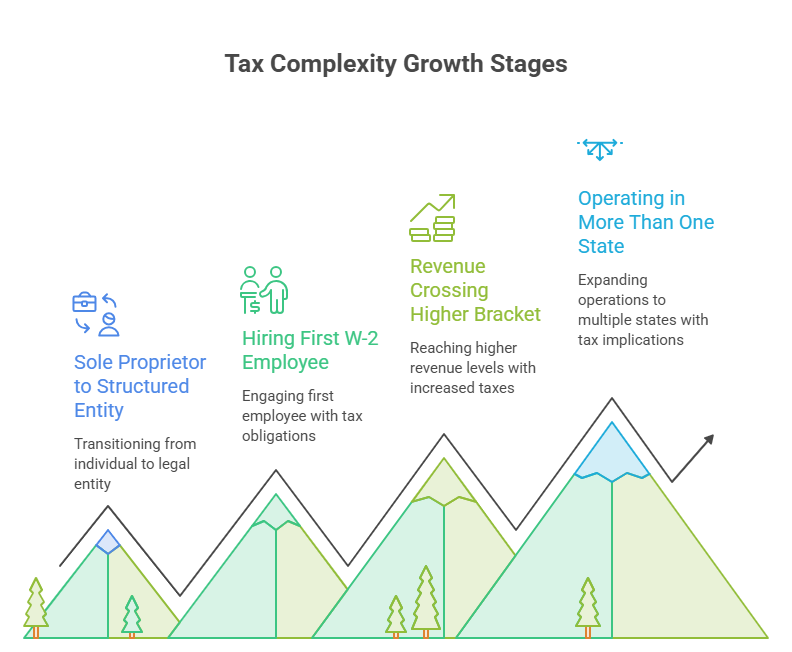
Every business passes through predictable stages where the tax picture changes significantly. Most owners are not told what those stages look like in advance, so the added complexity surfaces as a problem rather than something anticipated and managed.
Here is where tax complexity typically increases for growing companies:
- When you move from sole proprietor to a structured entity. The S Corporation election alone changes how you pay yourself, how payroll taxes are calculated, and how profits are distributed.
- When you hire your first W-2 employee. You become responsible for payroll tax deposits, quarterly employer filings, and year-end W-2 reporting. Missing deposit deadlines triggers penalties that add up quickly.
- When revenue crosses into a higher bracket. Higher income means more aggressive estimated tax planning is needed, and the cost of missed deductions increases proportionally.
- When you operate in more than one state. Remote work arrangements can create a nexus, a taxable presence where you have no physical location. This is one of the most commonly missed compliance issues in growing businesses.
Each of these transitions is manageable with the right business tax services in place. Without them, each becomes a reactive scramble.
If your business has crossed any of these thresholds recently, your tax setup may need a closer look. See how we help businesses stay compliant with our corporate tax offerings.
Why the Timing of Business Tax Decisions Matters as Much as the Decisions Themselves
One of the most underappreciated aspects of business tax support is that most meaningful tax moves have a deadline, and many are not April 15th.
S Corporation elections have specific filing windows. Retirement account contributions must be made before year-end or by the extension date. Cost segregation studies should be initiated before the depreciation timeline locks in. Estimated tax payments have four due dates throughout the year, and missing any carries a penalty regardless of whether you ultimately owe tax.
This is why business tax solutions that operate year-round deliver a fundamentally different result than support that activates only at filing time. By the time a seasonal preparer reviews your numbers, most decisions that could have reduced your liability have already passed.
Year-round tax planning protects your business margins in ways annual filing alone cannot. Reach out to us today and avoid costly tax filing errors with our small business CPA Houston services.
What Business Tax Services Look Like When They Are Actually Working
Most business owners who are underserved by their current CPA do not know it because they have no reference point for what better looks like. Here is what well-structured business tax offerings should deliver:
- Your books are always current, not reconstructed at year-end.
- Quarterly estimates are recalculated as your income changes throughout the year.
- Someone reviews your entity structure annually to confirm it still fits.
- You are notified of key filing deadlines in advance, not after the fact.
- Deductions are tracked proactively, not harvested from receipts at tax time.
- Multi-state exposure is reviewed whenever you add operations or remote staff.
If any of these are missing from your current setup, you are likely leaving money on the table in ways that compound over time.
Zahra Samji, our licensed Houston CPA with a background at PwC and Deloitte, works directly with every business client. The same person reviewing your entity structure is preparing your return and advising on your quarterly estimates, so the financial picture stays consistent and nothing falls through the gaps.
If the list above sounds different from what you currently experience, that gap is worth addressing. Talk to Zahra directly about what a properly structured business tax engagement looks like for your situation. Schedule a consultation with her now.
Looking Back
Business tax services are most effective when built around how your business is actually growing, not how it was structured when you started.
If your tax approach has not kept pace with your revenue, headcount, or operational footprint, the cost of that misalignment is real even when it is not visible.
The right engagement provides proactive planning, consistent attention, and a direct line to a CPA who understands your business well enough to see the gaps before they become problems.
Business Tax Services FAQs
At what revenue level should a business consider upgrading its tax services?
There is no fixed number, but most businesses benefit from more structured support once they have employees, operate in multiple states, or earn enough that missed deductions are a material cost. If your accountant is not raising planning questions year-round, it is worth reassessing.
How does an S Corporation election affect business tax solutions?
It changes how you pay yourself, how payroll taxes are calculated, and how profits pass through to your personal return. Proper setup, ongoing compensation documentation, and payroll compliance all become part of your engagement once the election is made.
What is a nexus, and why does it matter for growing businesses?
Nexus is a taxable connection to a state triggered by employees, inventory, or revenue above a threshold. Once established, you may be required to file and pay tax there even without a physical office.
How far in advance should I work with a CPA before a business acquisition or expansion?
Ideally, six to twelve months. Transaction structure, timing, and asset classification carry significant tax implications that are much harder to optimize after the deal closes.
Can business tax services help if I have fallen behind on filings or payments?
Yes. Catching up on back filings, negotiating penalty abatement, and building a compliant structure going forward are all areas a CPA with IRS resolution experience can help you address.

