

As your business grows, your use of freelancers, consultants, and specialized contractors increases. While this flexible workforce allows you to scale quickly, it also creates reporting obligations with the IRS.
Understanding how to fill out a 1099 form correctly is essential if you want to protect your deductions and avoid compliance issues. These forms allow the IRS to cross-reference the payments you deduct as business expenses with the income your contractors report on their tax returns.
For many founders, the challenge is not just filing a form but determining which form applies and how to complete it accurately. We guide business owners through these reporting requirements so your records remain consistent, defensible, and ready for scrutiny.
Choosing the Correct 1099 Form for Each Type of Payment
The first step in learning how to fill out a 1099 form is identifying which type of form applies to your payment. Not every vendor payment uses the same information return, and choosing the wrong one can create reporting discrepancies.
The most commonly used forms include:
| Form Type | Primary Use | Typical Reporting Box |
| 1099-NEC | Payments to independent contractors | Box 1 Nonemployee Compensation |
| 1099-MISC | Rent, prizes, legal settlements, and certain payments | Box 1 Rent or Box 3 Other Income |
| 1099-DIV | Dividends paid to shareholders | Box 1a Total Ordinary Dividends |
| 1099-INT | Interest payments | Box 1 Interest Income |
The most frequent reporting requirement for businesses involves Form 1099 for contractors, which is now reported on Form 1099-NEC rather than Form 1099-MISC.
If you pay an independent contractor $600 or more during the tax year for services related to your business, you must generally issue a 1099-NEC.
Understanding the distinction between these forms ensures that the IRS receives accurate information and that your deductions align with the contractor’s reported income.
Collecting Accurate Vendor Information Before Payments Begin
Your ability to correctly complete a 1099 begins long before January filing deadlines. The most effective compliance practice is collecting a Form W-9 from every contractor before issuing their first payment.
A W-9 provides three essential pieces of information:
- The contractor’s legal business name.
- Their business classification (individual, LLC, corporation, etc.)
- Their taxpayer identification number (TIN).
Without this documentation, your filing process becomes significantly riskier.
A common mistake occurs when contractors provide a trade name instead of the legal name associated with their tax identification number. When this happens, the IRS system generates a name/TIN mismatch.
If that discrepancy continues unresolved, you may be required to apply backup withholding, which means withholding 24 percent of the contractor’s future payments.
By collecting W-9 forms early, you transform year-end reporting into a routine administrative process rather than a stressful compliance scramble.
How to Fill Out a 1099 Form for Contractors
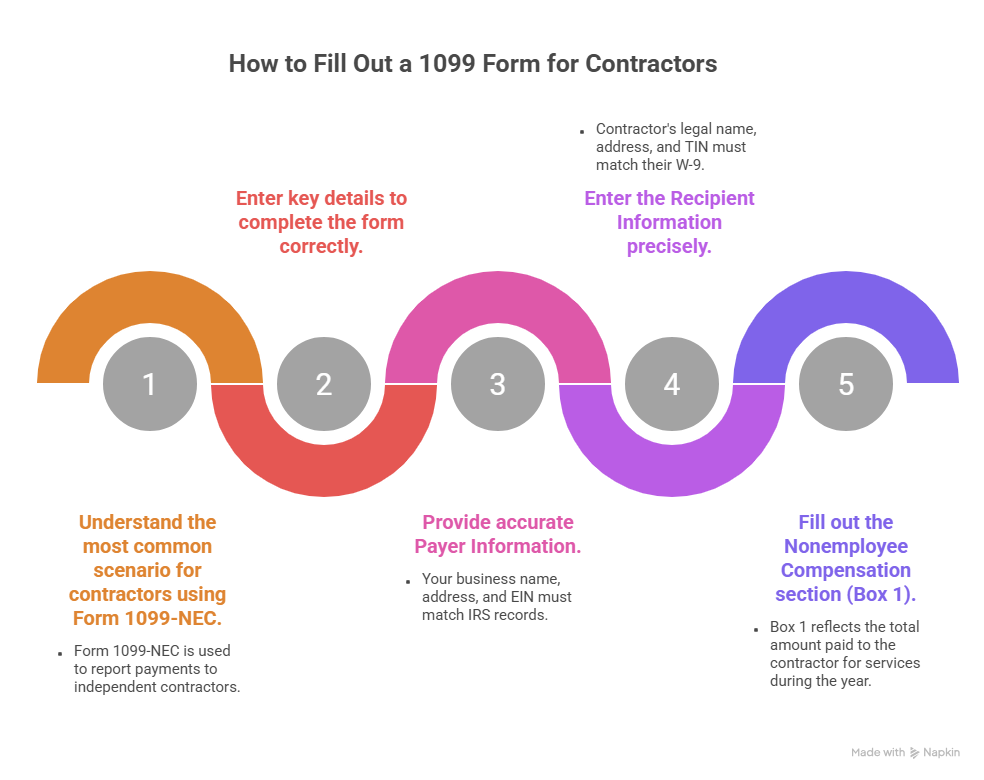
When it comes to filling out Form 1099 for contractors, the most common scenario involves reporting payments to independent contractors using Form 1099-NEC.
To complete the form correctly, you must enter several key details:
Payer Information
Your business name, address, and Employer Identification Number must match the records the IRS has on file.
Recipient Information
Enter the contractor’s legal name, address, and taxpayer identification number exactly as shown on their W-9.
Nonemployee Compensation
Box 1 is the most important section of the 1099-NEC. This box reflects the total amount you paid the contractor for services during the year.
One subtle but important detail involves reimbursed expenses. If you reimburse a contractor under a formal accountable plan with receipts, those reimbursements typically do not appear on the 1099. However, if you pay a flat fee that includes expenses, the entire payment must be reported.
Accurate categorization protects both your business and the contractor when they prepare their tax returns.
Reporting Dividend Distributions as Your Company Scales
As businesses mature and begin distributing profits, additional reporting obligations arise. If your corporation pays dividends to shareholders, you must report those payments using Form 1099-DIV.
Understanding how to fill out a 1099 form for dividend distributions requires more advanced financial oversight because these payments can fall into multiple tax categories.
For example:
- Ordinary dividends are reported in Box 1a.
- Qualified dividends, which may receive lower tax rates, are reported in Box 1b.
Accurate classification matters because it affects how shareholders report dividend income on their personal tax returns.
When your equity structure becomes more complex, such as when multiple investors or partners are involved, ensuring these forms align with your capitalization table becomes a critical accounting task.
Conclusion
When you learn how to fill out a 1099 form accurately, you protect your deductions, maintain clean records, and avoid unnecessary penalties.
At Skyline Financial CPA, our licensed Houston CPA, Zahra Samji, helps you implement systems that simplify contractor reporting and keep your records aligned with IRS expectations. She also ensures your reporting integrates seamlessly with broader tax planning strategies, including your individual taxes and business filings.
If you want to remove the stress from year-end reporting and ensure your compliance process is professionally managed, schedule a consultation with a CPA in Houston Zahra and build a smarter tax strategy for your growing business.
FAQs
What are the 1099 reporting requirements for new startups?
The core 1099 reporting requirements involve filing a form for any individual or unincorporated business to whom you have paid $600 or more during the tax year for business-related services. You must provide a copy to the contractor and the IRS by January 31 to avoid penalties.
What is the difference between a 1099-NEC and a 1099-K?
You use the 1099-NEC to report direct payments made via cash or check. If you pay 1099 for contractors using a credit card or a platform like PayPal, those third-party processors are generally responsible for reporting the income on Form 1099-K.
Can I file a 1099 form online for free?
The IRS provides a “FIRE” (File Information Returns Electronically) system, but it is technically complex. Most small businesses utilize IRS tax software or a professional CPA to handle e-filing.
How do I correct a 1099 form after I’ve already sent it?
If you find an error after filing, you must issue a “Corrected” 1099 as soon as possible. You will check the “Corrected” box at the top of the form and enter the updated, accurate information.
What are the penalties for missing the 1099 deadline?
The IRS imposes various penalties for late filings. Depending on how late the form is submitted, penalties can range from $60 to over $310 per form.

