
As your business progresses, your financial management becomes more complex. Many owners start with basic spreadsheets or simple accounting software, but eventually, they need professional guidance to maintain accurate records and plan for the future. This is where understanding the difference between an accountant and a bookkeeper becomes essential.
Both roles are critical to your financial infrastructure, but they serve very different purposes. Knowing how these roles work together helps you build a financial system that supports growth instead of only tracking expenses.
The Difference Between an Accountant and a Bookkeeper in Daily Financial Operations
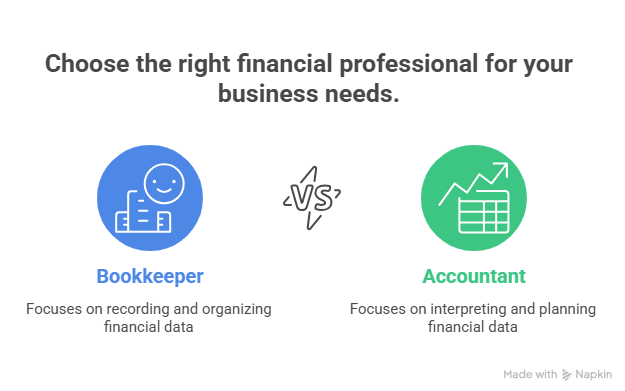
At its core, financial management works on two levels. First, someone must record and organize your financial transactions. Second, someone must interpret that information and turn it into strategic insight.
A bookkeeper handles the operational side of financial data. Their responsibilities typically include:
- Recording daily transactions.
- Reconciling bank and credit card accounts.
- Processing invoices and payments.
- Maintaining general ledgers.
Accurate records are the foundation of every financial system. When your books are organized through professional Houston bookkeeping services, you get a clear view of your cash flow and operational performance.
An accountant, on the other hand, focuses on interpretation and planning. Using organized financial data, an accountant analyzes trends, identifies tax opportunities, and ensures your financial statements align with regulatory requirements.
This shift from recordkeeping to tactical evaluation is where the difference between an accountant and a bookkeeper becomes most visible.
How Financial Data Becomes Strategic Insight
Many business owners believe bookkeeping alone provides financial clarity. While accurate records are important, they only tell you what has already happened.
An accountant examines those records to answer more strategic questions:
- How can your tax liability be reduced?
- Are your expenses categorized in the most beneficial way?
- Are you prepared for the upcoming tax obligations?
- How will financial decisions affect your long-term growth?
Through professional accounting services Houston, financial reports become tools for planning instead of simple documentation.
For example, a bookkeeper may show that your company spent a significant amount on equipment. An accountant evaluates whether that purchase qualifies for depreciation deductions, bonus depreciation, or other tax strategies that could lower your taxable income.
This analytical perspective is what transforms financial data into meaningful business intelligence.
Regulatory Authority and IRS Representation Rights
One of the most overlooked distinctions between these roles involves legal authority in tax matters. Many business owners assume anyone managing financial records can also represent them in front of the IRS. In reality, this is not always the case.
Bookkeepers are skilled administrative professionals, but they generally do not hold the licensing required to represent clients in audits or tax disputes.
Our professional Houston CPA, Zahra Samji, provides a different level of oversight and protection. This includes:
- Preparing and signing tax returns.
- Providing tax consulting and planning.
- Representing clients during IRS inquiries.
- Ensuring compliance with complex tax regulations.
For businesses dealing with evolving tax responsibilities, this legal and professional authority represents an important aspect of the difference between an accountant and a bookkeeper.
How Accurate Bookkeeping Directly Affects Your Tax Outcome
Strong accounting strategies rely on accurate financial records. If your transactions are incorrectly categorized throughout the year, even the best tax planning becomes difficult.
For example, misclassifying a capital purchase as a routine repair can distort your financial statements. This error may affect your balance sheet, inflate your profit margins, or lead to incorrect tax deductions.
This is why accountants and bookkeepers work in a complementary relationship. The bookkeeper ensures daily financial activity is recorded correctly, while the accountant ensures those records support your broader financial strategy.
When both roles operate together effectively, your financial system becomes both accurate and forward-looking.
When Your Business Needs Both Financial Roles
In the early stages of your business, you may only require basic bookkeeping support. As your company grows, however, the complexity of your financial operations increases.
Some signs that your business needs professional accounting oversight include:
- Hiring employees and managing payroll taxes.
- Expanding into multiple states.
- Preparing financial reports for investors.
- Managing larger revenue streams.
At this stage, relying solely on bookkeeping can leave business owners with clean records but a limited financial strategy.
The collaboration between a bookkeeper and accountant ensures that your daily financial data supports bigger decisions related to tax planning, growth projections, and regulatory compliance.
In Summary
While bookkeeping provides the essential foundation for accurate financial records, accounting delivers the strategic insight that helps your company grow and remain compliant with tax regulations.
Recognizing the difference between an accountant and a bookkeeper allows you to invest in the right financial expertise at the right time. When your books are accurate and your financial strategy is guided by professional analysis, you gain clarity, reduce risk, and create opportunities for long-term success.
Want your financial data to work for you instead of only documenting the past? Zahra helps business owners transform their financial systems into strategic tools for growth and tax efficiency.
Contact Skyline Financial CPA in Houston today to schedule a consultation and strengthen your financial foundation.
FAQs
Is a bookkeeper an accountant?
While the terms are used interchangeably, the answer is generally no. A bookkeeper focuses on the administrative task of recording transactions, whereas an accountant focuses on the analysis, tax strategy, and financial reporting.
What's the main difference between a bookkeeper and an accountant in terms of cost?
The difference between a bookkeeper and an accountant is reflected in their hourly or monthly rates. Bookkeepers are typically more affordable for daily data entry, while accountants charge a premium for their specialized knowledge in tax law and strategic planning.
Do I need to hire both accountants and bookkeepers for my startup?
In the beginning, you may only need a bookkeeper to keep your records straight. However, as you grow, having both accountants and bookkeepers, or a CPA who can oversee the bookkeeping process, is ideal.
Can an accountant fix mistakes made by a bookkeeper?
Yes, we perform “catch-up” or “clean-up” work where we review the ledger created by a bookkeeper to correct errors before filing taxes. However, it is always more cost-effective to have professional oversight from the start to prevent these errors from occurring in the first place.

