
Running your own business means every dollar that comes in and goes out is your responsibility to track, with no payroll department catching your mistakes before they become expensive.
Solid bookkeeping for self-employed professionals is not just about staying organized. It is the foundation that determines whether you keep more of what you earn or hand extra money to the IRS simply because your records were not built to protect you.
Why Mixing Personal and Business Money Creates Bigger Problems Than You Think
The single most common mistake self-employed professionals make is running business income and personal spending through the same account. It feels convenient at first, but it creates a tangled mess that makes tax season painful and puts you at greater risk if the IRS ever questions your deductions.
Here is what happens when your accounts stay blended:
- You lose the clear paper trail that proves a purchase was for business, not personal use.
- Your bookkeeper spends more time separating transactions than analyzing your numbers.
- You risk losing legitimate deductions because you cannot substantiate them clearly.
Opening a dedicated business account, even as a sole proprietor without a formal entity, gives you a clean line between what belongs to your business and what belongs to your personal life. This is one of the simplest habits that makes bookkeeping for self-employed professionals far more manageable from day one.
Bookkeeping for Self-Employed Income That Arrives Irregularly
Unlike a salaried employee with predictable biweekly deposits, your income as a self-employed professional might arrive in large lump sums, small scattered payments, or a mix of both, depending on your client base.
This irregularity makes it tempting to track income loosely, checking your bank balance and not maintaining organized records.
That approach eventually causes real problems:
- You lose sight of which payments have been invoiced versus received.
- You cannot easily calculate your quarterly estimated tax obligations without accurate totals.
- You miss patterns that would tell you which clients or services generate the most profit.
- You struggle to prove your income consistency if you apply for a loan or mortgage.
Categorizing income by source and date as it arrives, without reconstructing it later, gives you a real-time picture of where your business stands.
Setting Up a System That Reflects How You Work
Generic bookkeeping templates rarely fit the way self-employed professionals operate. A freelance graphic designer has different expense categories than a consultant who travels for client meetings, and a system built around someone else’s business model will always feel like a poor fit for yours.
A properly configured setup should reflect:
- Expense categories specific to your industry and how you generate revenue.
- Separate tracking for reimbursable client expenses versus true business costs.
- A clear method for recording cash payments that might otherwise slip through the cracks.
Getting your virtual bookkeeping set up correctly from the start means you see accurate, real-time numbers rather than discovering gaps months later when it is far more difficult to fix them.
Tracking Deductions Most Self-Employed Professionals Miss
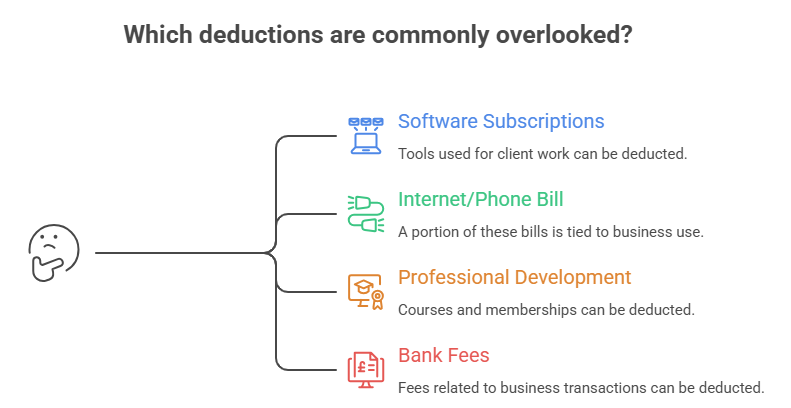
Beyond the well-known deductions like home office space and mileage, several categories go underused simply because people do not realize they qualify. Missing these deductions means paying more tax than necessary, year after year, without ever knowing what you left on the table.
Commonly overlooked write-offs include:
- Software subscriptions and tools used specifically for client work.
- A part of your internet and phone bill is tied to business use.
- Professional development courses, certifications, or industry memberships.
- Bank fees and payment processing charges are tied to business transactions.
Reviewing your full expense list with fresh eyes each year, without relying on memory, catches deductions that quietly slip through when your bookkeeping is not detailed enough. This is exactly the kind of gap that consistent bookkeeping for self-employed professionals is designed to close.
Why Sales Tax Obligations Catch Self-Employed Professionals Off Guard
If you sell products or particular taxable services, sales tax compliance adds another layer that many self-employed professionals overlook until a filing deadline is already missed.
Unlike income tax, sales tax has its own collection, reporting, and remittance rules that vary depending on what you sell and where your clients are located.
Understanding your sales tax obligations early prevents a surprise bill later, especially if your work has expanded into product sales or services that were not taxable when you first started your business.
Getting this piece wrong compounds quickly, since penalties accrue for every missed filing period.
Building Habits That Keep Your Books Accurate Year-Round
Bookkeeping is not a task you complete once a year in a panic before your deadline. It works best as a habit built into your regular schedule, so your records stay current and your numbers are always ready when you need them.
Some of the consistent habits make the biggest difference:
- Reconcile your accounts weekly instead of letting transactions pile up.
- Photograph and log receipts immediately, and do not store them in a shoebox.
- Always review your profit and loss statement monthly to catch trends early.
Zahra Samji works directly with self-employed professionals across Houston who want their books to reflect the true health of their business, not just a rough estimate pulled together at tax time.
She takes the time to understand your specific income patterns and expense categories, so your bookkeeping supports the decisions you make throughout the year. Contact her now!
Bringing Your Bookkeeping Full Circle
Solid bookkeeping for self-employed professionals protects your income, your deductions, and your peace of mind all at once.
When your books are accurate and current, quarterly estimated taxes stop feeling like guesswork, your deductions stay maximized, and tax season becomes a formality.
Building these habits now, rather than waiting until your records are already a mess, sets you up for a business that runs on clarity instead of catch-up.
Bookkeeping for Self Employed FAQs
Do I need separate bank accounts if I am a sole proprietor?
Yes. Even without a formal business entity, a dedicated account keeps your records clean and protects your deductions if questioned later.
How often should I update my bookkeeping as a self-employed professional?
Weekly updates work best for most people, since it prevents transactions from piling up and becoming harder to categorize accurately.
Can I deduct expenses paid with a personal credit card?
Yes, as long as the expense was genuinely for business purposes and you keep clear documentation showing the business use.
What happens if my bookkeeping is inaccurate when I file my taxes?
Inaccurate books can lead to missed deductions, incorrect income reporting, and a higher risk of triggering IRS questions later.

