

Working as an independent contractor gives you control over your schedule and your client list, but it also hands you a full set of tax responsibilities that a traditional employee never has to think about.
Independent contractor taxes require you to manage estimated payments, track deductible expenses, and file forms that look nothing like a standard W-2 return.
Getting this process right from the start protects your income and keeps you out of penalty territory that catches many new contractors off guard.
Understanding What Makes Your Tax Situation Fundamentally Different
When you were an employee, taxes for income, Social Security, and Medicare were automatically deducted from every paycheck. As an independent contractor, none of that happens on your behalf.
You are responsible for calculating and remitting both halves of Social Security and Medicare through self-employment tax, on top of your regular income tax liability.
This shift affects your finances in ways that surprise many first-year contractors:
- Your effective tax rate is higher than expected because you cover both the employee and employer portions of payroll tax.
- No safety net exists to catch missed payments the way employer withholding does.
- Every dollar of net profit, not gross income, determines what you owe.
Independent Contractor Taxes Start With Getting Your Forms Right
Your filing process centers around two key forms that work together to calculate your total liability. Schedule C details your business income and deductible expenses, producing your net profit figure.
Schedule SE then uses that net profit to calculate your self-employment tax obligation, which covers Social Security and Medicare contributions you would otherwise have split with an employer.
Getting comfortable with how these forms interact matters because:
- Your net profit from Schedule C flows directly into your Schedule SE calculation.
- Every legitimate deduction you claim on Schedule C lowers both your income tax and your self-employment tax simultaneously.
- Errors on either form can create discrepancies that delay your refund or trigger a notice.
Calculating and Managing Your Quarterly Estimated Payments
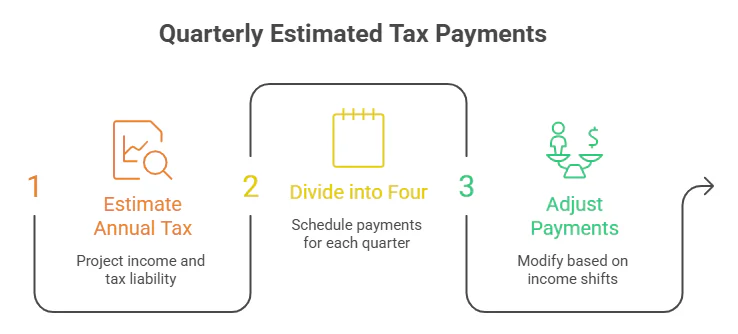
Because no one withholds taxes from your contractor income, independent contractor taxes generally require you to pay estimated taxes four times a year using Form 1040-ES.
Skipping this and paying everything at once in April almost always results in an underpayment penalty, even if you pay your full balance by the deadline.
A reliable approach to staying current looks like this:
- Estimate your annual tax liability based on either last year’s numbers or your current year’s income trajectory.
- Divide that estimate into four payments due in April, June, September, and January.
- Adjust your remaining payments if a particularly strong or slow quarter shifts your projected income significantly.
Texas contractors get one advantage here that freelancers in other states do not. Since Texas has no state income tax, your quarterly obligations only cover federal income tax and self-employment tax, which simplifies your calculations considerably.
Deductions That Reduce Both Your Income Tax and Self-Employment Tax
Every business expense you deduct does double duty, lowering your taxable income and your self-employment tax liability at the same time. This makes thorough expense tracking one of the highest-value habits you can build as a contractor.
Commonly claimed deductions include:
- Home office space, calculated through either the simplified method or actual square footage expenses.
- Equipment, software, and technology subscriptions used specifically for client work.
- Vehicle expenses tracked through either the standard mileage rate or actual cost method.
- Professional development, licensing fees, and industry association memberships.
Keeping your bookkeeping current through proper self-employment tax preparation means these deductions get captured accurately throughout the year, rather than reconstructed from memory during a stressful filing season.
Deciding When an S Corporation Election Makes Financial Sense
As your contracting income grows, staying a sole proprietor indefinitely may not be the most tax-efficient choice. Reviewing your independent contractor taxes can help determine whether changing your business structure makes financial sense.
Once your net profit reaches a certain threshold, electing S Corporation status can reduce your self-employment tax exposure by allowing you to split income between a reasonable salary and distributions that are not subject to the same payroll tax treatment.
This decision requires careful calculation, since S Corp status introduces payroll requirements and additional filing complexity that only makes sense once your income justifies the added administrative work.
Keeping Your Records Organized Without Losing Track of Payments
Beyond deductions, contractors need a system for tracking which invoices have been paid, which quarterly payments have been submitted, and how your income compares to your original projections.
A dedicated bookkeeping setup through QuickBooks configuration keeps this information organized in real time, so you are never guessing at your numbers when a quarterly deadline approaches.
Zahra Samji works directly with independent contractors across Houston, helping them navigate quarterly payments, maximize legitimate deductions, and decide when a structural change like an S Corp election makes sense for their income level.
Final Thoughts
Managing independent contractor taxes well comes down to consistency across the year, not a single push in April.
When you track your income and expenses with accuracy, stay current on quarterly payments, and review your entity structure as your business grows, tax season becomes predictable instead of stressful.
If you are ready for a clearer approach to your contractor taxes, reach out to schedule a consultation with Zahra and build a strategy that protects what you earn.
Independent Contractor Taxes FAQs
Do I need to make quarterly payments if this is my first year as a contractor?
Yes, if you expect your annual tax liability to be at least $1,000, the IRS expects quarterly estimated payments even in your first year.
What happens if I underestimate my quarterly payments?
You may owe a penalty on the underpaid amount, though you can adjust future payments once you recognize your income is higher than projected.
Can I claim a tax deduction for health insurance as an independent contractor?
Yes, self-employed individuals can generally deduct premiums paid for their own health insurance directly on their income tax return.
How is self-employment tax different from income tax?
Social Security and Medicare contributions are included in self-employment tax, while income tax is calculated separately based on your total taxable income.
At what income level should I consider an S Corp election?
There is no universal number, but many contractors start seeing meaningful savings once net profit consistently exceeds the mid-five figures annually.

