

Running a small business means your tax obligations touch nearly every financial choice that you make, from how you pay yourself to how you track a simple receipt. Managing small business taxes well is not about memorizing the tax code.
It is about building consistent habits throughout the year that keep you compliant, protect your deductions, and prevent April from turning into a scramble through a shoebox of paperwork.
Why Choosing Cash or Accrual Accounting Shapes Your Entire Tax Picture
One decision many small business owners never revisit after their first year is whether they operate on cash or accrual accounting. Cash basis records income when you receive it and expenses when you pay them, while accrual records both when they are earned or incurred, regardless of when money changes hands.
This choice affects how much taxable income you report in a given year, especially if your business carries significant receivables or payables.
Most small businesses start on a cash basis because it is simpler, but as your operations grow, revisiting this decision matters:
- Cash basis can delay recognizing income you have already earned but not yet collected.
- Accrual accounting gives lenders a more accurate picture of your financial health.
- Switching methods requires IRS approval, so the decision should be intentional, not accidental.
Getting clarity here through structured small business accounting ensures your method reflects how your business operates, rather than a default setting no one ever reconsidered.
Small Business Taxes Depend Heavily on Consistent Recordkeeping
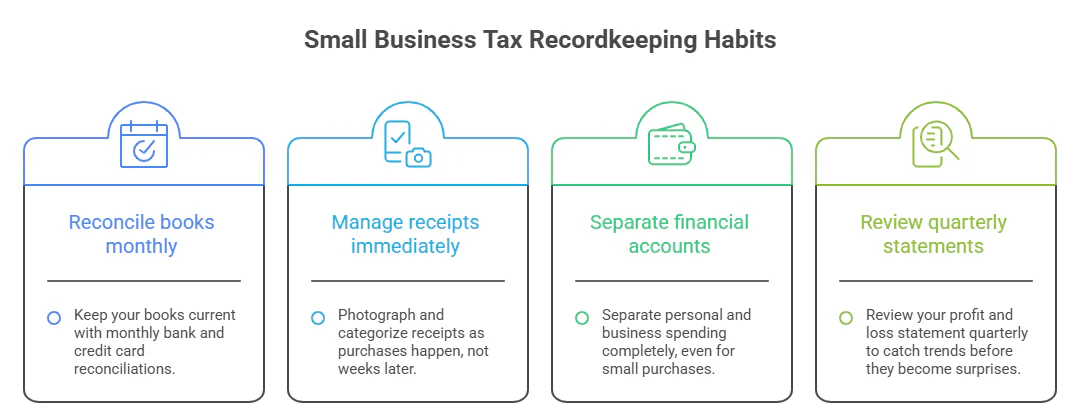
The single biggest factor separating a stressful filing season from a smooth one is whether your records stayed organized throughout the year. Business owners who reconcile accounts monthly catch discrepancies early, while those who wait until tax season spend hours reconstructing transactions from memory and scattered receipts.
A few habits protect you consistently:
- Keep your books current with monthly bank and credit card reconciliations.
- Photograph and categorize receipts as purchases happen, not weeks later.
- Separate personal and business spending completely, even for small purchases.
- Review your profit and loss statement quarterly to catch trends before they become surprises.
Strong bookkeeping habits built through proper small business recordkeeping turn tax season into a formality rather than a fire drill, since your numbers are already accurate and ready when filing time arrives.
Sales Tax Compliance That Small Business Owners Frequently Overlook
If your business sells taxable goods or certain services, sales tax collection and remittance carry their own set of deadlines separate from your income tax obligations.
Many small business owners assume this only applies to retail storefronts, but service businesses, online sellers, and even certain consulting arrangements can carry sales tax obligations depending on what they offer and where their customers are located.
Missing a filing period here creates penalties that accumulate quickly, since sales tax is generally due monthly or quarterly depending on your volume. Staying current on these small business tax deadlines protects you from a compliance gap that often goes unnoticed until a notice arrives.
Quarterly Estimated Payments Prevent a Painful April Surprise
If your business generates income without withholding, whether through self-employment or pass-through entity distributions, estimated taxes are generally due to the IRS four times each year.
Skipping these payments and paying everything at once in April can trigger an underpayment penalty on top of the tax you already owe.
Setting yourself up for smooth quarterly payments means:
- Calculating your estimate based on either last year’s liability or your current year’s projected income.
- Adjusting your payments if a strong quarter significantly changes your income trajectory.
- Marking your calendar for the April, June, September, and January deadlines well in advance.
Deductions Small Business Owners Consistently Underclaim
Beyond the well-known deductions like office supplies and mileage, several categories go underused because owners are not aware they qualify or assume the paperwork is not worth the effort. Missing these deductions year after year adds up to real money left on the table.
Frequently overlooked write-offs include:
- Professional development, licensing fees, and continuing education tied to your industry.
- A portion of home office expenses if you genuinely operate from a dedicated space.
- Business insurance premiums and professional liability coverage.
- Bank fees and payment processing charges tied to business transactions.
Why Year-Round Guidance Outperforms Annual Filing Alone
Small business taxes do not usually stay static year to year, especially as your revenue grows, your entity structure evolves, or you take on new services.
A single annual filing appointment cannot account for decisions that needed attention months earlier, which is why ongoing guidance throughout the year catches opportunities that a once-a-year meeting misses.
Zahra Samji works directly with Houston small business owners, providing year-round accounting and advisory support that connects your bookkeeping, your quarterly obligations, and your annual filing into one coherent strategy instead of three disconnected tasks handled at different times.
To Conclude
Managing small business taxes effectively comes down to consistency. When your books stay current, your quarterly payments stay on schedule, and your deductions get reviewed with real attention, tax season stops feeling like an annual crisis and becomes a predictable part of running your business.
If you want a clearer, more strategic approach to your business taxes this year, reach out to schedule a consultation with Zahra and build a plan that protects your profits year-round.
Small Business Taxes FAQs
How often should I review my small business finances for tax purposes?
Monthly reviews are the minimum standard, though quarterly deep dives help you catch trends and adjust your estimated payments accordingly.
Do I need to collect sales tax if I only sell online?
It depends on where your customers are located and whether you meet economic nexus thresholds in those states, so this should be reviewed carefully.
What to do if I miss a quarterly estimated tax payment?
You may face an underpayment penalty calculated based on how late the payment was and how much was owed for that period.
Is it possible to switch from cash to accrual accounting mid-year?
Generally no. Accounting method changes require IRS approval and typically take effect starting the following tax year.
How do I know if my business qualifies for a home office deduction?
The space must be used regularly and exclusively for business purposes, not a shared area used for both personal and business activities.

