

Owning rental property looks profitable on paper until you sit down and calculate what is left after mortgage payments, repairs, vacancies, and property management fees.
Real estate bookkeeping is what separates landlords who understand their true profitability from those who are just estimating based on whatever is left in their bank account.
Getting this system right protects your cash flow and gives you the clarity to make smarter decisions about your portfolio.
Why Tracking Cash Flow Per Property Changes Everything
If you own more than one property, lumping all your income and expenses into a single account tells you almost nothing useful.
One property might be generating strong positive cash flow while another quietly drains money every month, and you would never know which is which without separating your records property by property.
A property-level view reveals patterns that blended accounting hides completely:
- Which properties consistently outperform your projections and which underperform.
- Whether a specific property’s maintenance costs are trending upward year over year.
- How much cash reserve each property needs based on its own repair history.
Setting up dedicated tracking for each property, even within the same overall bookkeeping system, gives you the data to make decisions about which properties to hold, refinance, or sell.
Separating Security Deposits From Your Operating Cash
One of the most common real estate bookkeeping errors landlords make is treating tenant security deposits as available income the moment they arrive.
In most jurisdictions, landlords must hold security deposits for the tenant and return them at the end of the lease, less any valid deductions. Spending that money as if it were rental income creates a liability you may not be able to cover when a tenant moves out.
A cleaner approach separates these funds clearly:
- Hold security deposits in a distinct account, separate from your operating funds.
- Classify security deposits as liabilities on your books, not as income.
- Track deductions against each deposit individually, with documentation supporting every charge.
This distinction protects you legally and keeps your cash flow projections accurate, since deposit money was never truly yours to spend in the first place.
Real Estate Bookkeeping Requires Careful Expense Classification
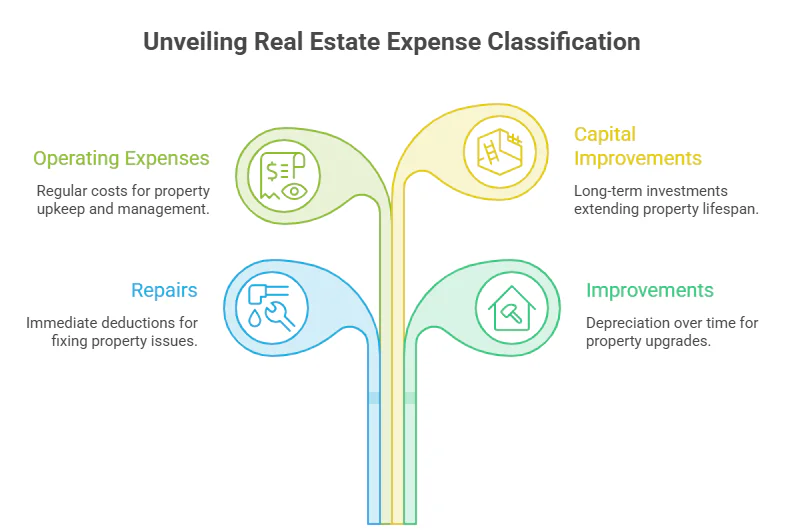
Not every dollar you spend on a property gets treated the same way for tax purposes, and mixing up these categories can misstate both your cash flow and your eventual tax liability.
Repairs are generally deductible in the year you incur them, while improvements must be capitalized and depreciated over time.
The distinction matters more than most landlords realize:
- Fixing a leaking faucet is a repair, deductible immediately against your rental income.
- Replacing an entire roof is an improvement, depreciated over its useful life instead of deducted all at once.
- Routine maintenance like landscaping or pest control falls under standard operating expenses.
- Capital improvements that extend a property’s useful life require their own depreciation schedule.
Getting this classification wrong either overstates your current deductions or misses depreciation you are entitled to claim.
Working through this with structured real estate accounting support ensures each expense lands in the right category from the start, rather than requiring a costly correction later.
Building Cash Reserves That Reflect Your Risk
Positive cash flow on paper does not mean you have enough set aside for the inevitable large expense, whether that is a major appliance failure, an extended vacancy, or an unexpected roof repair.
Landlords who skip reserve planning find themselves pulling from personal savings or credit when something goes wrong, which defeats the purpose of owning income-producing property in the first place.
A reasonable reserve strategy accounts for:
- A percentage of monthly rental income set aside specifically for repairs and vacancies.
- Property-specific reserves that reflect the age and condition of each individual property.
- A separate reserve tied to your overall portfolio for larger, less frequent expenses.
Why Depreciation Tracking Deserves Its Own System
Depreciation is one of the most valuable tools available to property owners, allowing you to recover the cost of your investment over time even while your property continues generating cash flow.
But accurate real estate bookkeeping requires records that go beyond simple income and expense logs, including purchase price allocation between land and building, plus any capital improvements made along the way.
If you actively manage your properties as a significant part of your work, understanding real estate professional status can meaningfully change how your rental losses interact with your overall tax picture, potentially allowing losses to offset other income rather than staying limited to passive activity rules.
Property Tax Timing and Its Effect on Your Books
Property tax bills arrive at different times than when the liability accrued, especially around a purchase or sale.
Reviewing your closing disclosure carefully ensures you capture the portion of property taxes that qualify as deductible for the period you owned the property, instead of missing this allocation entirely because it was buried in closing paperwork.
Zahra Samji works directly with Houston property owners managing single rentals and growing portfolios alike, building bookkeeping systems that reflect how real estate income flows, not a generic small business template stretched to fit.
Last Thoughts
Strong real estate bookkeeping services Houston gives you more than clean records for tax season. It gives you the visibility to know which properties are building wealth and which are quietly costing you money every month.
When your cash flow, reserves, and depreciation are tracked accurately at the property level, you make portfolio decisions based on real numbers, not guesswork.
If you want a clearer picture of your real estate cash flow, reach out to schedule a consultation with Zahra and build a bookkeeping system that supports your investment goals.
Real Estate Bookkeeping FAQs
Should each rental property have its own bank account?
Ideally yes, especially once you own more than one property, since it gives you accurate, property-specific cash flow data.
How do I know if an expense counts as a repair or an improvement?
Repairs return a property to its existing condition, while improvements enhance its value or extend its useful life and are generally depreciated.
What happens if I spend a tenant's security deposit before they move out?
You risk being unable to return the deposit when required, which can create legal liability depending on your local landlord-tenant laws.
How much should I keep in reserve per rental property?
A common guideline is one to two months of rental income per property, adjusted based on the property’s age and maintenance history.
Can poor bookkeeping affect my ability to claim real estate professional status?
Yes, since that status requires detailed documentation of hours spent on real estate activities, which weak recordkeeping makes difficult to prove.

