

Walking into tax season without your documents organized means delaying your filing, missing deductions, or triggering follow-up from the IRS.
So if you are asking what documents do I need to file taxes, the answer depends on your income sources, filing status, and deductions, but the framework for gathering everything correctly stays consistent.
This checklist covers what most guides skip: the less obvious documents, the situational ones that depend on your life and financial activity, and the records that prevent costly errors before they happen.
Personal and Household Information That Sets the Foundation for Your Return
Before you pull a single tax form, your personal records need to be accurate and current. Gather the following before anything else:
- Individual Taxpayer Identification Numbers or Social Security numbers for yourself, your spouse, and all dependents.
- Date of birth for every person listed on the return.
- Your prior-year tax return, which provides your adjusted gross income for identity verification when e-filing, and your prior-year figures for comparison.
- Bank account and routing numbers for an immediate deposit of any refund.
- IP PIN if the IRS has issued one to you or a dependent after a previous identity theft incident.
That last item catches people off guard every year. If the IRS issued you an Identity Protection PIN and you do not include it, your e-filed return will be denied, and a paper return will face serious processing delays.
Income Documents Apart from the W-2 That You Cannot Afford to Miss
The W-2 is the document most filers expect, but depending on how you earn income, it may be only one piece of a much larger picture. Answering what documents do I need to file taxes accurately means accounting for every income stream, not just your primary employer.
Collect all of the following that apply to your situation:
- W-2 from every employer you worked for during the year.
- 1099-NEC for freelance, contract, or self-employment income of $600 or more per client.
- 1099-K from payment processors like PayPal, Venmo, or Stripe if you received business payments.
- 1099-INT and 1099-DIV for dividend or interest income from bank accounts and investments.
- 1099-B for proceeds from the sale of stocks, bonds, or other securities.
- 1099-R for distributions from retirement accounts, pensions, or annuities.
- SSA-1099 if you received Social Security or SSDI benefits.
- 1099-G if you obtained unemployment compensation or a state tax refund.
- Schedule K-1 if you are a part of a partnership, shareholder in an S corporation, or beneficiary of a trust or estate.
K-1 forms are particularly problematic because they are issued later than other tax documents. If you are waiting on a K-1, do not rush to file without it. Filing an incomplete return and amending later costs more time and effort than filing on extension.
Deduction Records That Require Documentation Before Your Filing Appointment
If you work with a CPA on your tax preparation Houston TX, having these ready before your appointment prevents delays and ensures nothing is left on the table.
Deduction documentation to collect includes:
- Mortgage interest statement (Form 1098) and property tax payment records.
- Charitable contribution receipts for cash and non-cash donations, including acknowledgment letters for any single donation of $250 or more.
- Medical and dental expense receipts if your total exceeds 7.5% of your adjusted gross income.
- Student loan interest statement (Form 1098-E).
- Tuition and education expense statement (Form 1098-T).
- Childcare provider information, including the provider’s name, address, and Tax ID or Social Security number.
- Records of energy-efficient home improvements, if you are claiming the residential clean energy credit.
For self-employed filers, deduction documentation expands significantly to include business expense receipts, home office measurements, mileage logs, and records of health insurance premiums paid.
The Documents Most Filers Forget Until After They File
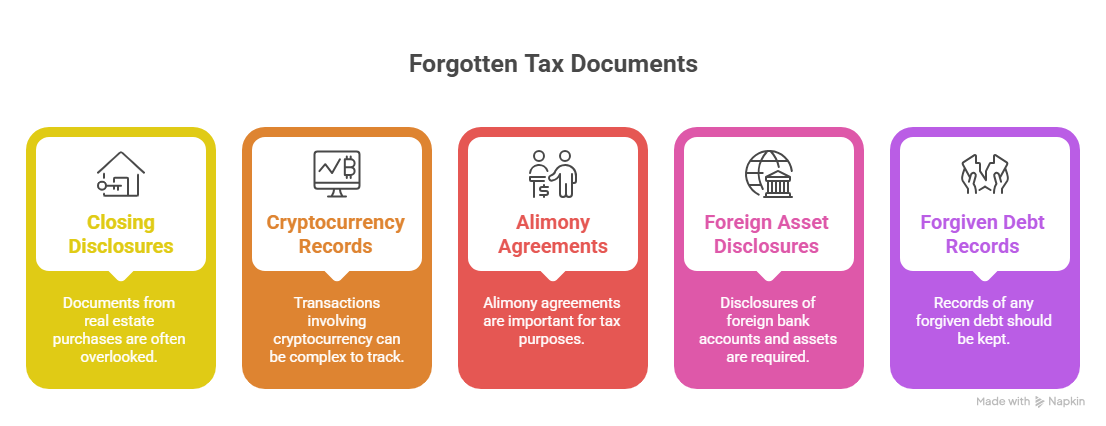
Answering what documents do I need to file taxes completely means accounting for life events and financial transactions that do not always generate obvious tax forms, but absolutely affect your return.
Do not overlook:
- Closing disclosures from any real estate purchase or sale during the year.
- Records of cryptocurrency transactions, including purchase dates, cost basis, and sale proceeds.
- Alimony agreements finalized before 2019, if you are still paying or receiving alimony under a pre-TCJA divorce decree.
- Foreign bank account or asset disclosures if you hold accounts outside the United States.
- Records of any forgiven debt, which may generate a 1099-C that is taxable as ordinary income.
In Conclusion
Knowing exactly “what documents do I need to file taxes” is the preparation step that decides whether your filing is accurate, complete, and filed on time.
Every category covered here represents a real-world area where missing documentation leads to errors, delays, or missed deductions.
At Skyline Financial CPA, Zahra Samji works directly with Houston individuals and small business owners to make sure every document is accounted for before a return is prepared.
Want a thorough, organized approach to your filing this year? Schedule a consultation with Houston CPA firm today! Getting it right starts with having everything in order.
FAQs
What documents do I need to file taxes if I have multiple income sources?
You need a separate income document for each source, including W-2s from all employers, 1099s from clients or platforms, and any investment or retirement distribution statements received during the year.
What if I did not receive a 1099 for the income I earned?
The income is still reportable regardless of whether a form was issued. Use your bank statements and invoicing records to document the amount and report it accurately on your return.
How long should I keep my tax documents after filing?
The IRS generally has three years to audit a return, so keeping records for at least three years from the filing date is recommended. Records related to property or assets should be kept longer.
Do I need last year's return to file this year?
Your prior-year adjusted gross income is required for e-filing identity verification. It also helps your CPA identify carry-forward items like losses, credits, or depreciation schedules that affect the current return.
What happens if I file without all my documents?
Filing with incomplete information increases the risk of errors, missed deductions, and potential IRS notices. If key documents are missing, filing for an extension gives you time to gather everything rather than amend a return later.

