

Freelancing gives you control over your schedule and income, but it also hands you a tax responsibility that most people underestimate until the first bill arrives. Understanding how to file self-employment taxes correctly means more than knowing which forms to submit.
It means tracking the right numbers throughout the year, making payments on time, and structuring your deductions so your net tax liability reflects your actual financial position.
This guide covers the mechanics, the commonly missed details, and the decisions that affect your outcome the most.
Why Self-Employment Tax Works Differently From What You Paid as an Employee
When you were a W-2 employee, your employer covered half of your Social Security and Medicare contributions. As a freelancer, you cover both halves.
The self-employment tax rate is 15.3% on net self-employment income subject to the Social Security wage base of $182,700 for 2026, and 2.9% on everything above that threshold.
That rate applies to your net profit, meaning your gross freelance income minus your allowable business deductions. Reducing your net profit through legitimate deductions is one of the most direct ways to reduce your self-employment tax obligation, not just your income tax.
One partial offset the IRS does provide is a deduction for half of your self-employment tax. You can deduct that sum from your gross income when calculating your adjusted gross income, which reduces your federal income tax even though it does not reduce the self-employment tax itself.
It is a modest offset, but it is one you should not overlook when your Houston CPA firm prepares your return.
The Quarterly Estimated Payment System Freelancers Must Follow All Year
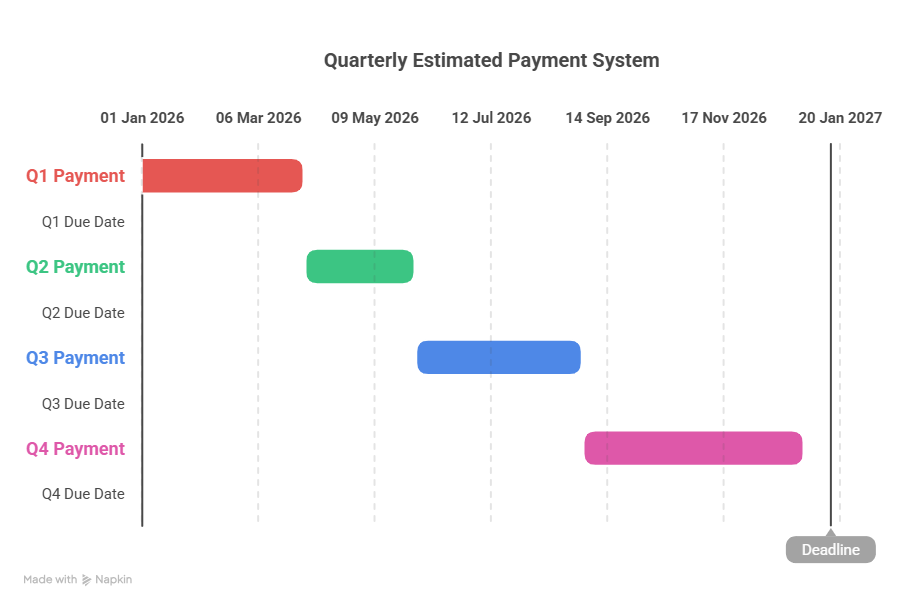
One of the most confusing parts of learning how to file self-employment taxes for the first time is figuring out that the IRS expects payments throughout the year, not just at filing time.
Because no employer is withholding on your behalf, you are responsible for remitting estimated taxes four times a year.
The 2026 estimated payment deadlines are:
| Payment Period | Due Date |
| January 1 to March 31 | April 15, 2026 |
| April 1 to May 31 | June 15, 2026 |
| June 1 to August 31 | September 15, 2026 |
| September 1 to December 31 | January 15, 2027 |
You can pay through the IRS Direct Pay portal or the Electronic Federal Tax Payment System. It’s essential to keep confirmation records of every payment, as these amounts are credited on your return, and missing one creates an artificial balance due.
Deductions That Directly Reduce the Net Profit Your Self-Employment Tax Is Calculated On
Because self-employment tax is based on net profit, every legitimate business deduction reduces both your income tax and your self-employment tax liability simultaneously.
This is where preparation and recordkeeping make a measurable financial difference for freelancers managing their self-employment taxes throughout the year.
Deductions worth tracking carefully include:
- Home office: The portion of your home used regularly and exclusively for business, calculated either by the simplified method or actual expenses based on square footage.
- Equipment and technology: Computers, cameras, software subscriptions, and tools used for client work, which may qualify for full expensing under Section 179 in the year of purchase.
- Professional development: Courses, certifications, books, and industry memberships directly related to your freelance work.
- Health insurance premiums: If you are not qualified for employer-sponsored coverage through a spouse, premiums you pay for yourself and your family are deductible from gross income.
- Retirement contributions: SEP-IRA contributions of up to 25% of net self-employment income reduce your taxable income per dollar and can be made up to your filing deadline, including extensions.
- Mileage: If you drive to client meetings, co-working spaces, or supply runs, the current mileage log with dates, destinations, and business purposes is the documentation standard the IRS expects.
How to File Self-Employment Taxes Using the Right Forms and Schedules
Filing as a freelancer becomes effortless once you understand how the forms connect. Schedule C documents your business income and deductions, producing the net profit that flows into your return, while Schedule SE uses that net profit to calculate your self-employment tax. Both schedules attach to your Form 1040.
Maintaining separate business records and bank accounts helps substantiate deductions and avoids the complications of combining personal and business transactions.
Even part-time freelancers who earn more than $400 in net profit during the year must file Schedule SE, as that threshold triggers a self-employment tax obligation regardless of whether income tax is owed.
Ending Note
Knowing how to file self-employment taxes correctly is not just a compliance obligation. It is a financial management skill that affects your cash flow, retirement savings, and long-term business sustainability.
Zahra Samji at Skyline Financial CPA helps Houston freelancers and self-employed individuals develop a tax plan that is accurate, strategic, and customized for their earnings.
If you want clarity on your tax position, connect with her for a consultation today. Your freelance income deserves the same level of planning that any business would apply.
FAQs
At what income level do I need to start paying self-employment tax?
You owe self-employment tax once your net self-employment income reaches $400 or more in a tax year. This threshold applies regardless of whether you also have W-2 income from an employer.
Can I deduct my home office if I sometimes work from a coffee shop or client site?
Yes, as long as you have a space in your home used regularly and exclusively for business. Occasional work from other locations does not disqualify you from claiming the home office deduction.
What happens if I miss a quarterly estimated payment deadline?
The IRS charges an underpayment penalty on the missed amount calculated from the due date through the date you pay. Making up the missed payment immediately limits how much interest and penalty accumulate.
Do I need a separate business bank account as a freelancer?
It is not legally required for sole proprietors. However, keeping detailed records makes your Schedule C reconciliation much cleaner and your deductions easier to substantiate when learning how to file self-employment taxes or if the IRS ever questions your return.
Is a SEP-IRA contribution still allowed if I already contributed to an IRA?
Yes. SEP-IRA and traditional or Roth IRA contributions are separate limits. You can contribute to both in the same tax year, subject to each plan’s individual eligibility and contribution rules.

