

Disability income fills a critical financial gap, but the tax treatment attached to it is not that simple.
Whether you receive Social Security Disability Insurance, a private long-term disability benefit, or payments through an employer-sponsored plan, the answer to “Is disability income taxable?” depends on several factors.
In this blog, we have discussed how each benefit type is treated under current IRS rules, what drives your specific tax outcome, and where the overlooked complications tend to surface.
Why the Source of Your Disability Benefit Determines Its Taxability
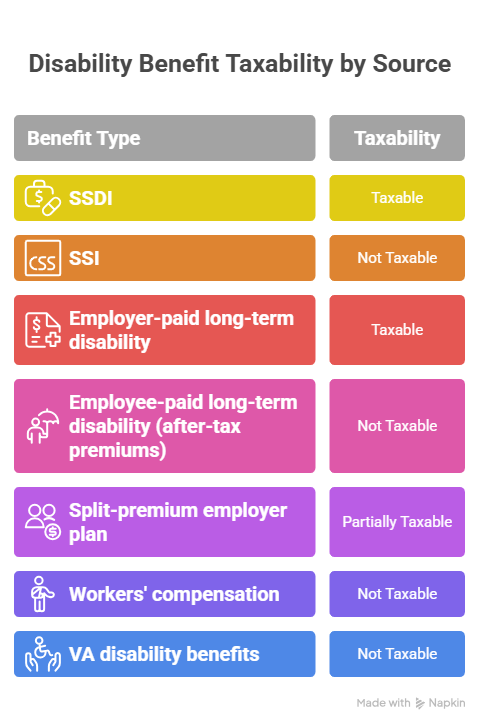
The IRS does not treat all disability income the same way. The critical variable is who paid the premiums or funded the benefit that you are now receiving. That single factor decides whether your payments are fully taxable, partially taxable, or tax-free entirely.
Here is how the major benefit types break down:
| Benefit Type | Tax Treatment |
| Social Security Disability Insurance (SSDI) | Up to 85% taxable, depending on combined income |
| Supplemental Security Income (SSI) | Never taxable |
| Employer-paid long-term disability | Fully taxable as ordinary income |
| Employee-paid long-term disability (after-tax premiums) | Generally tax-free |
| Split-premium employer plan | Partially taxable based on the employer contribution ratio |
| Workers’ compensation | Generally not taxable |
| VA disability benefits | Not taxable |
Understanding where your benefit falls on this table is the starting point for answering “Is disability income taxable?” in your specific situation.
How the IRS Calculates Whether Your SSDI Becomes Taxable
SSDI recipients assume their benefits are not taxable because they are receiving them due to a medical condition. That assumption is incorrect. The IRS uses a combined income formula to determine what percentage of your SSDI is subject to tax.
The Formula: Adjusted Gross Income (AGI) + Nontaxable Interest + 50% of your SSDI benefits.
The resulting figure is then compared against two thresholds:
- If your combined income ranges between $25,000 and $34,000 as a single filer, up to 50% of your SSDI may be taxable.
- If your combined income surpasses $34,000, up to 85% of your SSDI may be taxable.
- For married couples who file jointly, the thresholds are $32,000 and $44,000, respectively.
Part-time earnings, retirement distributions, interest income, and rental income all count toward combined income. If you are working part-time while receiving SSDI, reviewing your withholding early in the year prevents a large unexpected balance at filing time.
The Premium Payment Rule That Governs Private Disability Insurance Taxability
For people receiving benefits through a private long-term disability policy, questioning “Is disability income taxable?” depends on who paid the premiums and whether they were paid with pre-tax or after-tax dollars.
If your employer paid 100% of the premiums, your benefits are fully taxable as ordinary income. If you paid 100% using after-tax dollars, your benefits are generally tax-free.
In employer-sponsored plans where both you and your employer contribute, only the portion tied to employer-paid premiums is taxable.
For individuals dealing with unemployment and disability taxes, understanding this helps you decide whether to elect voluntary tax withholding on your payments.
Withholding and Estimated Payments on Disability Income Most Recipients Overlook
Unlike wages, most disability benefits do not have automatic withholding unless you specifically request it.
SSDI recipients can file Form W-4V to request voluntary federal withholding at a flat 7%, 10%, 12%, or 22% rate. Private disability insurers may or may not offer withholding depending on the plan.
If withholding is not set up and your disability income is taxable, you are responsible for making quarterly estimated payments to avoid underpayment penalties. The IRS underpayment penalty applies when you owe more than $1,000 at filing and have not paid at least 90% of your current-year liability or 100% of your prior-year liability throughout the year.
This is one of the more significant practical issues for disability income recipients, particularly those transitioning from full employment, where withholding is handled automatically.
Reviewing your situation with our Houston CPA, Zahra Samji, early in the year rather than at filing time gives you the opportunity to set up a payment structure that avoids penalties entirely.
To Sum Up
The answer to “Is disability income taxable?” is never a simple yes or no. It depends on your benefit source, premium payment history, combined income level, and how your payments are structured.
Each of those factors requires individual analysis, and getting them wrong can result in either an unexpected tax bill or a missed opportunity to reduce what you owe.
At Skyline Financial CPA, Zahra handles disability income, back payment elections, withholding decisions, and the compliance questions that come with each.
If you want clarity on how your disability benefits affect your tax position, book a consultation right away. You deserve answers that reflect your actual situation, not a generic summary.
FAQs
Is disability income taxable at the state level in Texas?
Texas has no personal state income tax, so disability income is not subject to state taxation regardless of the benefit type or amount you receive.
Do I need to report SSI on my federal tax return?
No. Supplemental Security Income is not taxable and does not need to be reported on your federal return. It is excluded from the combined income formula used to evaluate SSDI taxability.
What form does the SSA send for SSDI income reporting?
The Social Security Administration sends Form SSA-1099 each January showing the total SSDI benefits paid during the prior year. You use this form when preparing your federal return.
Can I avoid tax on SSDI by not having other income?
If your only income is SSDI and your combined income falls below the $25,000 single filer threshold, your benefits are not taxable. Additional income sources are what typically push recipients into taxable territory.
Should I set up withholding on my disability payments?
If your disability income is taxable and you do not have other sources for withholding, we strongly recommend setting up voluntary withholding or making quarterly estimated payments to avoid underpayment penalties at filing.

