
Every financial decision you make affects your long-term wealth as a high-earning professional.
Selecting the right tax professional is one of the most neglected decisions. The debate around tax advisor vs. CPA usually confuses business owners because both roles appear similar on the surface. However, the level of strategy, legal authority, and financial protection you receive can be dramatically different.
When you understand how these professionals operate, you stop viewing taxes as a yearly obligation and start treating them as a powerful tool for wealth preservation.
Tax Advisor vs. CPA From a Regulatory Perspective
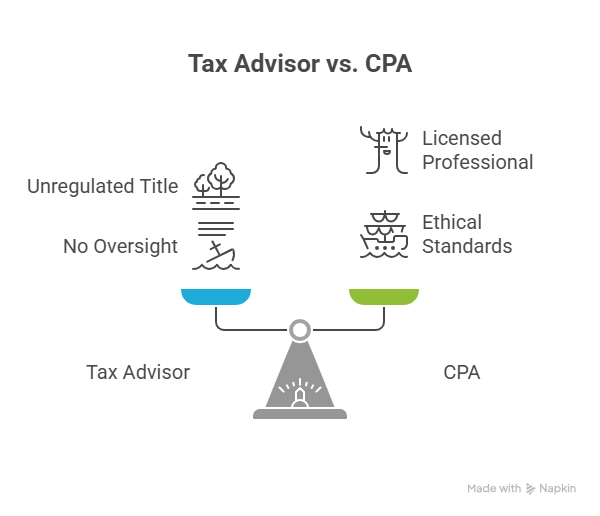
When evaluating between a tax advisor and a CPA, the most important difference lies in regulation and professional accountability.
The title “tax advisor” is broad. It can refer to a consultant, a seasonal preparer, or even someone who primarily uses tax software to assist clients. In many cases, the title itself is not regulated by a governing body.
A Certified Public Accountant, on the other hand, operates under strict licensing standards. A CPA must complete extensive education, pass a rigorous exam, and maintain ongoing professional training. More importantly, a CPA is legally bound to ethical standards enforced by a state board of accountancy.
For you, this means a CPA carries a higher level of responsibility and credibility. If your financial situation becomes complicated or subject to scrutiny, you want a professional who is accountable to a regulatory authority rather than someone operating without oversight.
The Power of Unlimited IRS Representation Rights
A critical factor in the tax advisor vs. CPA discussion is representation rights.
A CPA has what is known as unlimited representation rights before the IRS. This means they can represent you during:
- IRS audits.
- Appeals and disputes.
- Payment negotiations.
- Collection matters.
Many generic tax advisors do not have these rights.
Why does this matter to you?
Because the professional who designed your tax strategy should be able to defend it. If the IRS challenges a deduction, income classification, or credit claim, you want someone who can advocate on your behalf. A CPA essentially acts as both a strategist and a defender of your financial position.
This level of protection is particularly important if you operate a growing business, manage multiple income streams, or anticipate future investment rounds.
Advanced Tax Planning That Protects Your Bottom Line
The biggest misconception in comparing a tax advisor to a CPA is that a CPA only focuses on compliance, while an advisor focuses on planning.
In reality, the best Houston CPA combines both.
At Skyline Financial CPA, Zahra Samji evaluates your financial structure to identify ways to reduce your overall tax liability. This process may include:
- Evaluating your business entity structure.
- Optimizing owner compensation.
- Timing deductions and capital expenditures.
- Planning distributions and retained earnings.
For example, a strategic decision such as converting to an S corporation can significantly reduce self-employment taxes for profitable businesses.
Similarly, managing individual taxes alongside business filings ensures that your personal and corporate strategies align. When these systems operate together, your entire household tax burden becomes more efficient.
How Professional Oversight Strengthens Investor Confidence
If you plan to raise capital or eventually sell your company, tax compliance plays a major role in your valuation.
During due diligence, investors and buyers will closely examine your financial records. They want assurance that your business has maintained consistent and defensible tax practices.
In the tax advisor vs. CPA comparison, a CPA provides credibility that external stakeholders trust. Properly structured financial records demonstrate discipline, transparency, and operational maturity.
Poor tax hygiene, however, can create red flags such as:
- Inconsistent filings.
- Missing documentation.
- Unreported state tax obligations.
- Questionable deductions.
Even small errors can lead to valuation reductions or delays in acquisition negotiations. With professional oversight, your financial statements remain audit-ready and aligned with regulatory expectations.
Comparing Professional Capabilities
When choosing a tax advisor or a CPA, the following comparison highlights how their roles typically differ.
| Professional Attribute | Generic Tax Advisor | Licensed CPA |
| Licensing | Often none or voluntary | State-regulated license |
| IRS Representation | Limited or none | Unlimited representation rights |
| Technical Expertise | Varies widely | Extensive accounting and tax training |
| Strategic Planning | Often general guidance | Data-driven tax engineering |
| Ethical Oversight | Internal standards | State board enforced |
Last Words
Choosing between a tax advisor vs. CPA ultimately comes down to the level of strategy, protection, and credibility you want for your business.
A generic advisor may help you complete a tax return, but a CPA helps you build a financial framework that protects your revenue, reduces risk, and supports long-term growth.
At Skyline Financial CPA Houston, we focus on proactive tax planning designed to keep more of your hard-earned income working for you. From compliance to strategic optimization, we ensure your financial structure supports the vision you have for your business.
If you are ready to move beyond reactive tax filing and build a strategy that strengthens your bottom line, get in touch today to schedule a consultation with Zahra.
Tax Advisor vs CPA FAQs
Is a tax advisor the same as a CPA?
No, they are not the same. While all CPAs can act as tax advisors, not all tax advisors are CPAs. A CPA has passed a rigorous four-part exam and is governed by a state board of accountancy.
Do I need a CPA if my business is still small?
While you may not have high transaction volume yet, the decisions you make in the early stages have long-term consequences. Getting advice from a CPA early on can prevent expensive “clean-up” costs later and ensure you are maximizing your tax savings from the start.
Can a CPA help with my individual taxes and business taxes?
Yes. For most founders, personal and business finances are deeply intertwined. Zahra can analyze both your individual taxes and your corporate filings to ensure there are no missed opportunities for deductions or credits.
What should I do if I have several years of back taxes?
The most important step is to stop the accumulation of interest and penalties. We assist businesses in resolving back taxes by filing delinquent returns and exploring options like Offers in Compromise or Installment Agreements. A CPA’s representation is vital in these negotiations to ensure the IRS treats your business fairly.

