

Running a business means managing far more than products, services, and customers. You also need to stay ahead of compliance obligations that protect your company from penalties and unexpected financial stress.
One of the most common questions business owners ask is when are business taxes due, especially when multiple filing deadlines apply throughout the year.
Understanding these dates is not just about avoiding penalties. Tax deadlines affect your cash flow planning, investor reporting, and long-term financial strategy. When you know exactly what the tax calendar looks like, you can prepare your documentation early, estimate your liabilities accurately, and maintain full compliance with IRS requirements.
Below is a practical guide to the most important business tax deadlines and how they affect different business structures.
The Federal Filing Calendar That Shows When Are Business Taxes Due
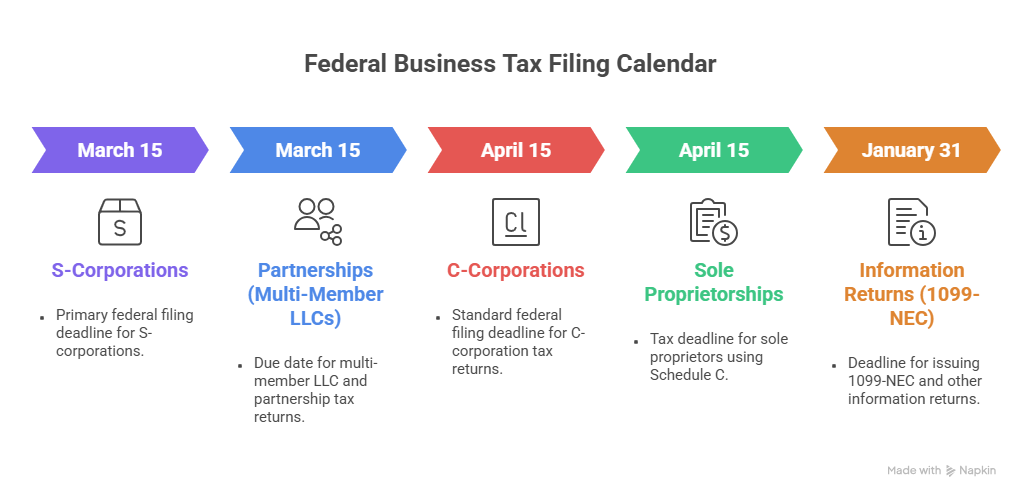
Your business tax deadline primarily depends on how your entity is structured for tax purposes. While many businesses operate on a calendar year ending December 31, the due date for your return varies based on whether you are a pass-through entity or a corporation.
For most calendar-year businesses, the standard federal filing deadlines are:
| Entity Type | Tax Form | Due Date (Calendar Year) |
| S-Corporations | Form 1120-S | March 15 |
| Partnerships (Multi-Member LLCs) | Form 1065 | March 15 |
| C-Corporations | Form 1120 | April 15 |
| Sole Proprietorships | Schedule C (Form 1040) | April 15 |
| Information Returns (1099-NEC) | Form 1099 | January 31 |
Pass-through entities such as partnerships and S-Corps must file earlier because their income “passes through” to the owners’ individual tax returns. Filing by March 15 allows shareholders and partners to receive their K-1 forms in time to complete their personal filings.
If your company operates as one of the many S corporations, paying close attention to the March deadline is essential for maintaining compliance and avoiding IRS penalties.
How Fiscal Year Businesses Shift the Tax Deadline
Many tax articles assume every business operates on a calendar year. However, some companies adopt a fiscal year to align with seasonal revenue cycles or operational needs.
If your business follows a fiscal year, your filing deadline changes accordingly. The general rule is that your return is due on the 15th day of the 3rd or 4th month after the fiscal year ends, depending on your entity type.
For example:
- A C-corporation with a fiscal year ending June 30 must file by October 15.
- An S-corporation with the same fiscal year would file by September 15.
Understanding when are business taxes due under a fiscal year structure requires careful planning. Miscalculating these adjusted deadlines can trigger automatic penalties from the IRS.
We commonly advise business owners to match their accounting cycles with their operational reality so reporting deadlines remain predictable and manageable.
The Quarterly Estimated Tax System That Many Businesses Leave Behind
A major content gap in most tax discussions is the role of estimated tax payments. Many business owners assume taxes are paid only once per year, but the U.S. tax system operates on a pay-as-you-go model.
If you owe more than $1,000 in taxes annually, you are generally required to make quarterly estimated payments.
These payments are due on:
- April 15.
- June 15.
- September 15.
- January 15 of the following year.
These estimated payments are especially important if you are held liable for self-employment taxes, which include both the employer and employee amounts of Social Security and Medicare.
Without proper planning, failing to make these payments can result in underpayment penalties, even if you pay your full tax bill by April.
Strategic tax planning helps you calculate these estimates based on real financial performance rather than guesswork.
The January Compliance Window That Businesses Should Not Miss
Before the March and April deadlines arrive, January introduces another important compliance window. During this period, businesses must file information returns and distribute required tax documents.
If you paid a contractor more than $600 during the year, you must issue Form 1099-NEC by January 31. The same deadline applies to distributing W-2 forms to employees.
These filings are critical because they inform the IRS about payments your business made during the year. Missing the January deadline can lead to significant per-form penalties.
Many business owners focus only on when are business taxes due in terms of income tax filings. However, these early-year reporting obligations are equally important for maintaining compliance.
Final Remarks
Tax deadlines should never feel like a surprise. When you understand the full business tax calendar, from January information returns to quarterly estimated payments, you gain the ability to start preparing with confidence.
Knowing when are business taxes due allows you to manage your cash flow effectively, keep accurate financial records, and avoid costly IRS penalties. With the right financial structure in place, tax compliance becomes a routine part of running your business rather than a source of stress.
If you want clarity around your filing deadlines and estimated payments, professional guidance from our licensed Houston CPA, Zahra Samji, can make a huge difference. She helps business owners build proactive tax strategies that keep them compliant and financially prepared throughout the year.
Contact Skyline Financial CPA in Houston today to schedule a consultation and ensure your business stays ahead of every tax deadline.
FAQs
What happens if a business tax deadline falls on a weekend or holiday?
If the date when business taxes are due falls on a Saturday or Sunday, or any other legal holiday, the deadline is pushed to the next business day. This applies to both federal and state filings.
What are the consequences of missing business tax deadlines?
Missing business tax deadlines can lead to two types of penalties, which are failure to file and failure to pay. The failure-to-file penalty is generally much higher, often 5% of the taxes that are unpaid for each month the return is late. We highly recommend filing an extension even if you cannot pay the full amount to mitigate these costs.
Are IRS tax dates the same for every type of LLC?
No, IRS tax dates for LLCs depend on how the entity is taxed. Single-member LLCs are treated as sole proprietorships (April 15), while multi-member LLCs are treated as partnerships (March 15).
How can I find my specific small business tax due dates for state taxes?
Your small business tax due dates for state filings can usually be found on your state’s Department of Revenue website. However, because these can vary wildly by state and tax type (income vs. franchise), we provide a consolidated calendar for our clients to ensure nothing is missed across different jurisdictions.

