

Tax planning services are not about finding loopholes. They are about understanding how your income, expenses, entity structure, and financial decisions interact under current tax law, so you pay exactly what you owe and not a dollar more.
If your only tax touchpoint is filing a return in April, you are already working at a disadvantage. Here are the specific planning moves that produce real, measurable results.
Why the Timing of Income and Deductions Changes Your Tax Liability More Than the Rate Does
Most people focus on tax rates when thinking about what they owe. Experienced tax planning focuses on timing. The year income is recognized and deductions are taken can shift your liability significantly, and in most cases, those decisions are within your control.
Common timing levers for business owners:
- Increasing deductible expenses into the current year when your income is higher.
- Deferring invoicing on completed work to push income into the next tax year.
- Timing equipment purchases to capture Section 179 or bonus depreciation in the most beneficial year.
- Funding retirement accounts before year-end to reduce current-year taxable income.
These are legitimate elections the tax code explicitly allows. Most small business owners do not use them because no one has walked through the numbers with them before the year closes.
Tax planning is most effective before the year ends, not after. Learn how our tax planning Houston TX services build a year-round strategy around your actual income, structure, and financial goals.
How Entity Structure Continues to Affect Your Tax Liability After Formation
Choosing a business entity is a one-time decision, but its tax implications evolve as your revenue grows. A structure that worked at $80,000 in net profit may cost you thousands at $200,000. Tax planning services assess whether your current structure still fits your income level.
Key structure-related planning questions:
- Would an S Corp election reduce your self-employment tax at your current profit level?
- Does your salary-to-distribution ratio hold up against the IRS reasonable compensation standard?
- Has a change in ownership or business activity created an unintended tax consequence?
Your entity structure should be reviewed against your actual financials every year, especially when revenue or ownership changes significantly.
Retirement Accounts as a Tax Planning Tool That Business Owners Underuse
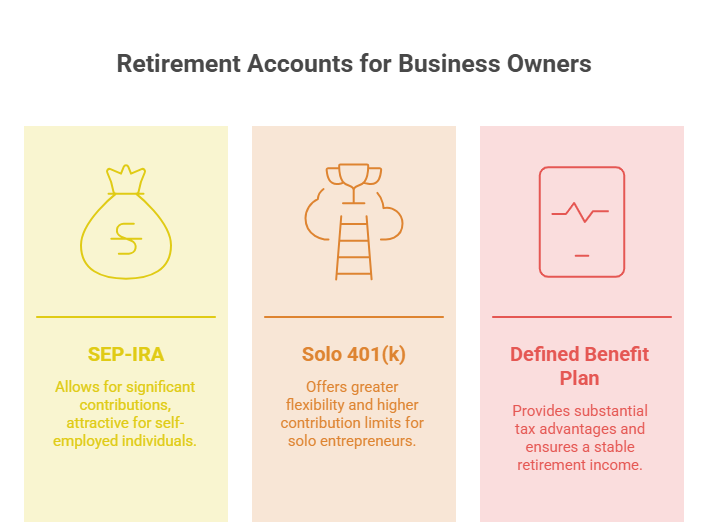
For self-employed individuals, retirement contribution limits go well beyond what a W-2 employee can contribute. The right plan depends on your net income, whether you have employees, and how much taxable income you want to offset.
Plans worth understanding:
- SEP-IRA: Up to 25% of total self-employment income, capped at $72,000 for 2026.
- Solo 401(k): Combined contributions up to $72,000, plus an $8,000 catch-up if you are 50 or older.
- Defined benefit plan: Higher limits for high-income earners starting the plan later in their career.
Getting this wrong in either direction leaves money with the IRS or creates compliance obligations you were not prepared to meet.
Not sure which retirement plan fits your structure and income level? Look through Skyline’s Self-Employment Tax Preparation Services for guidance on reducing self-employment tax liability with strategies built around your actual numbers.
Quarterly Estimated Taxes and How Underpaying Costs You More Than You Realize
Missing quarterly estimated payments does not just delay your obligation. It results in an underpayment penalty calculated on each missed installment, even if you pay the full balance by April.
Effective tax planning services address estimated payments by:
- Projecting annual liability from current-year income rather than using prior-year figures.
- Adjusting Q3 and Q4 payments when income shifts mid-year.
- Meeting the safe harbor threshold of 100% of prior-year tax or 90% of current-year liability.
Overpaying is also a planning failure. Giving the IRS an interest-free loan each quarter means that cash is not working for your business. The goal is precision, not just compliance.
How Proactive Tax Planning Services Prevent the Scramble That Happens Every April
Reactive tax preparation means filing the best return possible given what already happened. Proactive tax planning means those decisions are made while you still have options.
Zahra Samji at Skyline Financial CPA works with you throughout the year to review your income trajectory, revisit your deduction strategy, and make sure your estimated payments and entity structure keep pace with your actual financial position.
In Conclusion
Tax planning is a year-round function. The timing decisions, entity structure reviews, retirement contributions, and estimated payment adjustments covered here are all available to you under current tax law.
What separates business owners who use them from those who do not is having a licensed Houston CPA engaged with your numbers before the year closes, not after.
Your tax position next April is being shaped by decisions you make today. See how Zahra’s tax preparation services Houston TX connect your year-round financial picture to a return that reflects every legitimate advantage available to you.
Schedule your year-round tax planning session today!
Tax Planning Services FAQs
When is the best time to start tax planning for my business?
Any time before December 31 is meaningful, but Q3 is particularly valuable. You still have time to adjust income timing, fund retirement accounts, and recalibrate estimated payments before the year closes.
What is the difference between tax planning and tax preparation?
Tax preparation is filing your return based on what already happened. Tax planning is making financial decisions throughout the year to improve that return before it is filed. One is reactive; the other is proactive.
Can tax planning help if I already owe back taxes?
Yes. Addressing the existing obligation comes first, but a forward-looking plan reduces future liability and prevents the same situation from repeating. Both are most effectively handled together with a licensed CPA.
How do estimated tax payments fit into a tax plan?
Estimated payments are a direct output of a well-structured plan. Quarterly projections based on real income ensure you meet your obligation accurately without overpaying or triggering underpayment penalties.
Does tax planning look different for an S Corp owner versus a sole proprietor?
Yes. An S Corp owner plans around reasonable compensation, payroll taxes, and distribution timing. A sole proprietor focuses on self-employment tax reduction, retirement contributions, and quarterly accuracy. The strategies overlap in some areas but differ in execution.

