

Missing your S Corp tax filing deadline in 2026 brings consequences that compound faster than a standard late return, since the IRS assesses penalties per shareholder for every month your Form 1120-S sits unfiled.
Unlike sole proprietors who file alongside their personal return in April, S Corporation owners face a full month earlier deadline that catches many business owners off guard, especially those managing their first year under this structure.
Why Your Filing Date Lands a Month Before Most Businesses
S Corporations operate on a different calendar than sole proprietorships and C Corporations, and this earlier timeline exists because your business is a pass-through entity. The IRS needs your Schedule K-1s issued to shareholders in time for them to include that income on their own personal returns by April.
For calendar-year filers, your key 2026 date is:
- March 16, 2026, is your Form 1120-S filing deadline, shifted from March 15 since that date falls on a Sunday.
- Schedule K-1s must be distributed to every shareholder by this same date.
- If your business uses a fiscal year, your return is due on the 15th day of the third month following the close of your fiscal year.
Treating this as your standard April deadline is one of the most common mistakes new S Corp owners make, and it is entirely avoidable with the right calendar reminder in place.
S Corp Tax Filing Deadline 2026 Penalties Add Up Faster Than You Expect
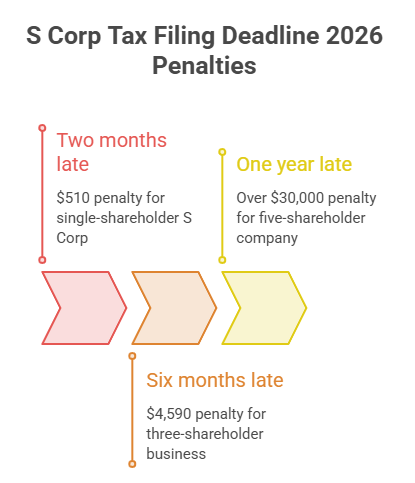
The penalty structure for a late S Corp return is notably harsher than for most other entity types, because it multiplies by both shareholders and months late. Knowing the S Corp tax filing deadline in 2026 can help you avoid these costly penalties.
The IRS assesses $255 per shareholder for every month or partial month your return remains unfiled, up to a maximum of twelve months.
Consider how quickly this scales:
- A single-shareholder S Corp filing two months late faces $510 in penalties.
- A three-shareholder business filing six months late accumulates $4,590.
- A five-shareholder company filing a full year late could face penalties exceeding $30,000.
If you find yourself facing accumulated penalties from a missed deadline, working through IRS tax resolution support early can help you explore options like first-time penalty abatement before the balance grows any larger.
Requesting an Extension Without Losing Track of What Still Comes Due
If you know your business cannot meet the March deadline, filing Form 7004 pushes your return out six months to September 15, 2026. This extension applies to your filing paperwork only, not to any tax owed, which is a distinction that trips up business owners who assume an extension covers everything.
A few details matter when requesting your extension:
- The extension request itself must be submitted by the original March 16 deadline.
- Schedule K-1s must still be issued to shareholders by the extended deadline if you file late.
- Any tax liability at the corporate level, such as built-in gains tax, still accrues interest from the original due date.
Tracking Shareholder Quarterly Payments Alongside Your Corporate Deadline
Because S Corporations do not pay federal income tax at the entity level, your tax liability passes through to shareholders, who then carry their own quarterly estimated payment obligations if they expect to owe $1,000 or more for the year. This creates two parallel calendars that shareholders sometimes confuse or forget entirely.
Understanding the S Corp tax filing deadline in 2026 means keeping both your corporate filing deadline and shareholder payment dates on track. Your shareholder-level 2026 payment dates include:
- April 15, 2026, for the first quarterly payment, aligning with the individual filing deadline.
- June 15, 2026, for the second quarterly installment.
- September 15, 2026, for the third payment, which lands on the same day as your extended corporate deadline.
- January 15, 2027, for the fourth and final quarterly payment.
Keeping these shareholder obligations connected to your corporate filing through proper individual tax preparation prevents the disconnect that happens when your business return and your personal return get treated as entirely separate processes.
Why W-2 Deadlines Matter Even for Shareholder-Employees
If you pay yourself a reasonable salary as an S Corp shareholder-employee, you still carry standard payroll reporting obligations. W-2 forms must be issued to yourself and any other shareholder-employees and filed with the Social Security Administration by February 2, 2026.
Missing this earlier deadline creates a domino effect, since your W-2 figures feed directly into both your corporate return and your personal filing, and errors caught late require corrections across multiple documents at once.
Keeping Your Books Ready Before Deadline Season Arrives
The single biggest factor in hitting your March deadline comfortably is whether your books were accurate and current throughout the year, rather than reconstructed in a rush during February.
S Corporations with clean, reconciled records move through tax preparation far faster than those piecing together transactions from scattered statements.
Zahra Samji works directly with Houston S Corp owners, keeping their bookkeeping current and organized throughout the year, so the March deadline arrives as a routine filing instead of a scramble against penalties that grow by the day.
Conclusion
Staying ahead of your S Corp tax filing deadline in 2026 protects you from penalties that compound quickly and unnecessarily.
When you track your March filing date, understand how extensions work, and keep shareholder quarterly payments aligned with your corporate calendar, tax season becomes predictable instead of stressful.
If you want a clear, personalized deadline calendar for your S Corporation, reach out to book a consultation with Zahra and file this year with confidence.
S Corp Tax Filing Deadline 2026 FAQs
What happens if I file my S Corp return one day late?
Even a single day late counts as a full month for penalty purposes, so you would owe $255 per shareholder for that partial month.
Does filing an extension stop penalties from accruing?
An extension prevents late filing penalties as long as you submit it by the original deadline, but any tax owed still accrues interest from March 16.
Can I still make an S election if I missed the deadline?
Late election relief is available in certain circumstances, so it is worth discussing your specific timeline with a CPA before assuming the option is closed.
Do all shareholders need to receive their K-1 by the same date?
Yes, all Schedule K-1s must be distributed by your filing deadline, whether that is the original March date or your extended September date.
Is first-time penalty abatement available for late S Corp filings?
Yes, taxpayers with a clean compliance history may qualify for first-time abatement, which can significantly reduce or eliminate an otherwise steep penalty.

