
Missing a tax deadline as an S-corporation owner is not just an inconvenience. It triggers an S-Corp late filing penalty that compounds quickly, especially when your return covers multiple shareholders.
These penalties are applied per shareholder, per month, so the cost of a single missed deadline grows fast depending on your ownership structure.
This blog breaks down how these penalties work, where most S Corps go wrong, and what your options are once a penalty has been assessed.
How the IRS Calculates the Penalty Per Shareholder
Most business owners are surprised to learn that the S-Corp late filing penalty is not a flat fine. The IRS applies it at $235 per shareholder, per month (as of the 2024 tax year), for up to 12 months. That means if your S Corp has four shareholders and you file three months late, your exposure is $235 x 4 x 3, which adds up to $2,820.
Here is what makes this worse: this penalty applies even if your S Corp owes no taxes. It is a failure-to-file penalty, not a failure-to-pay one. Your income level, your profitability, and your payment history do not reduce it automatically.
The penalty is assessed on Form 1120-S, the S Corporation’s annual information return. The IRS expects this to be filed by March 15th for calendar-year S Corps. Extensions are available, but they must be filed on time using Form 7004.
The Deadline Mistake That Trips Up S Corp Owners Every Year
The March 15th deadline catches many business owners off guard because it is a full month earlier than the individual return deadline. If your accountant or bookkeeper is primarily focused on personal returns, your S Corp filing can fall through the cracks.
A missed Form 1120-S also delays Schedule K-1s for every shareholder. Without K-1s, shareholders cannot accurately complete their individual returns, which can cascade into additional late filing issues on the personal side.
Quick Overview of S-Corp Late Filing Penalty
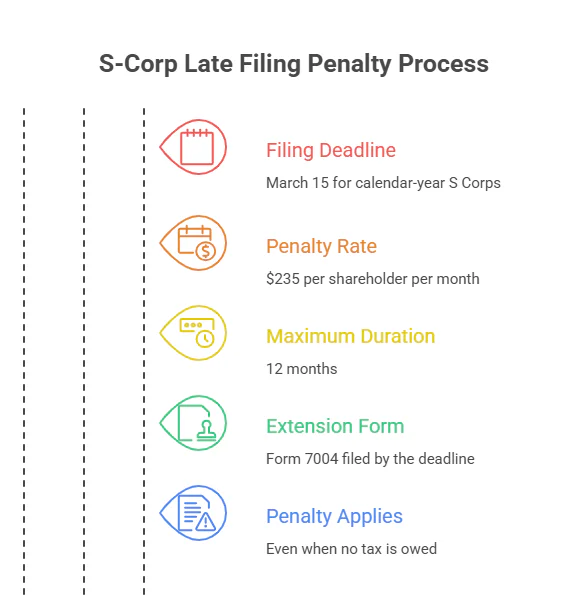
- Penalty rate: $235 per shareholder, per month.
- Maximum duration: 12 months.
- Filing deadline: March 15 (calendar-year S Corps)
- Extension form: Form 7004 (must be filed by the original deadline)
- Applies even when no tax is owed.
If your S Corp has outstanding years or has not been filing on time, getting back into compliance is the priority. We can help you understand where you stand. Check our S-corp tax preparation services.
First-Time Penalty Abatement and What It Actually Requires
The IRS offers a First-Time Abatement (FTA) program, and it is one of the most underused relief options available to S-corp owners. If your S Corporation has a clean compliance history with no penalties in the prior three years, you may qualify to have the S-corp late filing penalty waived entirely.
To request FTA, call the IRS directly or submit a written request. The IRS does not apply it automatically. You have to ask.
Beyond FTA, “reasonable cause” abatement covers situations such as:
- A serious illness or death involving the responsible party.
- A natural disaster that disrupted business operations.
- Demonstrated reliance on incorrect professional advice.
These are fact-based reviews. Documentation matters significantly. Simply saying it slipped your mind does not qualify.
If you are dealing with an IRS notice related to a missed S Corp deadline, getting guidance before you respond can make a meaningful difference. Explore how Zahra approaches IRS tax resolution to understand your options.
When S Corp Status Itself Becomes a Filing Risk
There is another layer worth knowing. If your S Corp repeatedly misses filing deadlines or the IRS determines the return is substantially incomplete, your S-corporation election can be put at risk.
Losing S Corp status means the entity may be reclassified as a C corporation, which changes your entire tax structure and eliminates pass-through treatment.
This is not a common outcome, but it is a real one for businesses that have been non-compliant for multiple years. Staying current on Form 1120-S is not just about avoiding the penalty. It is about protecting the tax structure you chose.
If you are evaluating the election and want to understand the compliance requirements before committing, learn more about how we support S Corporation elections.
To Sum It Up
The S-Corp late filing penalty is a cost that adds up fast and feels entirely avoidable in hindsight. Knowing the per-shareholder structure, the March 15th deadline, and your relief options puts you in a much stronger position.
Whether your S Corp is current or behind, getting clear on your obligations now is better than dealing with compounding penalties later. Houston CPA Zahra Samji is here to help you work through the specifics.
FAQs
Can the IRS waive an S corporation late filing penalty if I have a good reason?
Yes, through either first-time abatement or a reasonable cause request. You must proactively contact the IRS and provide supporting documentation, as it is not applied automatically.
Does the penalty apply if my S Corp had zero income for the year?
Yes. The failure-to-file penalty is not tied to income or tax owed. It applies regardless of whether your S Corp was profitable or active during the year.
What happens if multiple years of Form 1120-S are unfiled?
The IRS can assess the penalty for each year independently, up to 12 months per year per shareholder. Exposure across multiple unfiled years can become substantial.
Is a six-month extension available for S Corp returns?
Yes, Form 7004 extends the deadline to September 15th, but it must be submitted by March 15th and does not extend the time to pay any taxes owed.
Does filing late affect my shareholders' individual returns?
Yes. Late filing of Form 1120-S delays Schedule K-1 delivery, which can push back shareholders’ individual return timelines and potentially trigger additional late-filing issues on the personal side.

