

Running a law firm means managing two very different worlds at once: legal obligations to your clients and financial obligations to regulators.
While your focus stays on case outcomes and client representation, the numbers running in the background demand just as much precision. Proper law firm bookkeeping is not optional for a practice that wants to stay in good standing. In fact, it is a compliance requirement with real consequences when it is done poorly.
From trust account management to payroll tax filings, every financial record your firm keeps is either building or undermining your compliance position.
Why Trust Account Errors Are the Costliest Bookkeeping Mistake Law Firms Make
Most conversations about bookkeeping for legal practices jump straight to expense tracking or profit margins. But the area that creates the most serious compliance risk for attorneys is trust account management, specifically, the mishandling of IOLTA (Interest on Lawyers’ Trust Accounts).
Your trust account holds client funds, not your firm’s money. That distinction has to be reflected perfectly in your books. Combining trust funds with operating funds, even by accident, can trigger a state bar investigation, disciplinary action, or license suspension.
These are not theoretical risks, as bar associations across the country regularly cite commingling as one of the most common causes of attorney discipline.
What proper trust accounting looks like in practice:
- Separate ledgers for every client matter holding trust funds.
- Three-way reconciliation between your client ledger, trust account ledger, and actual bank statement is completed monthly.
- Zero tolerance for negative balances in any individual client sub-ledger.
- Clear documentation of every deposit, disbursement, and transfer tied to a specific matter.
If your current books cannot produce a clean three-way reconciliation on demand, that is a gap your firm needs to close before regulators or auditors find it first.
How Law Firm Bookkeeping Directly Affects Your Tax Compliance Position
Beyond bar compliance, your books determine how accurately your firm files and how defensible those filings are in an audit. Whether structured as a sole proprietorship, partnership, S-Corp, or LLC, your taxable income is only as accurate as your records.
A common issue for smaller practices is the distinction between revenue recognition and cash received. If your firm uses contingency fees, multi-year retainers, or deferred billing, your bookkeeping method, such as cash vs. accrual, directly affects what income is reported and when.
| Accounting Method | Revenue Recognized | Common For |
| Cash Basis | When payment is received | Smaller, simpler practices |
| Accrual Basis | When services are rendered | Larger firms with complex billing |
| Modified Cash Basis | Hybrid approach | Mid-size practices with mixed billing |
Getting this wrong does not just create an IRS problem. It distorts your profit and loss reports, makes quarterly estimated tax payments unreliable, and leaves you scrambling at year-end.
Well-maintained Houston bookkeeping services that are structured around your firm’s billing model can prevent these gaps before they compound.
Payroll Tax Obligations That Legal Practices Often Underestimate
Law firms that employ associates, paralegals, or support staff carry the same payroll tax responsibilities as any other employer, but the compliance stakes feel higher when the entity holding professional licenses is also the one that might face penalties for late filings.
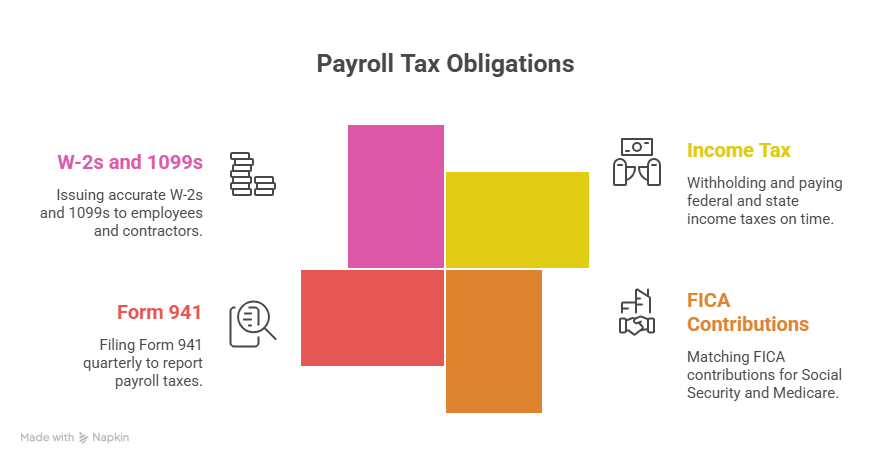
As an employer, your firm is in charge of:
- Withholding and paying both federal and state income taxes on time.
- Matching FICA contributions (Social Security and Medicare).
- Filing Form 941 quarterly to report payroll taxes.
- Issuing accurate W-2s to all employees and 1099s to independent contractors by IRS deadlines.
A common mistake in law firm bookkeeping, especially in firms with a mix of associates and contract attorneys, is misclassifying workers. Classifying an employee incorrectly as an independent contractor shifts payroll tax responsibility onto them, and when the IRS reclassifies that relationship, your firm absorbs back taxes, interest, and penalties.
The Chart of Accounts Structure That Makes Legal Bookkeeping Audit-Ready
One angle that gets almost no attention in most law firm financial guides is the chart of accounts. Your chart of accounts is the organizational backbone of your entire financial reporting structure, and a generic, out-of-the-box setup from accounting software rarely accounts for the realities of legal practice.
A compliance-ready chart of accounts for a law firm should include:
- Separate liability accounts for client trust funds (not lumped into general liabilities).
- Matter-level expense tracking to capture costs advanced on behalf of clients.
- Revenue accounts segmented by practice area, if your firm handles multiple specialties.
- Expense accounts that distinguish between deductible business expenses and non-deductible items.
When your chart of accounts is built correctly from the start, your accounting services Houston produce financial statements that are clean, defensible, and genuinely useful for firm management, not just a required annual exercise.
Conclusion
Your law firm carries a standard of professional responsibility in everything it does, and your financial records are no different.
Compliance is not just about avoiding penalties. With proper law firm bookkeeping, compliance becomes more than just avoiding penalties. It supports the reputation and licensure that your practice depends on.
If your trust accounts, payroll filings, and tax records are not getting the same level of precision that you bring to your casework, that gap is a liability worth addressing now.
At Skyline Financial, our licensed Houston CPA, Zahra Samji, works directly with professionals who need financial clarity without the confusion. If your firm’s books need a sharper structure or your compliance position needs a second look, reach out today, and let’s make sure your numbers reflect the integrity that your firm stands for.
Schedule a consultation with law firm CPA Houston today!
Law Firm Bookkeeping FAQs
How often should a law firm reconcile its trust accounts?
Most state bar guidelines require monthly trust account reconciliation, often using a three-way format. Waiting until year-end increases compliance risk, as even one month of missed discrepancies can grow into a larger issue.
What accounting method should law firms use, cash basis or accrual?
Most small- to mid-size firms use the cash basis method since it matches income with payments received. Firms with complex billing or long-term cases may benefit from accrual or a modified cash basis for clearer financial reporting.
What are the requirements for filing payroll taxes for a law firm with employees?
Firms must file Form 941 quarterly, remit payroll taxes based on IRS schedules, and issue annual W-2s. They must also provide 1099-NEC forms for contractor payments of $600 or more.
Can poor bookkeeping put my law license at risk?
Yes, especially with trust account mismanagement. Poor law firm bookkeeping can lead to commingling client and operating funds, which is a serious violation, so maintaining accurate, compliant books helps protect your professional standing.

