

If you are reviewing your financial statements and wondering how to calculate retained earnings, you are already thinking like a strategic business owner.
Retained earnings reflect the portion of your company’s net income that remains after dividends or owner distributions are paid. This figure directly impacts your equity, reinvestment capacity, and long-term financial stability.
Understanding how retained earnings work helps you evaluate profitability beyond monthly cash flow. It also strengthens your decision-making when planning expansion, distributions, or debt repayment.
Let’s discuss the formula, examples, and practical considerations that are essential for you to know as a business owner.
How To Calculate Retained Earnings Using The Core Formula
The formula itself is straightforward:
Beginning Retained Earnings + Net Income (Profit or Loss) – Dividends or Owner Distributions = Ending Retained Earnings
This calculation appears on your balance sheet under shareholders’ equity.
Each component matters:
- Beginning retained earnings come from the prior accounting period.
- Net income comes from your income statement.
- Dividends or distributions reduce retained earnings because profits are paid out rather than reinvested.
If your books are not reconciled properly, the calculation will be inaccurate. Reliable financial reporting is essential before you rely on retained earnings data.
Example Calculation for Practical Clarity
Consider this example:
- Beginning retained earnings: $80,000
- Net income for the year: $50,000
- Owner distributions: $20,000
Calculation:
80,000 + 50,000 – 20,000 = 110,000
Your ending retained earnings would be $110,000.
This amount represents cumulative profits that remain in the business. It does not necessarily equal your cash balance, which is a common misconception.
Why Retained Earnings Do Not Equal Cash
One area that is misunderstood involves the difference between retained earnings and available cash.
Retained earnings are an equity figure. Cash is an asset.
You may show strong retained earnings while having limited cash because funds may be tied up in:
- Accounts receivable.
- Inventory
- Equipment purchases.
- Debt repayments.
This distinction is critical when evaluating whether your business can afford distributions or expansion.
If you rely solely on your bank balance without reviewing equity figures, your decisions may lack a full financial context.
The Impact Of Dividends and Distributions on Retained Earnings
If your business pays dividends or owner distributions, those payments reduce retained earnings.
For corporations, dividend income must be reported properly. If you receive dividends personally, understanding how dividend income is taxed ensures your personal return aligns with corporate reporting.
For S Corporations and LLCs, distributions reduce equity but are not necessarily taxable at the time of distribution, depending on basis calculations.
Accurate tracking is essential to prevent equity imbalances or shareholder disputes.
How to Calculate Retained Earnings for Growing Businesses
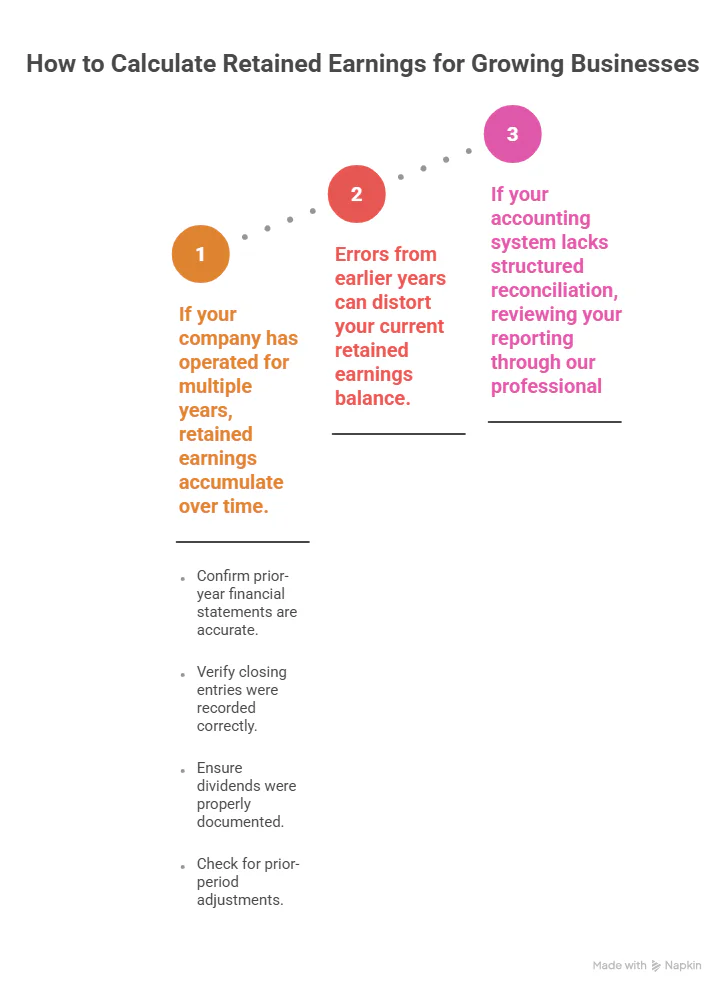 If your company has operated for multiple years, retained earnings accumulate over time.
When reviewing historical data, you should:
- Confirm prior-year financial statements are accurate.
- Verify closing entries were recorded correctly.
- Ensure dividends were properly documented.
- Check for prior-period adjustments.
Errors from earlier years can distort your current retained earnings balance.
If your accounting system lacks structured reconciliation, reviewing your reporting through our professional accounting services Houston can help correct discrepancies before they compound further.
Retained Earnings and Loan Approvals
Lenders review retained earnings when evaluating your creditworthiness.
Strong retained earnings may indicate:
- Sustainable profitability.
- Conservative distribution practices.
- Reinvestment in business operations.
Negative retained earnings, also known as an accumulated deficit, may signal operational challenges.
If you plan to apply for financing, reviewing this figure beforehand allows you to prepare supporting documentation and explain performance trends.
Negative Retained Earnings and What They Mean
Negative retained earnings occur when cumulative losses exceed cumulative profits.
This does not automatically mean your business is failing. It may result from:
- Startup losses.
- Significant reinvestment.
- Temporary downturns.
However, prolonged negative balances require analysis.
You should evaluate:
- Expense structure.
- Pricing strategies.
- Revenue growth.
- Debt obligations.
Understanding the root cause allows you to adjust strategically rather than react emotionally.
Timing Considerations At Year End
Closing entries at year’s end directly affect retained earnings.
You must:
- Close revenue accounts to retained earnings.
- Close expense accounts properly.
- Record dividends accurately.
Improper closing entries create equity discrepancies that carry forward into the next year.
How Retained Earnings and Paid-In Capital Impact Your Equity Structure
Another frequently overlooked topic involves distinguishing retained earnings from paid-in capital.
- Paid-in capital reflects funds invested by owners.
- Retained earnings reflect profits generated internally.
Separating these figures allows you to evaluate whether growth is driven by operational success or owner contributions.
Investors and lenders assess this ratio to determine your business’s sustainability.
Strategic Tips for Managing Retained Earnings
Understanding how to calculate retained earnings is only the first step. Managing them strategically is equally important.
You should consider:
- Setting distribution policies.
- Maintaining adequate reserves.
- Aligning reinvestment with growth plans.
- Monitoring debt-to-equity ratios.
Reinvesting profits strengthens long-term growth, but over-distribution can limit flexibility during downturns.
Balancing reinvestment with owner compensation requires you to have thoughtful financial planning.
Conclusion
If you have been asking how to calculate retained earnings, the answer lies in understanding the formula, reviewing accurate financial data, and interpreting what the number truly represents. Retained earnings reflect cumulative profitability and reinvestment decisions, not simply your cash balance.
When tracked correctly, this figure provides insight into financial stability, growth capacity, and equity strength. When miscalculated, it can distort your entire balance sheet.
If you want more insight into your financial statements or need help reconciling retained earnings accurately, schedule a consultation with Houston CPA Zahra Samji today.
She will evaluate your records, correct discrepancies, and make sure your financial reporting supports confident business decisions moving forward.
FAQs
- How often should retained earnings be calculated?
They are typically updated at the end of each accounting period, often monthly or annually.
- Can retained earnings be distributed anytime?
Distributions depend on entity type, available profits, and compliance requirements.
- Why are my retained earnings negative?
Negative retained earnings usually reflect accumulated losses or significant distributions exceeding profits.
- Are retained earnings taxable?
Profits are taxed when earned, not when retained. However, entity type affects tax treatment.
- Do retained earnings appear on the income statement?
No. They appear on the balance sheet under shareholders’ equity.

