

Are you running a dental practice? If so, then you are managing clinical schedules, patient care, insurance billing, and staff coordination all at once.
Bookkeeping services for dentists are not just about recording transactions. They are about building a financial system that reflects how a dental practice generates and spends money, which looks nothing like a standard small business.
This blog covers how dental-focused bookkeeping saves time, reduces errors, and gives you the visibility your practice needs.
Why Dental Revenue Cycles Create Bookkeeping Complexity That General Services Miss
Your revenue does not flow the way a typical business revenue does. You produce services at the chair, bill insurance carriers and patients separately, receive reimbursements at contracted rates that differ from your fee schedule, and write off the difference.
A bookkeeper unfamiliar with dental billing will record insurance write-offs as expenses, misstate your net collections, and produce reports that do not reflect what your practice earns.
Items requiring dental-specific bookkeeping treatment:
- Insurance adjustments are recorded as revenue contra entries, not expense line items.
- Accounts receivable are tracked separately by insurance AR and patient AR, so aging reports are meaningful.
- Unearned revenue from prepaid treatment plans or membership programs is recorded as a liability until services are rendered.
- Production versus collection metrics maintained alongside standard financial statements.
When these items are handled correctly, your profit and loss gives you a real picture of profitability. When they are not, you are making staffing and expansion decisions on numbers that do not reflect your practice.
How Treatment Mix Affects Overhead Allocation and What Your Books Should Show
Dental practices offering general dentistry alongside specialty procedures carry different cost structures by service line. A practice producing significant implant revenue has higher lab costs than one focused on preventive care. Your books should reflect this, not just total revenue against total expenses.
Proper overhead allocation by treatment category gives you:
- Lab fee percentages benchmarked against restorative and prosthetic case revenue.
- Supply costs are tracked by clinical area rather than one consolidated supply expense.
- Associate compensation is mapped to the procedures they generate.
This level of detail requires someone who understands dental production and how costs move with your case mix. Skyline’s dental accounting services are built around that specificity.
The Insurance Fee Schedule Problem Most Bookkeepers Never Address
Every time you add a new insurance plan or renegotiate fee schedules, your revenue model changes. Most bookkeeping services record what comes in without tracking whether collections align with your contracts.
Underpayments from carriers go undetected for months when billed fees, contracted rates, and posted payments are not reconciled regularly.
A dental-specific bookkeeping setup should include:
- A reconciliation process matching insurance payments against contracted fee schedules for top payers.
- Write-off tracking by insurance plan so you can identify which contracts are least profitable.
- A process for flagging payment discrepancies before the claim window closes.
This directly affects your collection rate and practice profitability.
What Dental Staff Payroll Should Look Like in Your Books
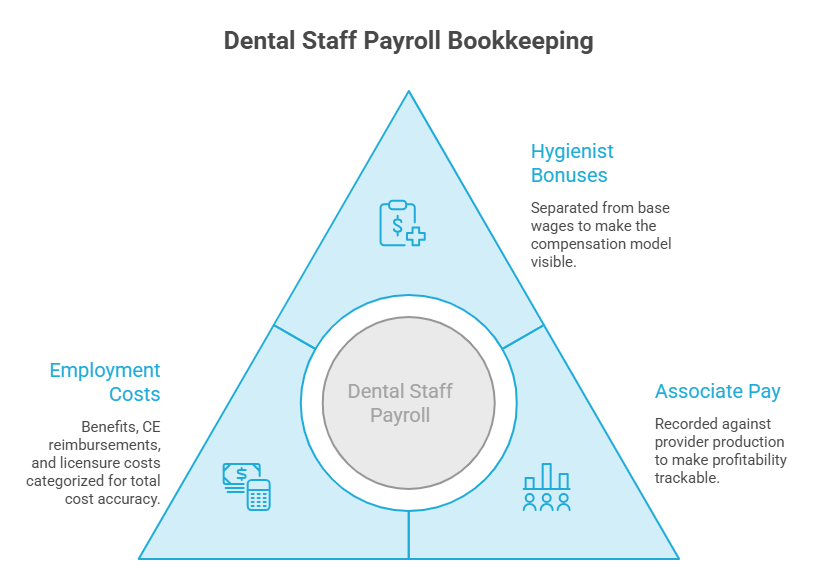
Dental practice payroll is more complex than in most industries. You have front office staff, assistants, hygienists on salary or production-based compensation, and potentially associates on percentage agreements. Recording these correctly is what makes your labor cost analysis meaningful.
Bookkeeping services for dentists should capture payroll with these distinctions:
- Hygienist production bonuses are separated from base wages, so your compensation model is visible.
- Associate pay is recorded against the production that the providers generate, making profitability by provider trackable.
- Benefits, CE reimbursements, and licensure costs are categorized separately for accurate total employment cost.
Zahra Samji at Skyline Financial sets up your practice books with the payroll structure that supports both your tax return and your management decisions. When bookkeeping services for dentists are structured correctly, your year-end work becomes a review rather than a reconstruction.
Year-End Bookkeeping and the Tax Implications That Come with It
Before your tax return is prepared, your books need to confirm that specific transactions were handled correctly:
- Equipment purchases are coded to the correct asset accounts for depreciation under Section 179 or bonus depreciation.
- Lease payments separated from CAM charges, tenant improvement reimbursements, or equipment lease obligations.
- Owner compensation is documented correctly, especially if your practice operates as an S corporation.
Any mismatch between how these items are recorded and how they appear on your return adds time and cost. Keeping bookkeeping aligned with your tax position is what dental bookkeeping is designed to prevent.
If your books need to be in order before your CPA starts, explore Skyline’s tax preparation services to see how both sides work together.
To Conclude
Bookkeeping services for dentists build the financial infrastructure that supports your billing process, staffing decisions, overhead management, and year-end tax return.
When your books are structured around how a dental practice generates and spends money, the clarity you gain translates into better decisions and lower costs.
If your practice is ready for bookkeeping built for dentistry, work directly with Zahra Samji at Skyline Financial CPA to get your financial foundation set up correctly.
Bookkeeping Services for Dentists FAQs
What makes bookkeeping for dental practices different from general small business bookkeeping?
Dental practices require specific treatment of insurance adjustments, production versus collection tracking, lab fee allocations, and provider-level payroll. A general bookkeeper records transactions without these distinctions, producing reports that do not reflect how your practice earns and spends money.
How should insurance write-offs be recorded in a dental practice?
Insurance write-offs should be recorded as revenue adjustments, not expenses. Recording them incorrectly overstates net revenue and distorts overhead percentages, making it impossible to benchmark your practice against dental industry standards.
Do bookkeeping services for dentists include accounts receivable management?
Bookkeeping tracks and categorizes AR balances, but active collections follow-up is handled by your billing team. Your bookkeeper should maintain aging reports that separate insurance AR from patient AR so you know where outstanding balances are concentrated.
Can dental practice bookkeeping support my S corporation payroll structure?
Yes. If your practice operates as an S corporation, your books should track owner compensation separately from distributions, and associate pay should be mapped to the production those providers generate, supporting your tax return and internal analysis.
How does clean bookkeeping reduce my year-end tax preparation costs?
When your dental practice books are maintained correctly, your CPA reviews and files your return rather than reconstructing records. Equipment depreciation, lease classifications, and owner compensation are already documented, reducing time and cost significantly.

