

A single job going over budget can eat into profit from three other projects that were running smoothly, and you will not know it happened until the numbers are already in the past.
That is exactly why bookkeeping for construction companies looks nothing like bookkeeping for a typical retail or service business.
Your revenue and expenses move project by project, which means generic accounting methods leave you guessing at your true profitability until it is too late to fix.
Why Job Costing Changes Everything About Your Bookkeeping for a Construction Business
Standard bookkeeping tracks income and expenses at the company level, but that view tells you almost nothing useful when you are running five projects simultaneously with different margins, timelines, and risk profiles.
Job costing breaks every dollar down to the specific project it belongs to, giving you a clear picture of which jobs are earning money and which are quietly draining it.
Without this level of detail, you run into predictable problems:
- Labor costs get lumped together across projects instead of being assigned to the specific job site.
- Material overages on one project go unnoticed because they blend into your overall expense totals.
- You cannot compare estimated costs against actual costs to improve future bidding accuracy.
When your books are structured around individual jobs from day one, you catch cost overruns while there is still time to adjust the project rather than discovering the damage after final billing. This job-level structure is the backbone of proper bookkeeping for construction companies of any size.
Tracking Retainage Without Losing Sight of Your Cash Position
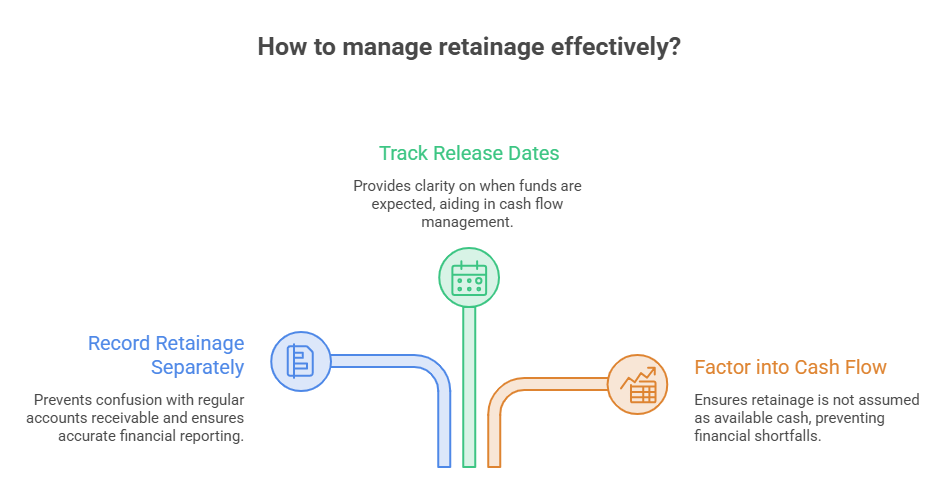
Retainage, the portion of payment your clients hold back until project completion, creates a cash flow trap for contractors who do not track it separately from their regular receivables.
That withheld amount, typically five to ten percent of the contract value, can represent tens of thousands of dollars sitting outside your immediate cash flow for months at a time.
A few practices keep retainage from catching you off guard:
- Record retainage as a separate receivable, not as part of your regular accounts receivable balance.
- Track release dates tied to specific milestones so you know when funds should arrive.
- Factor outstanding retainage into your cash flow projections, and do not assume it as available cash.
Miscounting retainage as spendable cash is one of the fastest ways a profitable-looking project turns into a cash crunch mid-quarter, which is why accurate bookkeeping for construction companies treats retainage as its own line item from the start.
Choosing the Right Revenue Recognition Method for Your Projects
How you recognize revenue affects both your financial statements and tax timing, and the right method depends on your contract length and project size.
Smaller contractors may qualify for the completed contract method, while larger or longer projects typically require the percentage-of-completion method. This decision shapes how your financial statements look to bonding companies, lenders, and clients.
Working with a firm that understands construction accounting services in Houston helps ensure your revenue recognition method matches your contract structure.
Equipment Depreciation Decisions That Affect Your Tax Bill
Heavy equipment represents one of the largest capital investments in construction, and how you depreciate it carries real tax consequences. Accurate bookkeeping for construction companies helps track these assets and supports the right depreciation strategy.
Section 179 and bonus depreciation both allow accelerated deductions in the year of purchase, but choosing between them depends on your income timing and long-term tax strategy, not just which option sounds better on paper.
Getting this wrong in either direction creates problems:
- Overusing accelerated depreciation in a low-income year wastes deduction value you could have used later.
- Failing to properly categorize equipment versus tools can misstate your depreciation schedule entirely.
- Inconsistent tracking makes it harder to calculate gain or loss accurately when you eventually sell equipment.
Managing Subcontractor Payments Without Compliance Headaches
Most construction companies work with a rotating roster of subcontractors, and each one requires accurate 1099 tracking throughout the year.
Missing a filing deadline or misclassifying a subcontractor as an employee creates penalty exposure that grows the longer it goes unaddressed.
Staying organized here means:
- Collecting a completed W-9 before the first payment goes out, not after the year ends.
- Tracking cumulative payments per subcontractor throughout the year, not just at tax time.
- Reviewing whether your working relationship still reflects a contractor rather than an employee.
Proper year-round bookkeeping through structured tax accounting services keeps subcontractor records current, so the 1099 season becomes a formality instead of a scramble through a year of scattered payment records.
Why Construction Bookkeeping Benefits From Industry-Specific Support
General accountants who handle a wide mix of clients miss the nuances that make construction financially distinct, from retainage treatment to percentage-of-completion calculations that require real judgment, not just a formula.
Zahra Samji works directly with Houston contractors who need someone who understands how job costing, equipment depreciation, and cash flow timing interact throughout a project’s lifecycle.
She takes the time to understand your specific contract types and project sizes, so your books reflect how your business operates. Contact Zahra today to keep your construction finances organized and your projects on track year-round.
Last Thoughts
Managing job costs effectively comes down to visibility. When your bookkeeping for construction companies tracks labor, materials, retainage, and equipment at the project level, you know exactly where your profit is coming from and where it is quietly slipping away.
That clarity protects your margins, strengthens your bidding accuracy, and gives you the financial documentation that bonding companies and lenders expect to see. Building this foundation now protects every project you take on going forward.
FAQs About Bookkeeping for Construction Companies
What is the biggest bookkeeping mistake construction companies make?
Failing to track costs at the individual job level makes it impossible to know which projects are profitable.
How should retainage be recorded in my books?
As a separate receivable distinct from your regular accounts receivable, since it will not be collected until specific milestones are met.
Can I switch revenue recognition methods once I have started using one?
Changing methods requires IRS approval in most cases, so the decision should be made carefully with your specific contract sizes in mind.
Do I need different bookkeeping for residential versus commercial projects?
The core principles stay the same, but commercial projects involve more complex retainage and longer timelines that require closer tracking.
How often should I review job costing reports during an active project?
Monthly reviews are the minimum, though weekly reviews on larger projects catch cost overruns before they become significant.

