

When you review your medical bills at the end of the year, it is natural to ask, “Are health expenses tax-deductible?” The answer is yes in many cases, but only if you meet specific IRS requirements. Learning about those requirements can make a meaningful difference in your taxable income and overall refund strategy.
Medical deductions are not automatic. You must qualify, itemize correctly, and document every expense carefully. If you overlook thresholds or misclassify payments, you could lose out on legitimate tax savings or invite unnecessary scrutiny.
Below, we break down what the IRS allows, where taxpayers make mistakes, and how you can approach this deduction strategically.
Are Health Expenses Tax-Deductible Under IRS Threshold Rules
The first technical rule you need to understand is the adjusted gross income threshold. For most taxpayers, you can deduct qualified medical expenses only to the extent that they go beyond 7.5 percent of your adjusted gross income (AGI).
This means:
- If your AGI is $100,000, only medical expenses above $7,500 are deductible.
- If your AGI is $60,000, expenses above $4,500 may qualify.
This threshold is where many taxpayers miscalculate. It is not the total amount of your medical bills that becomes deductible. It is only the portion that exceeds the 7.5 percent floor.
You must also itemize deductions on Schedule A instead of claiming the standard deduction. If your total itemized deductions do not surpass the standard deduction, claiming medical expenses may not reduce your tax liability at all. This is why tax planning is more important than just collecting receipts.
What Medical Expenses Qualify For Deduction
The IRS’s definition of qualified medical expenses is broader than many people assume, yet narrower in other areas. The key test is whether the expense was mainly for the diagnosis, cure, mitigation, treatment, or prevention of disease.
Below is a simplified breakdown.
| Qualified Expenses | Generally Not Deductible |
| Doctor and hospital bills | Cosmetic surgery (unless medically necessary) |
| Prescription medications | Over-the-counter vitamins (unless prescribed) |
| Medical insurance premiums (in certain cases) | General wellness programs |
| Dental and vision care | Non-medical spa treatments |
| Mileage for medical travel | Childcare while attending appointments |
This list is not completely comprehensive, but it highlights common areas of confusion. For example, medically necessary procedures may qualify even if they appear cosmetic.
Documentation from your healthcare provider becomes essential in those situations.
Insurance Premiums and Pre-Tax Contributions
One area often misunderstood involves health insurance premiums, especially when taxpayers ask, “Are health expenses tax-deductible in every situation?”
If you pay premiums with after-tax dollars, you may be able to include them as a medical expense. However, if your premiums are already deducted from your paycheck on a pre-tax basis through your employer, you cannot deduct them again.
This double-dipping error is common.
If you are self-employed, special rules apply. Premiums may qualify as an above-the-line deduction rather than an itemized medical expense.
If you are unsure how your premiums were treated, this is where professional guidance can prevent mistakes. We commonly see overlaps between medical deductions and other areas, such as disability taxes, particularly when benefits and medical costs intersect.
Long-Term Care and Specialized Treatments
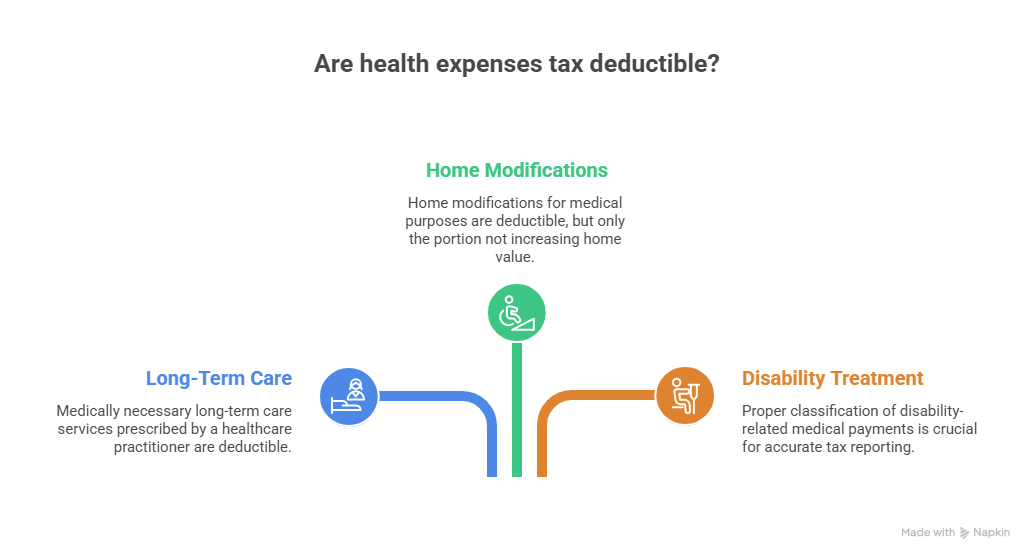
Qualified long-term care services can be deductible if they are medically necessary and prescribed by a licensed healthcare practitioner.
Additionally, certain home modifications may qualify if they are made for medical purposes. For example:
- Installing wheelchair ramps.
- Widening doorways.
- Adding handrails or safety bars.
However, only the portion that does not increase your home’s overall value is deductible. That calculation requires careful documentation and sometimes appraisal support.
If you or a family member receives disability-related medical treatment, classification becomes even more important. Mislabeling payments could affect both medical deductions and disability income reporting.
Medical Expenses for Dependents and Family Members
You can deduct qualified medical expenses paid for:
- Yourself.
- Your spouse.
- Your dependents.
Even if your dependent does not live with you full-time, you may still qualify under IRS dependency rules. In certain cases, you can deduct expenses for a child even if the other parent claims the child as a dependent, provided you paid the medical costs and the child otherwise meets dependency tests.
The timing of payments also matters. You deduct expenses in the year you paid them, not necessarily the year services were provided.
Timing Strategies and Bunching Deductions
If you are wondering, “Are health expenses tax-deductible?” the strategic question becomes whether you should accelerate or delay certain payments.
Some taxpayers benefit from “bunching” medical expenses into one tax year. For example:
- Scheduling elective procedures within the same calendar year.
- Prepaying certain treatments if allowed.
- Coordinating major dental or vision work.
By concentrating expenses in one year, you may exceed the 7.5 percent AGI threshold more easily. In lower-expense years, you might revert to the standard deduction.
This type of forward-looking strategy is where structured tax planning provides more value than reactive tax filing.
Recordkeeping Standards You Should Follow
The IRS expects substantiation for all medical deductions. You should maintain:
- Detailed invoices.
- Proof of payment.
- Insurance explanation of benefits.
- Prescription documentation when required.
- Mileage logs for medical travel.
Digital copies are acceptable, but they must be clear and organized. A spreadsheet summary alone is not sufficient if audited.
In Summary
Are health expenses tax-deductible? Understanding whether this applies to your situation requires more than reading a general list of qualifying expenses. Income thresholds, timing, reimbursements, and documentation standards all influence the final result.
Schedule a consultation with our Houston CPA, Zahra Samji, and receive tailored guidance based on your full financial background. Thoughtful planning today can protect your refund and prevent costly filing errors tomorrow!
FAQs
- Do I need to itemize to deduct medical expenses?
Yes. You must itemize deductions on Schedule A. If you choose the standard deduction, you cannot deduct medical expenses separately.
- Can I deduct medical expenses paid with a credit card?
Yes. You deduct the expense in the year you charged it, not when you pay off the credit card balance.
- Are health insurance premiums always deductible?
Not always. If your employer pays your premiums with pre-tax dollars, they are not deductible again.
- Can I deduct medical expenses for elderly parents?
If your parent qualifies as your dependent under IRS rules, you may deduct eligible medical expenses you paid on their behalf.
- What happens if my medical deductions are unusually high?
High deductions are allowed if legitimate, but they may increase audit risk. Proper documentation and accurate calculation are essential to support your claim.

