

Missing a single date on your tax calendar can trigger penalties that stack up faster than most business owners expect, which is exactly why tracking every business tax filing deadline in 2026 matters as much as the filing itself.
Your specific dates depend on your entity type, whether you have employees, and whether you requested an extension, so building a calendar around your structure protects you from costly surprises throughout the year.
Why Your Entity Type Determines Your Filing Date
Not every business files on the same schedule, and assuming your deadline matches a competitor’s or a friend’s business can cause you to miss your own date entirely.
Partnerships and S Corporations generally file earlier than sole proprietorships and C Corporations, which catches many first-time business owners off guard.
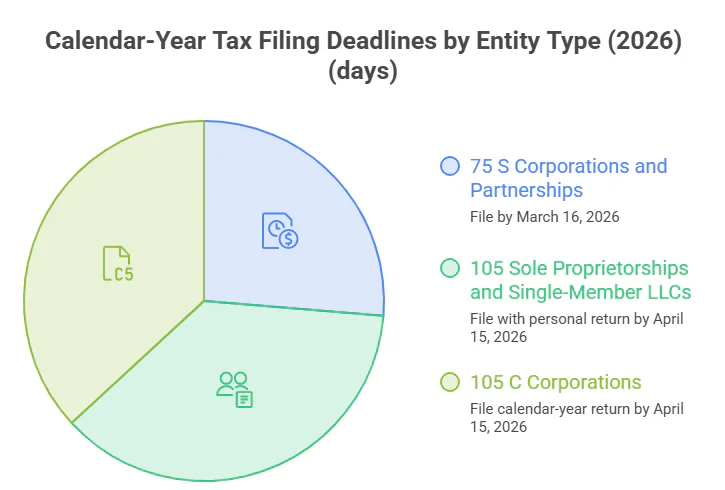
Here is how the standard calendar-year deadlines break down:
- S Corporations and partnerships file by March 16, 2026, since March 15 falls on a Sunday.
- Sole proprietorships and single-member LLCs file with your personal return by April 15, 2026.
- C Corporations file their calendar-year return by April 15, 2026, as well.
Confirming which category your business falls into at the start of the year, rather than assuming, prevents a scramble when the deadline sneaks up faster than expected.
Business Tax Deadline 2026 Dates for Quarterly Estimated Payments
If your business does not withhold taxes automatically, quarterly estimated payments keep you compliant throughout the year instead of facing a massive bill in April.
Missing even one quarterly payment can trigger an underpayment penalty, regardless of whether your total tax bill is eventually paid in full.
Knowing your business tax filing deadline in 2026 also means keeping track of your quarterly estimated payment obligations. Your 2026 quarterly payment dates fall on:
| Quarter | Payment Deadline |
| Q1 2026 | April 15, 2026 |
| Q2 2026 | June 15, 2026 |
| Q3 2026 | September 15, 2026 |
| Q4 2026 | January 15, 2027 |
C Corporations follow a slightly different structure, with an additional fourth-quarter installment due by December 15, 2026, rather than waiting until January like individuals and pass-through entities.
Corporate Tax Deadline 2026 Considerations for Extensions
Requesting an extension buys you more time to file, but it never extends the time you have to pay what you owe. Businesses that treat an extension as a payment delay end up facing penalties and interest on top of their original liability.
Understanding the business tax filing deadline in 2026 is especially important when you file for an extension. Extension deadlines for the 2026 filing season include:
- September 15, 2026, for S Corporations and partnerships that filed for an extension.
- October 15, 2026, for C Corporations and sole proprietorships that filed for an extension.
- Schedule K-1s must still be issued to owners by the applicable extended deadline.
Filing an extension without setting aside funds for your estimated liability is one of the most common mistakes business owners make, since the paperwork extension creates a false sense that the financial obligation has moved too.
Payroll and Contractor Reporting Deadlines You Cannot Miss
If your business employs workers or hires independent contractors, your tax reporting responsibilities go beyond your annual income tax return.
W-2 forms must reach employees, and 1099-NEC forms must reach contractors, by February 2, 2026, since the standard January 31 deadline falls on a Saturday this year.
Payroll tax deposits carry their own separate schedule depending on your deposit frequency, and missing these deadlines triggers penalties that compound the longer they go unaddressed.
Staying current on quarterly payroll filing throughout the year keeps these obligations organized instead of becoming a source of year-end panic when W-2 and 1099 deadlines arrive.
Why Texas Businesses Face an Additional State-Level Deadline
Beyond your federal obligations, Texas businesses carry their own annual filing requirement separate from income tax entirely.
The Texas franchise tax report is due May 15, 2026, and this deadline applies regardless of whether your business ultimately owes tax under the no-tax-due threshold.
Staying organized around your franchise tax filing protects your entity’s good standing with the state, since missing this deadline can eventually lead to forfeiture of your right to operate in Texas, a consequence that catches business owners off guard far more often than federal penalties do.
Building a Calendar That Works for Your Business
Generic deadline lists help, but the real value comes from mapping these dates against your specific entity type, employee count, and state obligations. A business with employees, multiple entities, or operations across state lines faces a more layered calendar than a single-member LLC with no staff.
Working with a CPA who tracks these dates as part of ongoing tax accounting support means deadlines get flagged before they arrive, not discovered after a penalty notice shows up in your mailbox.
Zahra Samji works directly with Houston business owners to build a filing calendar specific to their entity structure, so no deadline slips through the cracks during a busy quarter.
To Sum Up
Staying ahead of every business tax filing deadline in 2026 protects your business from penalties that are almost always avoidable with proper planning.
When you know your entity type’s specific dates, track your quarterly payments, and stay current on both federal and Texas state obligations, tax season becomes a scheduled event rather than a stressful scramble.
If you want a personalized deadline calendar built around your specific business, reach out to schedule a consultation with Zahra and stay compliant all year long.
Business Tax Filing Deadline 2026 FAQs
What happens if I miss my business tax filing deadline in 2026?
You face penalties and interest calculated from the original due date, and continued noncompliance can lead to more serious consequences depending on your entity type.
Does filing an extension give me more time to pay my taxes?
No. An extension only gives you more time to file your paperwork, while any taxes owed are still due on the original deadline.
When do I need to send 1099 forms to my contractors?
1099-NEC forms must be sent to contractors and filed with the IRS by February 2, 2026, for the 2025 tax year.
Are Texas franchise tax deadlines the same as federal deadlines?
No. The Texas franchise tax report is due May 15, 2026, separate from your federal income tax filing deadline.
What if my business does not operate on a calendar year?
Fiscal-year businesses file based on the 15th day of the third or fourth month following the close of their specific tax year, depending on entity type.

