

Every dollar you save on taxes is a dollar that stays in your business instead of leaving for the IRS, yet most business owners only think about tax-saving tips once a year, right before a filing deadline forces the conversation.
Real tax-saving strategies work best when they are built into how you run your business throughout the year, not squeezed into a rushed conversation in March.
The following approaches go beyond the basics and focus on decisions that move the needle on what you keep.
Why Timing Your Income and Expenses Deserves More Attention
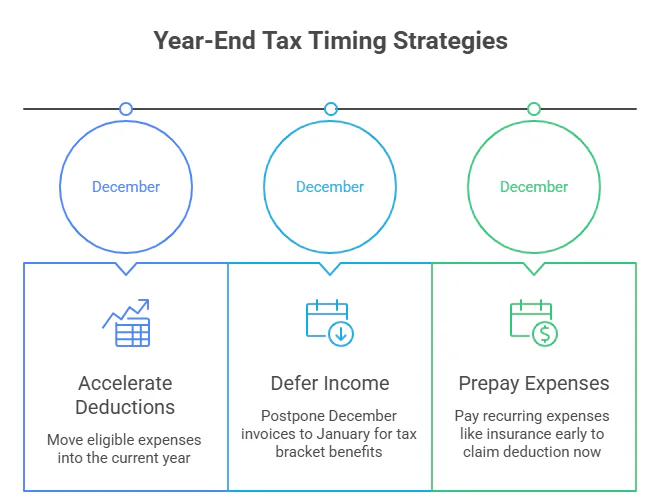
Most business owners treat income and expenses as things that happen throughout the year, without considering that the timing of certain transactions can shift your tax liability significantly.
A few strategic decisions around year-end can change which tax bracket your income falls into and how much you owe.
Consider these timing moves before your fiscal year closes:
- Move eligible deductible expenses into the current year if you expect your income to stay the same or decrease next year.
- Deferring invoices for December work into January if it benefits your overall bracket.
- Prepaying certain recurring expenses like insurance premiums to capture the deduction earlier.
These decisions require planning ahead of your deadline, not reacting once your books are already closed for the year.
Maximizing Retirement Contributions as a Genuine Tax Saving Strategy
Retirement contributions rank among the most underused tax-saving tips available to business owners, largely because people assume the contribution limits mirror what a typical employee sees through a workplace plan.
Business owners have access to significantly higher contribution options through SEP IRAs, Solo 401(k)s, and other structures designed specifically for self-employed individuals and small business owners.
The right plan depends on your business structure and income level:
| Plan Type | Best For | Contribution Advantage |
| SEP IRA | Solo owners or small teams | Contributions up to 25% of compensation |
| Solo 401(k) | Owner-only businesses | Higher combined contribution limits |
| SIMPLE IRA | Small businesses with employees | Lower administrative burden |
Choosing the wrong plan for your situation can mean leaving significant deduction potential on the table, so matching your plan to your actual business structure matters more than picking whichever option sounds familiar.
Tax-Saving Tips That Depend on Your Entity Structure
How your business is legally structured directly shapes which deductions and strategies are available to you.
A sole proprietorship, an S corporation, and a partnership each carry different rules around self-employment tax, owner compensation, and how profits pass through to your personal return.
For many growing businesses, revisiting the S Corporation election becomes worthwhile once net profit reaches a level where splitting income between reasonable salary and distributions meaningfully reduces self-employment tax exposure.
This is not a one-size-fits-all decision, and the math should be run against your specific numbers before making the switch.
Capturing Equipment and Asset Deductions Before Year-End
With Section 179 and bonus depreciation, you may be able to deduct the cost of qualifying equipment and assets in the year you place them in service, rather than spreading the deduction across many years.
This creates a powerful tool for businesses planning significant purchases, but only if the timing lines up with your fiscal year and income projections.
A few considerations shape whether accelerated depreciation makes sense for you:
- Whether you expect this year’s income to be higher than future years, making the deduction more valuable now.
- Whether the equipment will genuinely be used for business purposes starting this tax year.
- Whether spreading the deduction across future years might serve your tax strategy better depending on projected growth.
Why a Charitable Giving Strategy Can Support Both Your Values and Your Bottom Line
Charitable contributions offer more than goodwill. When structured correctly, they reduce your taxable income while supporting causes that matter to you or your business.
Beyond simple cash donations, strategies like donating appreciated assets or bunching multiple years of giving into a single tax year can produce meaningfully larger deductions than scattered, smaller contributions.
Business owners who plan their giving strategically, without making impulsive year-end donations, tend to see a more significant impact on their overall tax position.
Building a Year-Round Planning Relationship Instead of an Annual Conversation
The tax-saving tips that produce the biggest results require decisions made throughout the year, not compressed into a single meeting before your deadline. Quarterly check-ins catch opportunities related to income shifts, upcoming purchases, or entity changes while there is still time to act on them.
Zahra Samji works directly with Houston business owners to build ongoing tax planning strategies that evolve with your business throughout the year, rather than treating tax season as an isolated annual event disconnected from everything that happened in the preceding months.
In Short
Retaining more of your business revenue comes down to proactive decisions made consistently throughout the year, not a single clever move discovered at filing time.
The right tax-saving tips can make a meaningful difference when you combine smart timing, the right retirement structure, an optimized entity choice, and a thoughtful giving strategy.
The savings can compound year over year. If you are ready to move beyond generic advice and build a tax strategy tailored to your specific business, reach out to schedule a consultation with Zahra and start keeping more of what you earn.
Tax Saving Tips FAQs
How much can retirement contributions reduce my tax bill?
It depends on your plan type and income, but business owners using a SEP IRA or Solo 401(k) can shelter a significant portion of their net profit from current taxation.
Is Section 179 always better than bonus depreciation?
Not always. The best option depends on your income projections and whether you want to capture the full deduction now or spread it strategically.
Should I switch to an S corporation to save on taxes?
Only if your net profit is high enough that splitting income between salary and distributions creates meaningful self-employment tax savings as part of broader tax-saving strategies a CPA can calculate for you.
Do charitable donations need to be cash to qualify for a deduction?
No. Donating appreciated assets like stock can produce a larger deduction while also avoiding capital gains tax on the appreciation.
How often should I review my tax-saving strategy throughout the year?
Quarterly reviews work well for most businesses, allowing you to adjust your approach as income and circumstances shift.

