

Inheritance tax planning is not something you start when a death is imminent. By then, most strategies are no longer available.
Effective planning happens years in advance, when you still have time to restructure ownership and position your estate so those you intend to benefit actually receive what you built.
This blog addresses the moves that protect your assets while you still can.
Why the Federal Estate Tax Exemption Creates an Inheritance Tax Planning Window You Cannot Ignore Right Now
The federal estate and gift tax exemption is $15 million per individual in 2026, and married couples can effectively shield up to $30 million with proper planning.
Recent legislation permanently eliminated the previously anticipated 2025 sunset, providing greater certainty for estate planning and wealth transfer strategies.
- Strategic gifts can eliminate future appreciation from your taxable estate.
- Irrevocable trusts can transfer assets outside your estate while preserving long-term planning objectives.
- Business interests transferred at current valuations may reduce future estate tax exposure as those assets grow.
- Existing estate plans created around the anticipated 2025 sunset may need to be reviewed and updated.
If your estate is approaching the post-sunset threshold, waiting is the most costly decision you can make.
Estate tax laws have changed significantly since 2025. Learn how Skyline’s tax planning services can help you evaluate your estate exposure and build a strategy aligned with current law.
How the Annual Gift Tax Exclusion Works as a Long-Term Wealth Transfer Tool
You can give up to $20,000 per recipient in 2026 without filing a gift tax return or using any of your lifetime exemption. Married couples can double that to $40,000 through gift-splitting. Used consistently, these exclusions can compound into substantial tax-free transfers.
Beyond the standard annual amount:
- Direct tuition payments to educational institutions are excluded from gift tax entirely with no dollar cap.
- Direct medical payments on another person’s behalf qualify for the same unlimited exclusion.
- Five-year front-loading of a 529 plan can move up to $100,000 per beneficiary out of your estate immediately ($200,000 for a married couple electing gift-splitting)
All of these reduce your taxable estate without touching the larger lifetime exemption threshold.
Inheritance Tax Planning Through Business Succession and Valuation Discounts
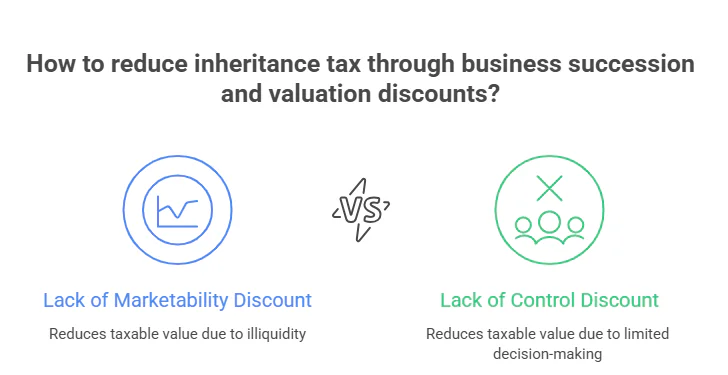
For business owners, a closely held interest can transfer at significantly reduced taxable value when the structure is right. Two discounts that are commonly used:
- Lack of marketability discount: A private company minority interest can be discounted 20% to 35% because it is less liquid than publicly traded assets.
- Lack of control discount: A non-controlling LLC or family limited partnership interest reduces taxable value because the recipient cannot force distributions or liquidation.
Both require qualified valuations and proper entity documentation established well before the transfer.
Business succession strategies require time to implement correctly. Explore our individual tax services to work with Zahra Samji on a plan built around your estate, business interests, and your family’s long-term financial position. Get expert guidance for your tax return.
The Stepped-Up Basis Rule That Determines Which Assets to Gift Now Versus Hold Until Death
Assets held at death receive a stepped-up basis to fair market value on the date of death. Heirs owe no capital gains tax on appreciation that built up during your lifetime. That rule shapes your entire gifting strategy:
- Highly appreciated assets like real estate or long-held stock belong in the estate where the step-up wipes out the capital gains, not in a lifetime gift where your original low basis transfers.
- Assets with little appreciation or those inside retirement accounts do not benefit from the step-up and are better candidates for lifetime gifting.
This single decision impacts how much of each asset your heirs actually keep after taxes.
How Irrevocable Trusts Remove Assets from Your Estate Without Losing Their Benefit
Irrevocable trusts exclude assets from your estate that are taxable while still letting you define how they are used.
A Spousal Lifetime Access Trust moves assets out while your spouse retains access. A Grantor Retained Annuity Trust transfers appreciated business interests at reduced transfer tax costs. A Qualified Personal Residence Trust reduces the taxable value of a real estate transfer.
Zahra Samji at Skyline Financial CPA can identify which trust structure fits your estate composition and help plan the funding timeline with estate tax rules updated for 2026.
Concluding Thoughts
Inheritance tax planning works best when it starts early. The exemption sunset, annual gifting tools, valuation discounts, stepped-up basis decisions, and trust structures covered here all take time to implement.
The earlier you build a plan with a licensed Houston CPA, the more of what you built your family actually gets to keep.
Decisions made today protect what your family receives tomorrow. See how Skyline’s financial solutions can help you build a detailed plan that protects your assets, reduces transfer taxes, and carries out your intentions exactly as intended.
Discuss your tax needs with our expert.
Inheritance Tax Planning FAQs
Does the United States have a federal inheritance tax?
The federal government taxes the deceased person’s total estate, not what each heir receives. Six states impose a separate inheritance tax paid by the recipient. These are two distinct obligations that should not be confused with one another.
Do lifetime gifts reduce my estate tax exemption?
Taxable gifts reduce your remaining lifetime exemption dollar for dollar. Annual exclusion gifts and direct tuition or medical payments do not count against the exemption and reduce your estate without any offset to the larger threshold.
Should I transfer appreciated assets to heirs now or wait until death?
Hold highly appreciated assets until death so heirs receive the stepped-up basis and owe no capital gains tax on prior appreciation. Gifting during life passes your original low basis, creating a capital gains liability when heirs eventually sell it.
Do I need an estate attorney or a CPA for inheritance tax planning?
Both serve distinct roles. An estate attorney drafts legal documents like trusts and wills. A CPA models tax consequences and aligns the plan with your income and business tax position. Comprehensive estate planning typically requires both working in coordination.

