

Every hour you spend managing payroll manually is an hour not spent growing your business. And unlike most administrative tasks, payroll carries a penalty structure that turns small mistakes into expensive corrections.
If you have been considering whether to outsource payroll services Houston TX, this year is the right time to make that decision with clarity.
This blog covers the specific operational and compliance burdens that make in-house payroll unsustainable and what a well-structured outsourced arrangement actually delivers beyond paychecks.
The Hidden Time Cost of Managing Payroll In-House That Most Owners Overlook
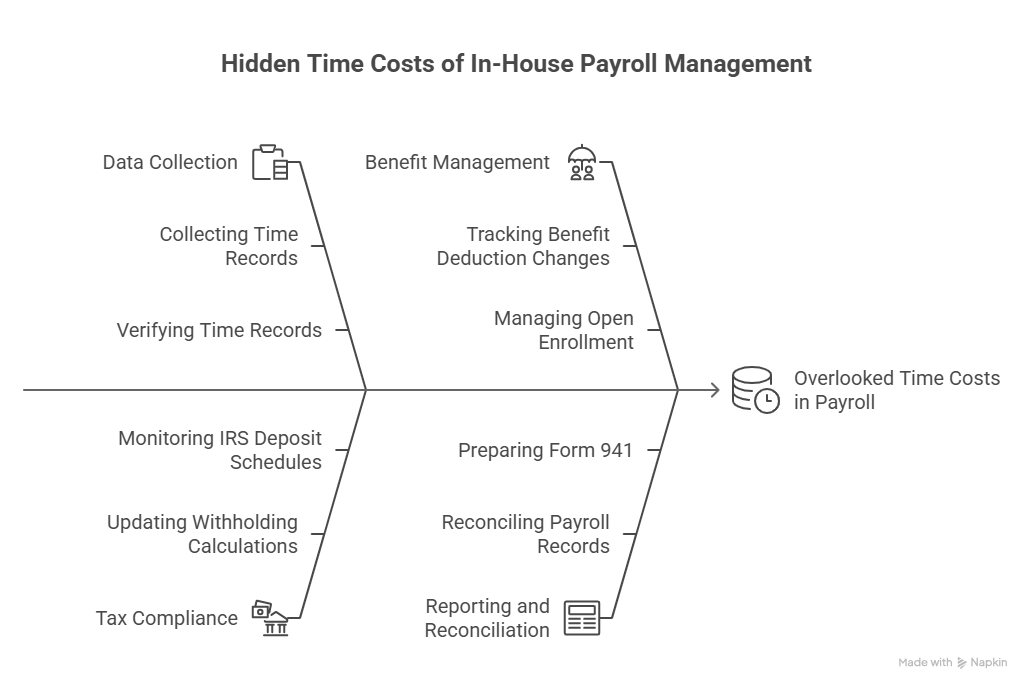
Most small business owners who manage payroll themselves underestimate how much time the function actually consumes. The visible part is running the payroll itself. The invisible part is everything that surrounds it.
Consider what managing payroll in-house requires on a recurring basis:
- Collecting and verifying time records for hourly employees before each run.
- Updating withholding calculations when employees submit new W-4 elections.
- Tracking benefit deduction changes tied to open enrollment or qualifying life events.
- Monitoring IRS deposit schedules and remitting payroll taxes on time to avoid penalties.
- Reconciling payroll records against your general ledger after every run.
- Preparing and filing Form 941 each quarter with figures that match your deposit history.
- Managing garnishment orders as they arrive and applying them correctly to net pay calculations.
- Issuing W-2s by January 31st and submitting the W-3 transmittal to the Social Security Administration.
Why Payroll Penalties Accumulate Faster Than You Expect When Something Goes Wrong
The IRS failure-to-deposit penalty is one of the most aggressive penalty structures in the tax code. It applies the moment a payroll tax deposit is late, and the rate increases the longer the deposit remains unpaid.
Here is how the penalty tiers work:
| Days Late | Penalty Rate |
| 1 to 5 days | 2% of the unpaid deposit |
| 6 to 15 days | 5% of the unpaid deposit |
| 16 or more days | 10% of the unpaid deposit |
| 10 or more days after the IRS notice | 15% of the unpaid deposit |
When you plan to outsource payroll services to a reputable provider, deposit accuracy and filing timeliness become their responsibility rather than yours. The risk does not disappear, but it shifts to a system built specifically to manage it.
The Compliance Exposure That Grows Alongside Your Headcount
Payroll management becomes harder as you add employees because compliance complexity does not scale linearly. Each new hire adds variables like pay rates, withholding, benefits, and classifications with different tax treatment.
Incorrectly classifying an employee as a type of independent contractor may reduce taxes in the short term, but creates significant retroactive exposure if the IRS disagrees, including unpaid taxes, interest, and penalties.
When you outsource payroll services, the classification review happens as part of onboarding new workers rather than as a reactive correction after an audit. That proactive structure protects you from exposure that is genuinely difficult to see coming from inside the business.
How Outsourcing Payroll Connects to a Cleaner Annual Tax Filing
The quality of your payroll records directly affects your tax return. Wages are deductible, but only if the documentation is defensible. When records align with Form 941, your general ledger, and W-3, the deduction is easy to claim and support.
Inconsistent records from manual or fragmented systems force your CPA to reconcile issues instead of focusing on accuracy and planning. Clean payroll filing records provide a solid foundation going into tax season.
This matters even more when deductions involve compensation, including retirement contributions, health insurance, and reasonable salary documentation.
What to Evaluate When Deciding Whether to Outsource Payroll Services This Year
Before you make a decision, the right questions to ask are about scope, integration, and expertise rather than just price.
Evaluate potential arrangements based on:
- Whether the provider handles tax deposits and quarterly filings or only processes payroll and leaves compliance to you.
- How errors and corrections are handled and who bears responsibility when a penalty arises.
- Whether the system integrates with your accounting software to eliminate manual reconciliation between payroll and your general ledger.
- Whether the provider has experience with Texas-specific obligations, including franchise tax implications tied to payroll structure and multi-entity arrangements.
- Whether year-end W-2 preparation and transmittal are included or billed separately.
The businesses that benefit most when they outsource payroll are the ones that treat it as a compliance and advisory function rather than a transactional one.
The goal is not just accurate paychecks. It is a payroll infrastructure that supports your tax strategy, protects your compliance record, and frees your attention for the work that actually grows your business.
Concluding Remarks
The decision to outsource payroll services is ultimately a decision about where your time and risk tolerance are best managed.
The compliance obligations attached to every payroll run are real, recurring, and unforgiving when mishandled. A professional arrangement removes that burden and replaces it with accuracy, timeliness, and documentation that holds up under scrutiny.
At Skyline Financial CPA in Houston, Zahra Samji partners with Houston business owners to simplify payroll tasks, filing requirements, and related tax strategy decisions.
Get in touch with her now if you want to remove payroll from your plate and manage it with professionalism and accuracy.
Outsource Payroll Services FAQs
At what business size does it make sense to contract out payroll services?
It makes sense from your very first hire. The compliance obligations that come with even one employee create the same deposit schedules, quarterly filings, and year-end reporting requirements as a larger workforce.
Will outsourcing payroll eliminate my personal liability for payroll tax errors?
Outsourcing reduces your operational risk, but the IRS can still hold responsible parties personally liable as per the Trust Fund Recovery Penalty for unpaid payroll taxes. Choosing a reputable provider with strong accuracy standards matters significantly.
How does outsourcing payroll affect my bookkeeping and accounting records?
A well-integrated payroll service pushes payroll journal entries directly into your accounting system after each run, keeping your general ledger current without manual entry and reducing reconciliation time at month-end.
Can an outsourced payroll provider handle bonuses, commissions, and irregular pay runs?
Yes. Off-cycle payroll runs for bonuses and commissions are standard in most outsourced arrangements. The provider applies the correct supplemental withholding rate and processes the deposit obligation on the same schedule as regular payroll.
What happens to my payroll records if I switch providers?
Your payroll records belong to you and should be fully exportable when you transition between providers. Prior-year payroll data, W-2 copies, and Form 941 filing history should transfer as part of any responsible offboarding process.

