

The moment you hire your first employee, your tax obligations multiply in ways that catch most small business owners by surprise.
If you have been wondering what are payroll services and whether your business actually needs them, the answer depends less on your company’s size and more on how well you understand the compliance requirements that come with every paycheck you issue.
This blog covers what payroll services actually do, where business owners run into costly mistakes without them, and what to evaluate before choosing how to handle payroll for your growing operation.
The Compliance Obligations That Make Payroll Far More Complex Than Cutting a Check
Issuing a paycheck is the visible part. The compliance work underneath it is what most business owners underestimate until a penalty notice arrives.
Every time you pay an employee, you are triggering a series of federal and state obligations that run on strict schedules with no tolerance for lateness.
Those obligations include:
- Calculating and withholding the correct federal income tax based on each employee’s Form W-4 elections.
- Withholding the employee’s share of Social Security tax at 6.2% and Medicare tax at 1.45%.
- Paying the employer’s matching share of Social Security and Medicare on top of what you withhold.
- Depositing those combined payroll taxes to the IRS on a schedule determined by your total tax liability, either semi-weekly or monthly.
- Filing Form 941 quarterly to report wages paid, taxes withheld, and deposits made.
- Filing Form 940 annually for Federal Unemployment Tax Act obligations.
- Issuing accurate W-2s to every employee by January 31st and submitting the W-3 transmittal to the Social Security Administration.
Missing any one of these steps triggers penalties that compound quickly. The IRS failure-to-deposit penalty alone can reach 15% of the unpaid amount, depending on how late the deposit is. For a business operating on tight margins, that exposure is very important.
What Are Payroll Services Actually Doing Behind the Scenes
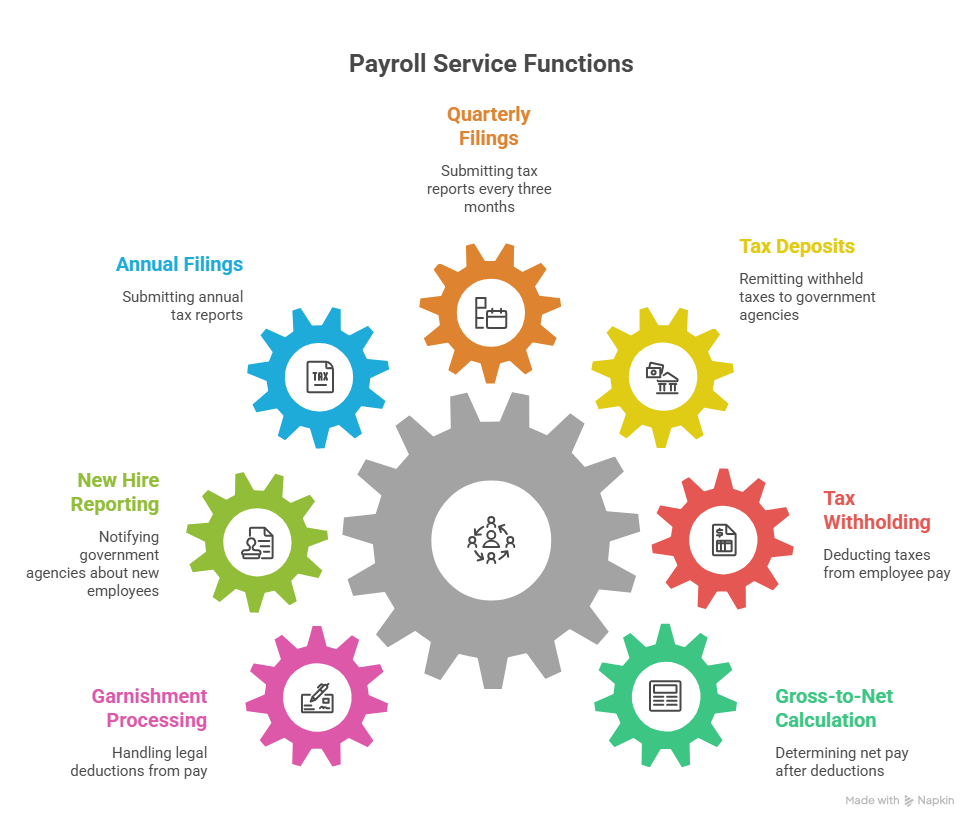
When you work with a payroll service provider, you are outsourcing the calculation, withholding, deposit, and filing functions described above to a system or professional built specifically to manage them accurately and on time.
Here is what a comprehensive payroll service handles on your behalf:
| Function | What It Involves |
| Gross-to-net calculation | Computing net pay after all withholdings and deductions |
| Tax withholding | Federal income tax, Social Security, Medicare, and state taxes, where applicable |
| Tax deposits | Remitting withheld taxes to the IRS on the correct schedule |
| Quarterly filings | Preparing and submitting Form 941 each quarter |
| Annual filings | Form 940, W-2 issuance, and W-3 transmittal |
| New hire reporting | Reporting new employees to the state as required by law |
| Garnishment processing | Handling wage garnishments for child support or creditor judgments |
Understanding what are payroll services covering in this context makes it clear that the value is not just convenience. It is risk management. Each of those functions carries a penalty exposure if handled incorrectly or late.
The Payroll Tax Deposit Schedule Most New Employers Get Wrong
One of the most common compliance failures for first-time employers is misunderstanding the deposit schedule. The IRS assigns your deposit frequency based on your payroll tax liability during a lookback period, and it can change as your business grows.
New employers default to monthly deposits, with payroll taxes due by the 15th of the following month. Once liability exceeds $50,000, you move to semi-weekly deposits with specific due dates based on payroll timing.
Many employers do not realize their frequency has changed until a penalty notice arrives. Quarterly payroll filing reviews help catch these changes before they create compliance issues.
Where Contractor Misclassification Creates Payroll Tax Exposure You May Not See Coming
Many small business owners avoid payroll complexity by classifying workers as independent contractors, which is reasonable when the classification is legitimate.
When it is not, the tax exposure can reach back several years and include unpaid payroll taxes. The IRS evaluates this using behavioral control, financial control, and relationship-type factors.
Key indicators that a worker may be an employee include:
- You control when, where, and how the work is performed.
- The worker works exclusively or primarily for your business.
- You provide tools, equipment, or a workspace.
- The relationship is ongoing rather than project-based.
- You can terminate the worker without contractual consequences.
If an audit determines that a contractor should have been classified as an employee, you become liable for both the employer and employee shares of payroll taxes, plus penalties and interest.
Reviewing your worker classifications as part of your annual small business tax planning Houston TX process reduces that risk drastically.
Final Thoughts
What are payroll services providing, at their core, is accuracy, timeliness, and compliance across one of the most penalty-sensitive areas of small business taxation.
Whether you are managing your first hire or scaling a growing operation, getting payroll right from the start protects your business from exposure that accumulates quickly and quietly.
At Skyline Financial CPA Houston, Zahra Samji works directly with you to bring clarity to payroll obligations, filing requirements, and the tax strategy decisions that payroll structure affects.
If you want to make sure your payroll setup is compliant and aligned with your overall tax position, schedule a consultation for payroll services Houston TX today.
What Are Payroll Services FAQs
What are payroll services typically costing small businesses?
Costs vary widely based on employee count and service level. Basic payroll processing starts around $40 and $150 per month for a small number of employees, with additional fees for tax filing, year-end forms, and HR features.
Can I run payroll myself without a service provider?
Yes, but you are personally responsible for all deposit deadlines, filing accuracy, and compliance requirements. Most business owners find that the penalty risk and time investment outweigh the cost of a professional service.
How often do I need to file Form 941?
Form 941 is filed quarterly, with due dates on April 30th, July 31st, October 31st, and January 31st. It reports wages, withheld taxes, and deposits made during each quarter.
What happens if I miss a payroll tax deposit deadline?
The IRS charges a failure-to-deposit penalty ranging from 2% to 15%, depending on how many days late the deposit is. Consistent lateness can also trigger increased IRS scrutiny of your payroll compliance overall.
Do I need to run payroll for myself as a sole proprietor?
No. Sole proprietors are not employees of their own business and do not run payroll for themselves. You report business income and pay self-employment tax through your personal return instead.

