

Your property tax bill arrives, and the number feels disconnected from anything you can verify or challenge.
If you have ever questioned what are real estate taxes and how that final number actually gets calculated, you are not the only one. Most property owners pay the bill without ever understanding the assessment behind it, which means they also miss legitimate opportunities to reduce it.
This blog breaks down how real estate taxes work, what drives the numbers on your bill, and what you can actually do about them.
How Local Governments Calculate What You Owe Each Year
Real estate taxes are imposed by local taxing authorities, not the federal government. In Texas, your county appraisal district determines your property’s assessed value, and multiple taxing entities apply their rates to that value. Your total bill combines rates from your county, municipality, school district, and any special districts in your area.
The formula works like this: the assessed value multiplied by the combined tax rate equals your annual tax bill. Both variables can change every year. The appraisal district can raise your assessed value, and taxing entities can adjust their rates through their annual budget process.
There is no state property tax in Texas. Every dollar on your bill goes to local entities, which is why property tax rates vary across Houston neighborhoods and surrounding counties.
The Difference Between Market Value and Assessed Value on Your Notice
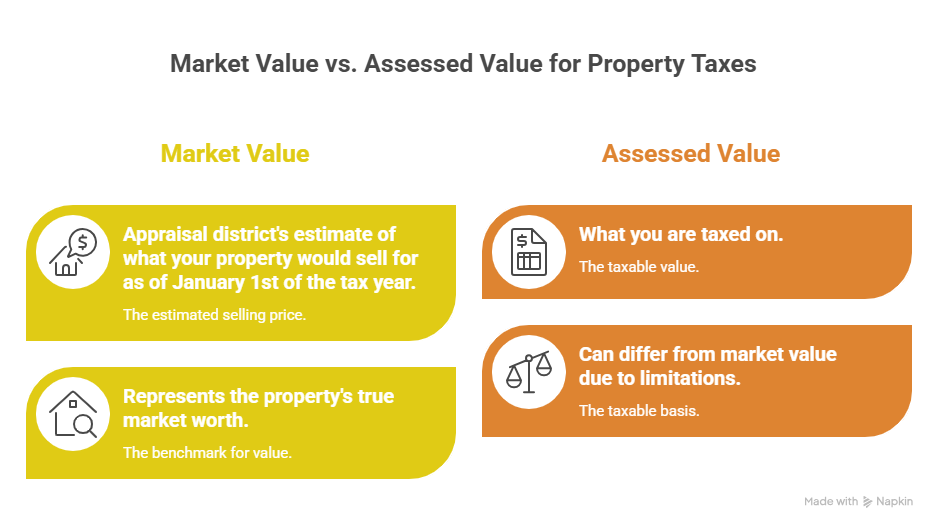
Your appraisal notice shows both figures, and understanding the gap affects how you evaluate whether your bill is accurate.
Market value is the appraisal district’s estimate of what your property would sell for as of January 1st of the tax year. Assessed value is what you are taxed on, and in Texas, it can differ from market value because of two limitations:
- Homestead cap: For properties with a homestead exemption, the assessed value cannot increase by more than 10% per year, regardless of how much market value rises. If your market value jumps 25%, your taxable value is still capped at a 10% increase.
- Exemptions: Homestead, over-65, disabled veteran, and other exemptions reduce assessed value directly, lowering the taxable base before rates are applied.
If you are asking what are real estate taxes costing you more than they should, the first place to look is whether your market value is accurate and whether you are receiving every exemption you qualify for.
Why Your Assessment Can Be Wrong and What the Protest Process Involves
Appraisal districts manage thousands of properties and rely on mass appraisal models using comparable sales, neighborhood averages, and property characteristics, and they make mistakes.
Your property may be overvalued due to incorrect data, poor comparable selection, or failure to account for condition issues.
You have the right to protest your assessed value every year, and you do not need to wait for a dramatic increase. The protest deadline in Texas is typically May 15th or 30 days after your notice is mailed, whichever is later.
Effective evidence in a protest includes:
- Recent sales of comparable properties that support a lower value.
- An independent appraisal from a licensed appraiser.
- Documentation of condition issues like foundation problems, roof damage, or outdated systems.
- Photographs and repair estimates that reflect deferred maintenance that the district’s records do not capture.
Understanding what are real estate taxes billing you for starts with verifying that the assessed value is defensible. A number that cannot be supported by comparable evidence is a number worth challenging.
How Real Estate Taxes Interact With Your Federal Tax Return
For investment property owners and small business owners with commercial real estate, what are real estate taxes doing to your federal return is a separate but equally important question.
Here is how real estate taxes interact with federal tax obligations:
| Property Type | Federal Tax Treatment |
| Primary residence (itemizing) | Deductible up to $10,000 SALT cap |
| Rental property | Fully deductible as a business expense |
| Commercial property | Fully deductible against business income |
| Vacant land held for investment | Deductible if elected, but complex rules apply |
The Assessment Appeals and Exemption Errors That Cost Property Owners the Most
Two situations create the most unnecessary real estate tax expense: failing to protest an inflated assessment and missing or losing an exemption you qualify for.
Homestead exemptions in Texas must be applied for after you purchase a property and are not automatic. If you never filed the exemption, you have been paying taxes on the full assessed value without the cap protection or reduction it provides.
For property investors managing multiple properties, working with a CPA experienced in real estate taxes helps ensure correct classification, full deductions, and proper review of assessment notices before the protest deadline passes.
Last Thoughts
Understanding what are real estate taxes billing you for is the foundation of managing them strategically. From assessment accuracy and exemption eligibility to federal deductibility and protest rights, every layer of your property tax obligation is worth reviewing carefully.
At Skyline Financial CPA Houston, Zahra Samji connects directly with you to bring clarity to exactly these situations. If you want a professional review of how real estate taxes are affecting your overall tax position, schedule a consultation today.
FAQs
What are real estate taxes based on in Texas?
They are based on your property’s assessed value as determined by your county appraisal district, multiplied by the combined tax rates of all local taxing entities that apply to your property.
Can I deduct real estate taxes on my federal return?
It depends on your property type. Personal residence taxes are deductible up to the $10,000 SALT cap if you itemize. Rental and commercial property taxes are fully deductible as business expenses.
How do I know if my property assessment is too high?
Compare your assessed value against recent sales of similar properties in your area. If comparables consistently support a lower value, you have grounds for a protest with your county appraisal district.
What happens if I miss the Texas property tax protest deadline?
You lose the right to contest that year’s assessed value through the formal protest process. The next opportunity is the following tax year when a new notice is issued.
Is the homestead exemption applied automatically in Texas?
No. You must apply for it through your county appraisal district after purchasing and occupying the property as your primary residence. It is not granted automatically at closing.

