

Real estate investing builds wealth over time, but the financial complexity that comes with it builds just as steadily. Between depreciation schedules, passive activity loss rules, cost segregation opportunities, and the tax treatment of different property types, the accounting behind your portfolio is not something that standard small business bookkeeping handles well.
Personalized real estate accounting services address the specific financial structure of property investment, from how rental income gets reported to how gains are deferred and how losses are applied.
If your current accounting setup was not designed around real estate, it is almost certainly costing you more than you realize in missed deductions and misapplied tax treatment.
How Depreciation Strategy Separates Investors Who Pay Too Much Tax from Those Who Do Not
Depreciation is a powerful yet underutilized tool for real estate investors, especially without industry-specific accounting knowledge. Residential property decreases in value over 27.5 years, and commercial property over 39, but many investors overlook cost segregation, where significant tax savings often disappear.
Cost segregation is an engineering-based analysis that reclassifies property components like flooring, fixtures, cabinetry, and certain land improvements for shorter depreciation lives, typically 5, 7, or 15 years, generating larger early-year deductions.
For new or improved properties, a cost segregation study combined with bonus depreciation can produce a first-year deduction that meaningfully reduces taxable income. This IRS-recognized method requires proper documentation and professional execution.
Accurate real estate accounting services make cost segregation actionable by tracking reclassified components on separate depreciation schedules integrated with your overall tax reporting.
The Passive Activity Loss Rules That Every Rental Property Owner Needs to Understand Correctly
Depreciation generates paper losses, which are valuable, but whether you can use them depends on your passive activity classification and adjusted gross income.
Rental activities are generally passive, meaning losses usually offset only passive income, not W-2 or business income, unless specific exceptions apply.
Two key exceptions are usually misunderstood:
- The $25,000 rental loss allowance lets active participants deduct up to $25,000 against non-passive income, phasing out between $100,000 and $150,000 AGI.
- Real estate professional status removes the passive classification, letting qualifying investors offset any income if they spend over 750 hours per year and more than half their working time in real estate.
Your real estate accounting services Houston must track hours, document participation, and apply the correct passive activity treatment for each property.
1031 Exchanges and the Accounting Requirements That Determine Whether the Deferral Holds
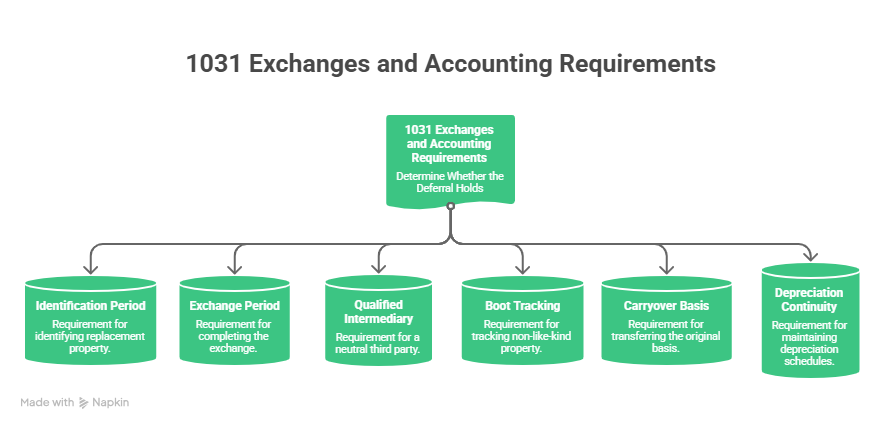
A 1031 exchange allows you to avoid a capital gains tax on the selling of an investment property by reinvesting the earnings into a like-kind replacement property.
The tax benefit is substantial, but the accounting requirements that support the exchange are precise, and errors in how the transaction is recorded can reverse the deferral.
Here is what a properly documented 1031 exchange requires from an accounting perspective:
| Requirement | Detail |
| Identification Period | Replacement property must be identified within 45 days of the sale closing |
| Exchange Period | Replacement property must be acquired within 180 days of the sale closing |
| Qualified Intermediary | Proceeds must be held by a qualified intermediary, not the taxpayer |
| Boot Tracking | Any cash or non-like-kind property received is taxable in the year of exchange |
| Carryover Basis | The adjusted basis of the relinquished property carries over to the replacement property |
| Depreciation Continuity | Depreciation on the replacement property must reflect both the carryover basis and any additional basis from new consideration paid |
Why Rental Portfolio Growth Creates Accounting Complexity That Scales Faster Than Most Investors Expect
A single rental property is manageable with simple records, but two or three properties require more structure. Portfolios of five or more, with mixed rental types and entity structures, create accounting complexity that demands a systematic approach.
As your portfolio grows, accounting needs expand:
- Track income and expenses separately for each property to support accurate Schedule E reporting.
- Prepare entity-level reports, including K-1s for LLCs or partnerships.
- Analyze short-term rental classification under the seven-day rules, affecting passive activity treatment.
- Track intercompany transactions like management fees or shared expenses.
- Manage state-level real estate taxes and filings across multiple jurisdictions.
Outsourcing real estate accounting as your portfolio scales helps you avoid costly catch-up work later.
Final Word
Real estate investing creates financial complexity at every stage, from acquisition and depreciation to disposition and reinvestment. Without purpose-built accounting, decisions are made with incomplete information, and tax benefits can go undocumented.
The right real estate accounting services give your portfolio the structure it needs to perform as intended.
At Skyline Financial, Zahra Samji, a qualified CPA in Houston TX, works directly with real estate investors who want their accounting to reflect the full sophistication of their portfolio.
If you are ready to put professional accounting behind your real estate portfolio and stop leaving tax savings undocumented, schedule a consultation today and get the strategic financial guidance your investments need with real estate CPA Houston.
Real Estate Accounting Services FAQs
What do real estate accounting services typically include for rental property investors?
They cover property-level income and expense tracking, depreciation schedules, Schedule E preparation, passive loss analysis, and entity-level reporting. Scope grows as your portfolio and transactions become more complex.
How do accounting services for real estate handle properties held in multiple LLCs?
Each LLC is considered a separate entity with its own books, tax returns, and K-1s. Accounting tracks intercompany transactions, management fees, and shared expenses to ensure accuracy.
What is the benefit of cost segregation, and which investors should consider it?
Cost segregation accelerates depreciation for property components with shorter recovery periods, creating larger early deductions. It’s best for investors with recently acquired or improved properties and enough taxable income to use the deductions.
Can I outsource real estate accounting if my properties are in different states?
Yes. Outsourcing consolidates multi-state portfolios, coordinates state filing obligations, tracks nexus issues, and ensures accurate income allocation for each state.
How does real estate professional status affect my tax return, and what documentation do I need?
It removes the passive classification, letting losses offset non-passive income. You must keep time logs documenting hours spent on each real estate activity, which your accounting should capture consistently.

