
When you form a limited liability company, the most common question that follows is, “Is an LLC a business license?” The short answer is no. However, the confusion is understandable. Both involve registering your business with the government, and both are required for legal operation in many cases. But they serve entirely different purposes.
If you assume that forming an LLC automatically gives you permission to operate, you may unintentionally expose your business to penalties, compliance issues, or even forced shutdowns. Understanding the distinction protects you legally and financially.
Let’s break this down clearly so you know exactly what your business needs.
Why An LLC and a Business License Are Not The Same
An LLC is a legal entity structure formed at the state level. It builds a separate legal identity for your business and provides liability protection for you as the owner.
A business license, on the other hand, is a permit issued by a city, county, or state that authorizes you to operate within a specific jurisdiction or industry.
Forming an LLC does not automatically grant operational permission. It establishes your business structure, but it does not replace required local or industry-specific licensing.
If you are asking yourself, is an LLC a business license?, the key difference is this:
- An LLC protects you legally.
- A business license permits you to be operational legally.
You often need both.
The Compliance Gap That Can Put Your Business at Risk
Many online formation services focus only on entity creation. Once your Articles of Organization are filed, you may believe you are fully compliant. This is where problems begin.
Operating without proper licensing can lead to:
- Local fines.
- Delayed contract approvals.
- Permit denials.
- Business closure notices.
Your LLC registration is filed with the Secretary of State. Business licenses are typically handled by local municipalities. These are separate regulatory systems that do not automatically communicate with each other.
State-Level Obligations Beyond LLC Formation
After forming your LLC, you may also have state tax responsibilities that are unrelated to licensing.
For example:
- Annual reports.
- State income tax registration.
- Sales tax permits.
- Employer registration.
In states like Texas, LLCs may also be subject to franchise tax reporting requirements. Even if no tax is due, a report may still be required annually.
Being unable to meet these obligations can result in forfeited good standing, which affects your ability to obtain financing or enter into contracts.
Industry-Specific Licenses And Permits
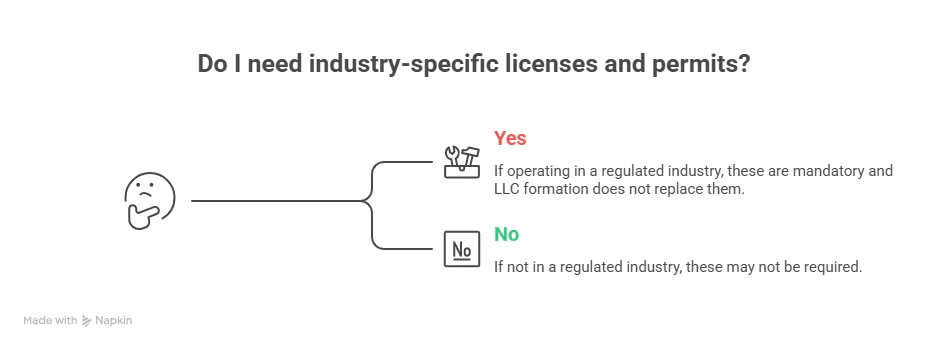
Certain industries require additional permits regardless of entity type.
Examples include:
- Contractors
- Healthcare providers.
- Restaurants
- Real estate professionals.
- Financial service providers.
If you operate in a regulated industry, forming an LLC does not replace professional licensing requirements.
When business owners ask, “Is an LLC a business license?” they are usually trying to simplify compliance. Unfortunately, regulatory requirements are layered, and you must address each layer independently.
Local City and County Licensing Requirements
Your city or county may require:
- General business operating permits.
- Zoning approvals.
- Home-based business permits.
- Signage permits.
- Health inspections.
These are separate from your LLC registration. Even online businesses may require local registration depending on the jurisdiction.
Ignoring local requirements can create problems when you are applying for bank accounts, merchant processing, or commercial leases.
Federal Registrations That Are Commonly Confused
Another area of confusion involves federal registration.
Your LLC may need:
- An Employer Identification Number.
- Federal tax elections.
- Payroll tax registration.
An EIN is issued by the IRS for tax identification. It is not a business license.
Similarly, if you elect S Corporation taxation, you are making a tax classification change, not obtaining operational permission.
Each registration serves a different compliance function.
Comparing LLC Formation And Business Licensing
To clarify further, here is a side-by-side comparison:
| Category | LLC Formation | Business License |
| Purpose | Creates a legal entity | Grants operating permission |
| Issued by | Secretary of State | City, county, or state agency |
| Provides liability protection | Yes | No |
| Required annually | Often | Often |
| Industry-specific | No | Sometimes |
| Tax classification impact | Yes | No |
This distinction highlights why both may be necessary depending on your business type and location.
The Tax Consequences Of Misunderstanding Compliance
Improper registration can create unexpected tax issues.
If your business operates without proper licensing, you may:
- Invalidate certain contracts.
- Face retroactive penalties.
- Trigger state audits.
- Accumulate unpaid fees.
In some cases, unresolved compliance problems can contribute to tax filing complications or unpaid liabilities. If you already have unresolved obligations, reviewing guidance on back taxes by Skyline Financial CPA Houston may help you understand available resolution options.
Compliance is not just about paperwork. It directly affects your financial stability.
Practical Steps You Must Take to Stay Audit-Ready
To operate confidently, you should:
- Confirm your LLC is properly registered and active.
- Verify local business licensing requirements.
- Register for state tax obligations.
- Obtain industry-specific permits if applicable.
- Maintain annual filing compliance.
Asking, “Is an LLC a business license?” is the first step. The next step is confirming every layer of registration has been addressed.
We help business owners evaluate their structure and tax compliance so they can focus on growth rather than regulatory uncertainty.
Conclusion
Forming an LLC is an important legal step, but it does not replace licensing requirements. If you are wondering, Is an LLC a business license?, the answer is clear. An LLC protects you as a legal entity. A business license authorizes you to operate.
Do you want to know whether your business has met all necessary registration and tax obligations? Our expert Houston CPA, Zahra Samji, can review your structure and filings to ensure you are fully compliant. Connect with her today for a personalized consultation!
FAQs
1. Do I need a business license if I have an LLC?
In most cases, yes. Your LLC does not replace city or county licensing requirements.
2. Is an EIN the same as a business license?
No. An EIN is a federal tax identification number, not operational permission.
3. What happens if I operate without a business license?
You may face fines, penalties, or forced closure depending on your jurisdiction.
4. Do online businesses need local licenses?
Sometimes. Requirements vary by city and county, so you must verify local regulations.
5. Can I request a business license before forming an LLC?
Yes. However, many jurisdictions require your entity formation to be completed before issuing a license.

