
When you compare bookkeeping vs accounting, the distinction is not just technical—it directly affects how well your business stays compliant, manages cash flow, and plans for growth.
Many business owners assume the two are interchangeable. In reality, they serve different purposes, operate at different levels, and influence your financial decisions in different ways.
If you are unsure which one your business needs, the answer depends on more than your size or revenue. It depends on your goals, complexity, compliance requirements, and how proactive you want to be with financial strategy.
Let’s break this down in a practical way that helps you make an informed decision.
How Bookkeeping and Accounting Differ in Daily Business Operations
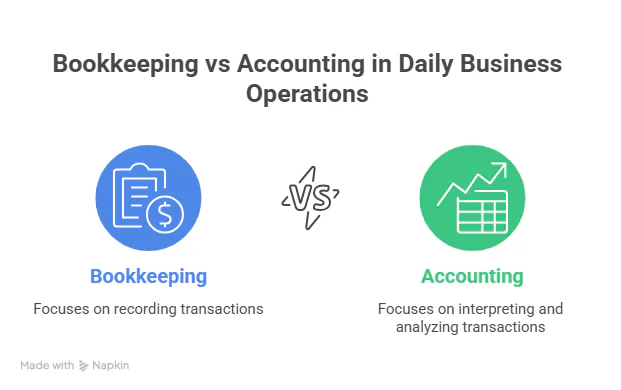
At a high level, bookkeeping focuses on recording transactions, while accounting focuses on interpreting and analyzing those transactions.
But that simple definition does not explain how each function impacts your daily operations.
Bookkeeping typically includes:
- Recording income and expenses.
- Reconciling bank and credit card accounts.
- Managing accounts payable and receivable.
- Maintaining organized financial records.
Accounting, on the other hand, includes:
- Reviewing financial statements.
- Tax planning and compliance.
- Financial forecasting.
- Strategic advisory and risk management.
Bookkeeping creates the foundation. Accounting builds the strategy on top of it.
Why Accurate Bookkeeping Alone is Not Always Enough
You may have clean transaction records, balanced reconciliations, and organized receipts. That is a strong start. However, bookkeeping alone does not answer deeper questions such as:
- Are you overpaying in taxes?
- Is your entity structure still optimal?
- Can you afford to expand?
- Are your margins aligned with industry benchmarks?
Bookkeeping tells you what happened. Accounting tells you what it means and what to do next.
If your financial records are inconsistent, Skyline Financial CPA Houston can help you build a stable reporting system with our Houston bookkeeping services before moving into higher-level advisory work.
The Hidden Compliance Risks Many Businesses Overlook
One area often missing from discussions about bookkeeping vs accounting is compliance exposure.
Bookkeepers focus on recording transactions accurately. However, compliance involves:
- Interpreting tax laws.
- Applying IRS regulations correctly.
- Ensuring proper expense classifications.
- Reviewing payroll tax treatment.
- Preparing financial statements that meet reporting standards.
Without accounting oversight, errors may go unnoticed until tax season, or worse, during an IRS inquiry.
If your business runs as an S Corporation, partnership, or multi-member LLC, the margin for error increases. Financial oversight becomes more critical as your entity structure grows more complex.
When Growing Revenue Changes Your Financial Needs
A common misconception is that small businesses only need bookkeeping. While that may be true in early stages, growth changes your needs quickly.
As revenue increases, you may encounter:
- Estimated quarterly tax requirements.
- Payroll compliance issues.
- Multi-state tax obligations.
- Cash flow forecasting challenges.
- Inventory valuation complexities.
At that point, bookkeeping alone may no longer support wise decision-making. You need accounting insight to manage expansion responsibly.
Looking into our structured accounting services Houston becomes valuable when your financial decisions affect long-term tax exposure and profitability.
Cost Considerations Beyond Hourly Rates
Many business owners compare bookkeeping vs accounting based solely on cost. Bookkeeping is typically less expensive than accounting services, which leads some owners to delay accounting support.
However, the real question is not hourly cost. It is a financial impact.
You should consider the potential cost of:
- Missed deductions.
- Incorrect tax filings.
- Poor entity structuring.
- Unmanaged cash flow gaps.
- Late penalty fees.
Strategic accounting saves more than it costs by reducing risk and identifying opportunities.
Decision Making Versus Data Entry
Another overlooked difference lies in decision authority.
Bookkeeping is operational. It ensures transactions are recorded properly.
Accounting is advisory. It provides insight into:
- Whether you should change the compensation structure.
- When to reinvest profits.
- How to prepare for an audit.
- Whether to restructure your entity.
If you regularly ask financial “what if” questions, you are already operating at the accounting level, even if you only have bookkeeping support.
Financial Planning and Scenario Modeling
Planning rarely appears in basic comparisons of bookkeeping vs accounting, yet it is one of the most valuable accounting functions.
Planning helps you evaluate:
- The impact of hiring new employees.
- The feasibility of expanding locations.
- Cash flow stability during seasonal slowdowns.
- Projected tax liability before year-end.
Without accounting analysis, you may operate reactively rather than proactively.
We focus not only on historical data but also on forward-looking financial strategy, so you can make better decisions before committing to major changes.
Audit Readiness and Documentation Discipline
Accurate bookkeeping organizes transactions. Accounting ensures documentation supports compliance standards.
This includes:
- Reviewing expense substantiation.
- Ensuring reasonable compensation for S Corporations.
- Verifying correct depreciation schedules.
- Confirming proper classification of contractors versus employees.
Audit readiness is not something you address after receiving a notice. It is built into your financial systems from the beginning.
5 Signs You May Need Both Services
You likely need bookkeeping and accounting if:
- Your revenue exceeds six figures.
- You operate as an S corporation or a partnership.
- You pay employees or contractors.
- You want to reduce tax liability legally.
- You are planning an expansion.
Bookkeeping ensures clean data. Accounting ensures strategic direction.
In Conclusion
Choosing between bookkeeping vs accounting is not about picking one over the other. It is about understanding where your business stands today and where you want it to go.
If your operations are simple and stable, bookkeeping may be sufficient for now. However, as your business grows, accounting oversight becomes essential for compliance, tax efficiency, and financial strategy.
Not sure which level of support fits your current needs? Our licensed Houston CPA, Zahra Samji, can evaluate your structure, reporting systems, and growth plans to determine the right solution. Schedule a consultation with her today and strengthen your long-term financial position!
Bookkeeping vs Accounting FAQs
- Can I start with bookkeeping and add accounting later?
Yes. Many businesses begin with bookkeeping and transition to accounting support as complexity increases.
- Is bookkeeping required if I already have an accountant?
Yes. Accurate bookkeeping provides the data accountants rely on for analysis and tax preparation.
- Does accounting include tax preparation?
Yes. Accounting services typically include tax planning and preparation, along with compliance oversight.
- How do I know if my books are inaccurate?
Frequent reconciliation discrepancies, unclear reports, or inconsistent profit margins may indicate bookkeeping issues.
- Can outsourcing save money compared to hiring internally?
In many cases, yes. Outsourcing bookkeeping or accounting reduces payroll costs while providing professional oversight.

