
The 1031 exchange rules give real estate investors one of the most powerful tax deferral tools in the entire tax code.
Reinvesting sale proceeds into a like-kind replacement lets you defer capital gains tax, often indefinitely. But the rules come with strict deadlines, property requirements, and compliance conditions that catch investors off guard. Miss one step and the deferral collapses.
This blog covers the mechanics and nuances that determine whether your exchange actually holds up.
The Two Deadlines That Control Every 1031 Exchange
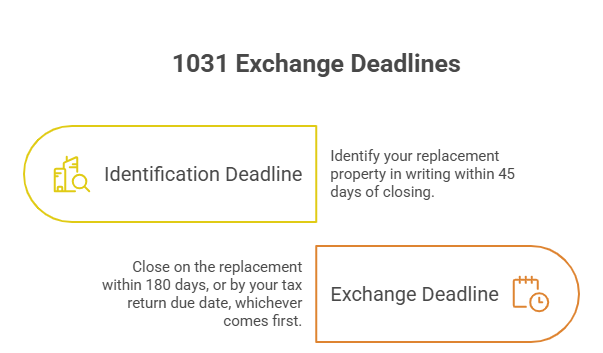
Timing is the most unforgiving part of the 1031 exchange rules. Once you close on the relinquished property, two deadlines run simultaneously:
- 45-day identification deadline: Identify your replacement property in writing within 45 days of closing.
- 180-day exchange deadline: Close on the replacement within 180 days, or by your tax return due date, whichever comes first.
These deadlines do not bend for market delays or financing issues. If your return is due before 180 days expire and you have not filed an extension, your window closes early. Filing an extension to October 15 is a necessary step for investors closing late in the year.
Property Identification Rules That Are Stricter Than Most Investors Expect
The IRS limits how many properties you can identify. Under the 1031 exchange rules, you have three options:
- Three-property rule: Identify up to three properties irrespective of combined value.
- 200% rule: Identify any number given that the combined value does not go above 200% of the relinquished property’s value.
- 95% rule: Identify any number if you close on at least 95% of their combined fair market value.
Most investors use the three-property rule. Identification must be in a signed written document delivered to your qualified intermediary. Verbal identification does not count, and selections cannot change after the 45-day window closes.
Navigating real estate tax obligations requires more than meeting deadlines. Review our real estate tax services to work with Zahra Samji on depreciation, capital gains planning, and exchange compliance built around your investment strategy.
What Qualifies as Like-Kind Property and Where Investors Get It Wrong
The like-kind requirement is broader than most investors assume, but it has firm limits. Any real property retained for investment or productive use in a trade or business qualifies for exchange.
What qualifies:
- Residential rental property exchanged for commercial property.
- Raw land exchanged for an apartment building.
What does not qualify:
- Your primary residence or a second home used personally.
- Fix-and-flip property held primarily for resale.
- Personal property like equipment or vehicles, excluded since the 2017 Tax Cuts and Jobs Act.
The IRS evaluates your holding intent. A property sold shortly after acquisition may raise questions about whether genuine investment intent existed.
Boot and Depreciation Recapture Still Create Tax Liability Inside a Valid Exchange
1031 exchange rules defer capital gains but do not eliminate all tax exposure. Boot is any cash or non-like-kind property you receive in the exchange. If your replacement is worth less than your relinquished property, that shortfall is taxed as capital gain. To fully defer your gain, the replacement must equal or exceed the relinquished value, and all net proceeds must be reinvested.
Depreciation recapture under Section 1250 is a separate issue. Accumulated depreciation is recaptured at 25% when you sell, and a 1031 exchange carries that exposure forward rather than eliminating it. When you eventually sell without exchanging, recaptured depreciation from all prior properties comes due at once.
Depreciation recapture and capital gains exposure require proactive planning. See how our tax planning Houston services help you stay ahead of the tax implications tied to your real estate portfolio before they compound.
The Qualified Intermediary Requirement and Why Your Own Funds Cannot Touch the Proceeds
You cannot receive the sale proceeds from your relinquished property at any point during the exchange. If the funds touch your bank account, the exchange is disqualified. A qualified intermediary holds the proceeds, facilitates the replacement purchase, and ensures the exchange agreement is in place before closing.
Your attorney, qualified accountant, real estate agent, or anyone who has served as your agent in the past two years cannot act as your QI. Confirming that your QI carries adequate insurance and holds funds in segregated accounts is a due diligence step that protects your entire exchange.
End Note
The 1031 exchange rules are a genuine wealth-building tool, but only when executed precisely. The deadlines are fixed, the identification requirements are specific, and boot and depreciation recapture do not disappear.
Understanding how each rule applies to your portfolio lets you plan strategically rather than reactively. If you are considering an exchange, engaging a licensed CPA in Houston TX before you close is what protects the outcome.
Ready to plan your next exchange with full tax clarity? Connect with Zahra Samji today and work one-on-one to structure your exchange, manage your depreciation schedule, and protect your deferral from start to finish.
1031 Exchange Rules FAQs
Can I do a 1031 exchange on a property owned for less than a year?
There is no statutory minimum holding period, but the IRS evaluates your intent. Properties sold shortly after acquisition may not meet the held-for-investment requirement if the pattern resembles dealer activity rather than investment.
What happens to my depreciation basis after a 1031 exchange?
Your depreciation basis from the relinquished property carries into the replacement. Future deductions may be lower than expected, and accumulated recapture exposure transfers forward along with the exchange.
Can a vacation home qualify for a 1031 exchange?
Possibly, under IRS safe harbor rules. The property must have been rented at reasonable market value for at least 14 days per year in each of the two prior years, and personal use cannot exceed 14 days or 10% of rental days.
Is there a limit on how many times I can use a 1031 exchange?
No. You can chain exchanges indefinitely to defer capital gains across multiple transactions. At death, heirs receive a stepped-up basis that can eliminate accumulated deferred gain entirely under current tax law.
Does a 1031 exchange affect my state tax liability?
It depends on your state. Most conform to federal 1031 treatment, but some do not. Cross-state exchanges require a separate review of tax obligations in both the relinquished and replacement property states.

