

Sorting through search results for the best bookkeepers in Houston quickly turns into an overwhelming list of similar-sounding services, each promising accurate books and stress-free reconciliations without telling you much about what actually separates a strong bookkeeper from a mediocre one.
The right fit depends on more than proximity or price. It comes down to specific factors like software compatibility, industry familiarity, and how closely your bookkeeping connects to your broader tax strategy.
Why Bookkeeping and Accounting Are Not Interchangeable Services
Many business owners use the terms “bookkeeping” and “accounting” as if they mean the same thing, but understanding the distinction changes what you should expect from whoever manages your books.
Bookkeeping covers the day-to-day recording of transactions, reconciling accounts, and organizing your financial data. Accounting takes that data and interprets it, building financial statements and strategic guidance around what the numbers actually mean for your business.
This distinction matters when you are choosing a provider:
- A bookkeeper focused purely on data entry may not flag strategic opportunities buried in your numbers.
- An accountant who never reviews your day-to-day transactions may miss errors that compound over months.
- The strongest arrangement connects both functions, so your books feed directly into decisions rather than sitting isolated in a spreadsheet.
Best Bookkeepers in Houston Understand Local Compliance Nuances
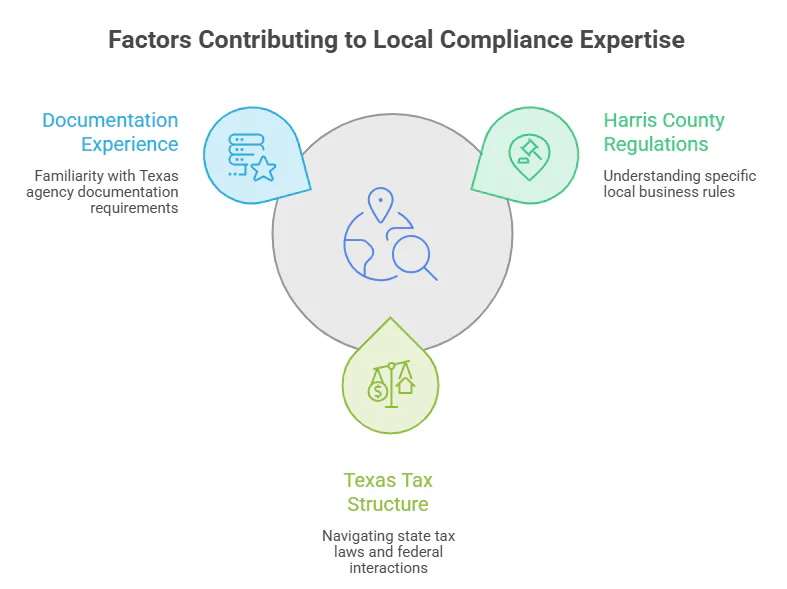
Houston businesses carry compliance obligations that a bookkeeper working from a generic national platform may not fully understand.
Texas franchise tax, sales and use tax nuances specific to certain industries, and local business permit requirements all factor into how your books should be structured throughout the year.
A locally grounded bookkeeper brings:
- Familiarity with Harris County business regulations that affect how certain transactions should be categorized.
- Understanding of how Texas’s lack of state income tax interacts with your federal filing obligations.
- Direct experience navigating the specific documentation Texas agencies expect during compliance reviews.
This local knowledge often prevents small categorization errors that compound into larger compliance headaches once tax season arrives.
Matching Bookkeeping Expertise to Your Specific Industry
Generic bookkeeping templates struggle to capture the nuances of specialized industries, and this gap becomes obvious the moment your business needs anything beyond basic income and expense tracking.
A distribution company managing inventory across multiple warehouses has fundamentally different bookkeeping needs than a professional services firm invoicing by the hour.
Consider how industry specialization changes what your books need to capture:
- Distribution businesses require landed cost tracking, freight allocation, and inventory valuation across warehouse locations.
- Law firms need trust account compliance, case cost tracking as receivables, and partner distribution structures.
- Service-based businesses need clean categorization of billable versus non-billable time and project profitability.
If you operate in a specialized field, working with someone who understands distribution-specific accounting practices or law firm trust account requirements produces books that actually reflect the mechanics of how your business generates revenue, rather than a one-size-fits-all approach borrowed from an unrelated industry.
Questions That Separate Strong Bookkeepers From Mediocre Ones
A short conversation before committing to a bookkeeper reveals far more than a polished website or a list of software certifications. The right questions get past surface-level credentials and into how someone actually approaches your specific situation.
Worth asking directly:
- How do you handle reconciliation when my records are incomplete or messy at the start?
- What reporting cadence do you recommend based on my business size and industry?
- Can you connect me with tax planning support, or does that require a separate relationship entirely?
- How do you communicate if you spot a discrepancy or an unusual transaction?
Vague answers here signal a transactional relationship focused on data entry alone, while specific, thoughtful responses signal someone who genuinely engages with your business.
Weighing Virtual Bookkeeping Against a Local In-Person Relationship
Remote bookkeeping has become increasingly common, and for many businesses, it offers real advantages in flexibility and cost without sacrificing quality.
The key is confirming that virtual support still includes the responsiveness and local compliance knowledge that makes a difference for Houston-based businesses.
Choosing virtual bookkeeping support built around cloud-based systems means your records stay current and accessible regardless of location, while still connecting to someone who understands Texas-specific obligations rather than applying generic national assumptions to your account.
Why Working Directly With a CPA Changes What Your Bookkeeping Delivers
Many bookkeeping services route your account through whichever staff member has availability, which means the person reviewing your numbers changes depending on the month.
Zahra Samji works directly with Houston business owners on their bookkeeping, connecting it to tax strategy and compliance in a way that keeps your financial picture consistent instead of fragmented across different hands.
In Conclusion
Finding the best bookkeeper in Houston comes down to matching expertise with your specific business needs, not settling for whichever provider ranks highest in a quick search.
When you prioritize industry familiarity, local compliance knowledge, and a connection between your books and your broader tax strategy, you build a relationship that genuinely supports your growth.
If you are ready to work with someone who understands your business specifically, contact Skyline Financial CPA now and see what dedicated, connected bookkeeping looks like.
Best Bookkeepers in Houston FAQs
Is a bookkeeper the same as an accountant?
No. Bookkeepers focus on recording and organizing daily transactions, while accountants interpret that data to produce financial statements and strategic guidance.
Should I choose virtual bookkeeping or an in-person provider?
Both can work well, as long as your virtual provider still understands Texas-specific compliance requirements and offers responsive communication.
How often should my bookkeeper reconcile my accounts?
Monthly reconciliation is the standard minimum, though businesses with high transaction volume often benefit from weekly reviews.
Can my bookkeeper also handle my tax filing?
Some bookkeepers work independently from tax preparers, but working with someone who connects both functions typically produces more accurate, strategic results.
What credentials should I look for in a bookkeeper?
While formal certification is not always required, experience with your specific industry and clear references matter more than a generic credential alone.

