
If you use Venmo to collect payments for freelance work, sell products, or run any kind of side business, you have probably asked, “Does Venmo report to the IRS?” The short answer is yes, under certain conditions. But the rules have shifted significantly in recent years, and the current threshold is not what most people expect.
Knowing when Venmo reports, what counts as reportable income, and what you owe regardless of whether a form is issued is essential for staying compliant.
The Current Reporting Threshold and Why It Keeps Changing
As of 2026, Venmo is required to issue Form 1099-K when a user gets more than $20,000 in gross payments and completes more than 200 transactions in a calendar year.
This was permanently restored by the One Big Beautiful Bill Act, enacted in 2025, reversing a series of planned lower thresholds that created widespread confusion since 2021.
The table below shows how the federal threshold has changed across recent tax years:
| Tax Year | Federal 1099-K Threshold |
| 2022 | $20,000 + 200 transactions |
| 2023 | $20,000 + 200 transactions |
| 2024 | $5,000 (any transaction count) |
| 2025 and beyond | $20,000 + 200 transactions (permanent) |
If you received Venmo payments for goods or services during 2026, you generally will not receive a Form 1099-K unless you exceed both the $20,000 payment threshold and 200 transactions.
For those wondering, “Does Venmo report to the IRS? The answer is yes when reporting thresholds and payment types meet IRS requirements. For 2025 forward, the $20,000 and 200-transaction standard applies.
One important note: some states have lower reporting thresholds. Even below the federal level, your state may still require Venmo to issue a 1099-K based on where you live.
What Venmo Reports to the IRS and What It Does Not
Venmo only reports payments tagged as goods and services. Personal payments such as splitting a bill or reimbursing a roommate are excluded. But that distinction does not excuse income you have actually earned.
Here is what the IRS cares about regardless of whether a 1099-K is issued:
- Any payment received in exchange for work, services, or goods is taxable income.
- The absence of a 1099-K means Venmo did not issue the form, not that the income is exempt.
- You are still required to report all business income, including amounts below the $20,000 threshold.
- Incorrectly tagging business payments as personal to avoid the threshold can be treated as tax evasion.
The method of payment does not change the taxable nature of income. If someone pays you through Venmo for work performed, that is self-employment income and belongs on Schedule C.
If you receive payments through Venmo or other platforms and are unsure what needs to be reported, Zahra Samji can help you get your self-employment tax preparation right. Connect with her today!
Does Venmo Report to the IRS Even If You Mix Personal and Business Use
This is where many freelancers get into trouble. If you use one Venmo account for both personal and business transactions, the platform cannot separate them. All payments received through the goods and services toggle count toward your threshold and appear on your 1099-K.
What that means in practice:
- Your 1099-K may include reimbursements or shared expenses incorrectly tagged as goods and services.
- You will need to reconcile the 1099-K total against your actual business income when filing.
- The IRS matches 1099-K figures to your return, so a discrepancy without documentation can trigger a notice.
A dedicated account used exclusively for business transactions is the cleanest solution. It simplifies your recordkeeping and protects you if your return is questioned.
This separation becomes even more important for business owners asking, “Does Venmo report to the IRS?” since clear records make it easier to distinguish business income from personal transactions.
Keeping business and personal finances separated is one of the most practical steps for your tax position. If your books need organizing before your next filing, explore Skyline’s bookkeeping services. Discuss your bookkeeping needs with an expert.
What to Do If You Received a 1099-K You Were Not Expecting
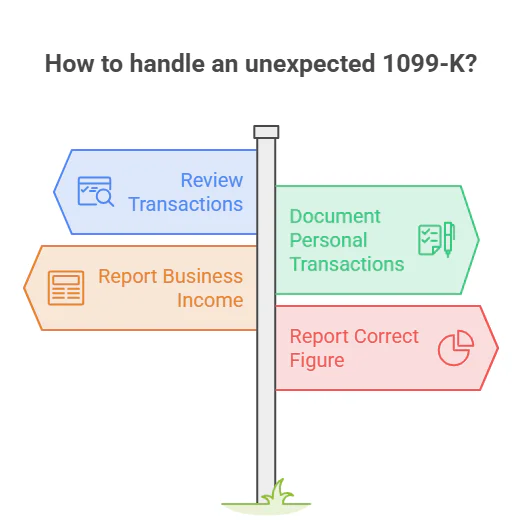
If Venmo issued you a Form 1099-K you were not anticipating, do not ignore it. The IRS received a copy at the same time you did. Here is how to approach it:
- Review the total and identify which transactions were for actual goods or services.
- Separate personal transactions incorrectly tagged and document why they are not income.
- Report your business income on Schedule C and offset it with legitimate business expenses.
- If the 1099-K includes non-income amounts, report the correct figure and document the discrepancy.
Resolving a 1099-K discrepancy without guidance often costs more than addressing it proactively.
Final Considerations
So, does Venmo report to the IRS? Yes, when your goods and services payments surpass $20,000 and 200 average transactions in a calendar year. But the more important point is that the reporting threshold is not your tax liability threshold.
All business income received through Venmo is taxable regardless of whether a form is issued. Keeping transactions organized and filing accurately is what protects you from compliance problems.
If you received a 1099-K or have questions about how platform income affects your return, work directly with personal tax accountant Houston Zahra Samji for clear, practical guidance. Start your tax preparation conversation.
Does Venmo Report to IRS FAQs
Do I owe taxes on Venmo payments even if I did not receive a 1099-K?
Yes. The 1099-K threshold determines when Venmo issues the form, not when income becomes taxable. All payments received for goods or services are taxable regardless of whether a form was issued.
What is the difference between Venmo goods and services payments and personal payments?
Goods and services payments count toward the 1099-K threshold and are taxable income. Personal payments like splitting a bill are excluded, but mislabeling business payments as personal to avoid reporting is a compliance risk.
Goods and services payments count toward the 1099-K threshold and are taxable income. Personal payments like splitting a bill are excluded, but mislabeling business payments as personal to avoid reporting is a compliance risk.
Document each personal transaction and reconcile the discrepancy on your return with a clear explanation. The IRS allows you to report the correct income amount as long as you can support it with records.
Does Zelle report to the IRS the same way Venmo does?
No. Zelle does not issue 1099-K forms because it acts as a transfer intermediary rather than a payment processor. But business income received through Zelle is still taxable and must be reported.

