
Most small business owners do not lose sleep because payroll is complicated. They lose sleep because one missed deposit or misclassified worker can trigger penalties that take months to resolve.
Payroll services for small business exist to remove that exposure from your plate. This blog covers the specific compliance obligations, cost drivers, and decisions that impact whether your payroll setup protects you or puts you at risk.
Why Payroll Tax Deposit Schedules Are the Highest-Risk Part of Your Payroll Obligation
Most business owners know payroll taxes need to be withheld. Fewer know that the deposit schedule decides whether penalties apply. The IRS assigns your frequency based on your lookback period, and missing the schedule by even a day triggers a tiered failure-to-deposit penalty starting at 2% and climbing to 15%.
Your schedule falls into one of two categories:
- Monthly depositor: Taxes deposited by the 15th of the following month.
- Semi-weekly depositor: Deposits due Wednesday or Friday based on your pay date.
Your classification can shift as payroll grows. Crossing the threshold without realizing it means depositing on the wrong schedule. A payroll provider integrated with your accounting catches this. A spreadsheet does not.
If payroll tax deposits feel like a moving target, you are not alone. See how our payroll services Houston TX keep your deposit schedule accurate and your compliance record clean every pay period.
Choosing Payroll Services for Small Business That Align with Your Tax Filing
The most important distinction when evaluating payroll services for small business is whether payroll integrates with your tax filing. Data sitting in a separate system from your general ledger creates reconciliation gaps at year-end and leaves your CPA working from incomplete records.
The integration points that matter most:
- Payroll journal entries coded to your chart of accounts.
- Employer payroll tax expense captured in real time, not rebuilt at year-end.
- W-2 and 1099 data aligned with your general ledger before filing season.
- Form 941 figures that match your deposit history without manual reconciliation.
When these pieces connect, your financial statements reflect true labor costs, and your return is built on verifiable data. When they do not, you introduce risk at every reconciliation point.
Worker Classification Errors That Lead to Back Tax Assessments and IRS Audits
Incorrectly identifying employees as independent contractors is one of the most expensive payroll mistakes a small business can make. If a 1099 worker is later determined to be an employee, you become liable for the employer portion of FICA, back withholding, and penalties across multiple years.
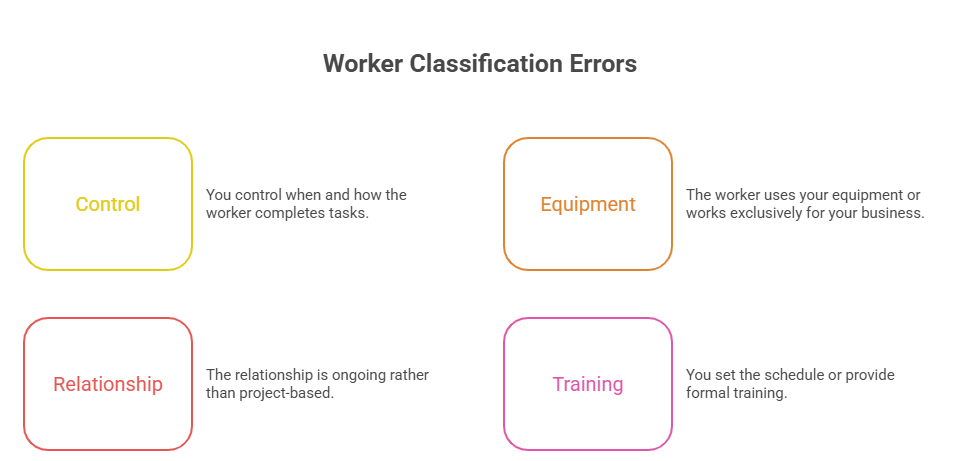
Common IRS indicators of misclassification:
- You control when and how the worker completes tasks.
- The worker uses your equipment or works exclusively for your business.
- The relationship is ongoing rather than project-based.
- You set the schedule or provide formal training.
Reviewing that classification now is far less costly than responding to an IRS reclassification later.
Worker classification issues do not resolve themselves. Explore Skyline’s small business accounting Houston services to get your payroll records, contractor classifications, and tax filings reviewed by a licensed CPA before they become a liability.
What Year-End Payroll Compliance Requires More Than Just Filing W-2s
Year-end payroll is where recordkeeping gaps surface. Filing W-2s is the visible deliverable, but the supporting data matters just as much. This is where reliable payroll services for small business play a key role in ensuring accuracy before year-end close. Before filing, confirm:
- W-2 wages match your four quarterly Form 941 filings.
- Federal deposits reconcile against your IRS deposit transcripts.
- Employer-paid life insurance above $50,000 is included in W-2 Box 1.
- S Corp shareholder health insurance premiums appear in Box 1 and Box 14.
- 1099-NEC forms are issued for all non-employee compensation of $600 or more.
A mismatch between your 941 totals and W-2 wages is a common trigger for IRS notices. Reconciling before the filing deadline keeps your records clean.
How Payroll Decisions Directly Affect Your Business Tax Return
Every dollar you run through payroll affects your taxable income, deductible expenses, and, for S-corp owners, your reasonable compensation exposure. The salary you pay yourself determines both your payroll tax liability and the legitimacy of your distribution strategy.
Zahra Samji at Skyline Financial reviews your compensation structure alongside your business return to make sure both are aligned, defensible, and optimized for your actual income level.
Conclusion
Payroll is one of the most penalty-sensitive functions in your business. The deposit schedules, worker classifications, year-end reconciliations, and tax return implications all interact in ways that surface quickly when something is off.
This is why payroll services for small business need to be set up correctly and consistently maintained alongside your accounting and tax position throughout the year, separating a clean compliance record from one that requires constant correction.
Want your payroll and books working as one system? Learn how Zahra’s Houston bookkeeping services connect your payroll records, financial statements, and tax filings into one clean, audit-ready system.
Payroll Services for Small Business FAQs
How often do I need to deposit payroll taxes as a small business?
The IRS imposes either a monthly or semi-weekly schedule based on your lookback period tax liability. New employers start as monthly depositors and may be reclassified as payroll volume grows.
What happens if my Form 941 totals do not match my W-2 totals?
A mismatch is one of the most common triggers for IRS compliance notices. You will need to identify the discrepancy, file corrections if needed, and reconcile both figures before they escalate into a formal inquiry.
Can I pay myself through payroll as an LLC owner?
Single-member LLCs taxed as sole proprietors take owner draws, not payroll. If your LLC has elected S Corp treatment, you are required to pay yourself a reasonable salary through payroll before taking profit distributions.
Do I need to issue a 1099 to every contractor I pay?
You must file Form 1099-NEC for any individual or unincorporated business paid $600 or more for services. Payments to corporations are generally exempt, with the exception of legal and medical service providers.
What is the penalty for missing a payroll tax deposit deadline?
Failure-to-deposit penalties start at 2% for deposits one to five days late and reach 15% for amounts unpaid 10 days after your first IRS notice. Repeated late deposits can trigger broader scrutiny of your full payroll compliance record.

