
Choosing between an S Corp vs. LLC is one of the most consequential tax decisions you will make as a business owner. Both offer liability protection, but how each treats your income, self-employment taxes, and distributions is fundamentally different.
Making the wrong call does not just complicate your filings. It costs you money every year. This blog breaks down where the real tax differences lie so your decision is grounded in your actual numbers.
How Self-Employment Tax Exposure Differs Between the Two Structures
For most owners comparing S Corp vs. LLC, self-employment tax is where the conversation gets complex. As a single-member LLC taxed as a sole proprietor, your entire net profit is subject to self-employment tax at 15.3% up to the wage base, and 2.9% above it. There is no way around it.
An S Corp changes this. As a shareholder-employee, you split income into two categories:
- A reasonable salary, subject to payroll taxes.
- Distributions above that salary, not subject to self-employment tax.
If your net profit is $150,000 and you pay yourself a $70,000 salary, only that salary carries payroll tax exposure. The remaining $80,000 passes through as a distribution, free of that 15.3% burden. Over time, that difference compounds into real savings.
Already operating as an S Corp or considering the election? Explore Skyline’s S Corp tax preparation services to make sure your filings are structured to capture every available advantage.
The Reasonable Salary Requirement Is the Most Misunderstood S Corp Rule
The most common mistake after electing S Corp status is paying yourself too little. The IRS requires shareholder-employees to receive a reasonable salary for services rendered. Undercompensating yourself to push more income into distributions triggers scrutiny, and the consequences include back payroll taxes, interest, and penalties.
What qualifies as reasonable depends on your industry, role, and what the market pays for comparable work. There is no fixed formula. What matters is that your salary is defensible if questioned.
Zahra Samji at Skyline Financial helps you model the salary-distribution split based on your actual revenue and industry benchmarks, so your structure is both tax-efficient and audit-ready.
Ownership Flexibility and Investor Considerations That Favor the LLC
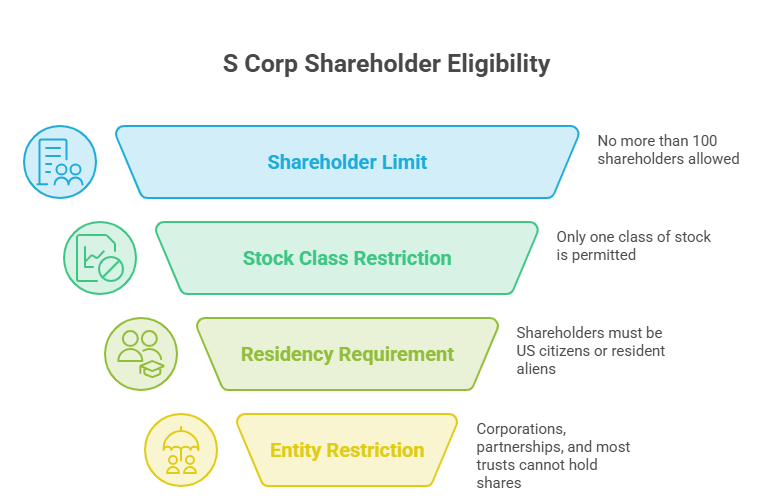
Tax savings are not the only factor in the S Corp vs. LLC decision. The S Corp comes with hard statutory restrictions:
- No more than 100 shareholders.
- Only one class of stock permitted.
- Shareholders must be either US citizens or resident aliens.
- Corporations, partnerships, and most trusts cannot hold S Corp shares.
An LLC has none of these limits. You can have unlimited members, multiple classes of membership interest, and foreign investors. If your business may take on venture funding or bring in partners with different economic rights, an LLC offers structural flexibility the S Corp simply cannot match.
When the S Corp Election Makes Financial Sense for Your Business
The S Corp election is not a universal win. Running payroll, filing quarterly Form 941s, and managing added accounting complexity all carry real costs. For lower-revenue businesses, that compliance overhead can offset the tax savings entirely.
As a general benchmark, the election tends to make sense when your net profit consistently exceeds $40,000 to $50,000 per year. The right timing matters too. Form 2553 must be filed no later than two months and fifteen days after the start of the tax year for which you want the election to apply.
Thinking about making the S Corp election this year? Learn how Skyline handles S Corporation Elections, from the filing timeline to long-term tax planning, so you do not miss the window or leave money on the table.
State Tax Treatment Is a Factor Most Business Owners Overlook
Federal tax savings from the S Corp election can be offset depending on your state. Some states do not acknowledge S Corp status and tax the entity at the corporate level. Others impose franchise taxes or minimum fees that do not apply to single-member LLCs.
In Texas, there is no personal income tax, which changes the S Corp calculus compared to high-income-tax states. However, the Texas margin tax applies to both structures. The entity that saves the most federally may not be the most efficient when state-level obligations are included in the total picture.
Final Thoughts
The S Corp vs. LLC question does not have a universal answer. It depends on your revenue, growth plans, ownership structure, and state obligations. What matters is that your choice is based on a complete picture of your tax exposure, not a general assumption. A licensed CPA in Houston can run the actual numbers for your situation before you commit to either path.
Need help evaluating which structure fits your business? Browse Skyline’s accounting services Houston and work directly with Zahra Samji to get a clear, numbers-based answer for your specific situation.
S Corp vs LLC FAQs
Can an LLC elect to be taxed as an S Corp?
Yes. An LLC can submit a Form 2553 to elect S Corp tax treatment without changing its legal structure. It retains operating flexibility while gaining the payroll tax advantages associated with S Corp status.
Is an S Corp harder to maintain than an LLC?
Yes. An S Corp requires running payroll, quarterly Form 941 filings, annual meetings, and maintaining corporate records. An LLC has fewer ongoing compliance obligations, which is why many owners prefer it at lower revenue levels.
What happens if I pay myself too little as an S Corp owner?
The IRS can restructure your distributions as wages and assess back payroll taxes, interest, and penalties. A defensible, reasonable salary is essential to keeping your S Corp structure intact under any level of scrutiny.
Can I switch from an LLC to an S Corp mid-year?
You can, but timing matters. Form 2553 must generally be filed within two months and fifteen days of the tax year start. Late election relief is available in some cases, but planning ahead avoids the uncertainty entirely.
Does an S Corp provide the same liability protection as an LLC?
Yes. Both structures, S Corp vs. LLC, shield your personal assets from business debts and liabilities. The distinction between them is primarily in tax treatment and ownership rules, not the level of liability protection each provides.

