
Most small business owners manage accounting and payroll as two separate functions, often through two separate systems with two separate workflows. That separation creates more problems than it solves.
When your books and your payroll do not talk to each other, reconciliation errors accumulate, deductions get missed, and your financial statements stop reflecting reality. Integrating accounting and payroll services under a unified arrangement fixes that disconnect and delivers financial clarity that neither function can produce on its own.
This blog covers why integration matters and how a combined approach supports better decisions at every stage of business growth.
The Reconciliation Problem That Siloed Payroll and Accounting Creates
When payroll and accounting operate independently, someone has to manually transfer payroll data into the general ledger after every run. That transfer introduces a reconciliation step that is both time-consuming and error-prone.
The most common problems that surface in siloed systems include:
- Payroll journal entries were posted to incorrect expense accounts, which distorts your profit and loss statement and misrepresents where labor costs are actually sitting.
- Employer payroll tax obligations are recorded in the wrong period because the deposit date does not match the pay period it covers.
- Benefit deductions are processed in payroll but not reflected correctly in your accounting records, creating discrepancies between what employees see on their pay stubs and what appears in your books.
- Bonus and commission payments are processed outside the regular payroll cycle and either omitted from the general ledger or double-counted.
- Year-end W-2 figures that do not reconcile against your accounting records can create complications when your CPA prepares your return.
How Integrated Accounting and Payroll Services Produce Financial Statements You Can Trust
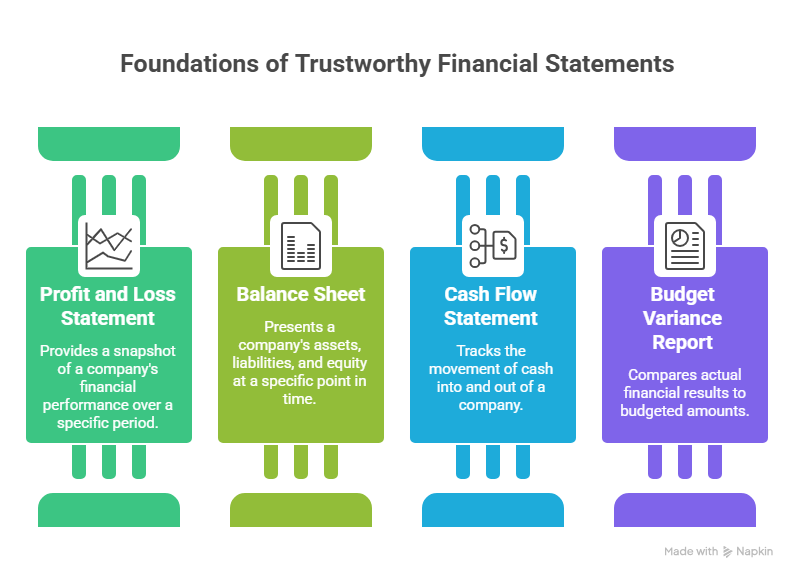
When accounting and payroll solutions operate within a unified framework, every payroll run produces a corresponding journal entry that flows directly into your general ledger without manual intervention.
Here is what that integration produces across your core financial reports:
| Financial Report | What Integration Adds |
| Profit and loss statement | Accurate labor cost breakdown by pay period |
| Balance sheet | Correct accrued payroll liabilities and tax deposit obligations |
| Cash flow statement | Precise payroll-related cash outflows, including employer taxes |
| Budget variance report | Actual wages versus budgeted compensation by department |
The Tax Deduction Accuracy That Depends on Payroll and Accounting Being Aligned
Labor costs are typically the largest deductible expense category for businesses with employees.
The deductibility of wages, employer payroll taxes, retirement plan contributions, and health insurance premiums all depend on those costs being recorded correctly in your books before your return is prepared.
When accounting and payroll support are integrated, those deductions flow from payroll records into your accounting system with the documentation already attached. Your CPA pulls the figures directly from your general ledger, which matches your Form 941 filings, your payroll registers, and your deposit history. That alignment is what makes a deduction defensible under scrutiny.
When the systems are separated and records are reconciled manually, the risk of discrepancies between what was paid, what was reported, and what was deducted increases with every pay period.
By the time your accounting services Houston provider reviews your year-end records, correcting those discrepancies may require amended payroll filings or adjustments that complicate your return.
Labor Cost Visibility as a Strategic Growth Tool for Houston Business Owners
One of the most underutilized benefits of unified accounting and payroll services is the labor cost visibility it creates at the management level.
When wages and payroll taxes are coded accurately to your general ledger in real time, you can analyze labor cost as a percentage of revenue by pay period, by department, or by project, depending on how your chart of accounts is structured.
That visibility supports decisions that siloed systems simply cannot inform reliably:
- Evaluating whether your current headcount is sustainable at your current revenue level before adding another hire.
- Identifying whether overtime costs are driven by understaffing or workflow inefficiency.
- Projecting the full cost of a compensation increase, including employer tax and benefit impact, before committing to it.
- Comparing labor cost trends across quarters to detect early warning signs of margin compression.
These are not hypothetical benefits. They are the practical outputs of financial infrastructure that was built to integrate rather than operate in parallel.
Final Insights
Running accounting and payroll services as separate functions costs you more than just reconciliation time. It costs you financial statement accuracy, deduction defensibility, and the labor cost visibility you need to make confident decisions as your business grows.
A unified approach eliminates those costs and replaces them with an integrated financial infrastructure that supports your CPA, your compliance record, and your growth strategy simultaneously.
Zahra Samji at Skyline Financial CPA works one-on-one with you to align accounting and payroll functions in a way that produces accurate records, clean filings, and financial statements that actually reflect your business.
If you are ready to move beyond siloed systems, set up a meeting with her today. Your books and your payroll services Houston TX should be working together, not against each other.
Accounting and Payroll Services FAQs
Do accounting and payroll solutions need to use the same software platform to be integrated?
Not necessarily. Many accounting and payroll platforms offer direct integrations through APIs that sync data automatically. What matters is that payroll journal entries flow into your general ledger without manual re-entry after each run.
How does integrating payroll with accounting affect my month-end close process?
It significantly accelerates the month-end close by eliminating the manual payroll reconciliation step. When journal entries post automatically, your accounting records are current within days of each payroll run rather than waiting for a manual transfer.
Can integrated accounting and payroll services handle multiple pay schedules?
Yes. Businesses running weekly, biweekly, and semi-monthly payroll for different employee groups can manage all schedules within an integrated system, with separate journal entries generated for each run.
Will my financial statements look different after integrating payroll with accounting?
Your statements will be more accurate and more detailed. Labor costs will be broken into distinct categories, including gross wages, employer payroll taxes, and benefit contributions, rather than appearing as a single combined payroll figure.
Is integrated accounting and payroll support suitable for businesses with contractors as well as employees?
Yes. Contractor payments and the associated 1099 obligations can be tracked within the same accounting framework alongside employee payroll, giving you a complete labor cost picture across all worker types.

