

Starting a new business can be very exciting and full of possibilities. However, before you launch your first product or sign your first client, you face a foundational decision that will shape your financial future.
That is, choosing between an LLC vs sole proprietorship. It affects your personal liability, how much you pay in taxes, and how easily your business can grow over time.
At Skyline Financial Management, we have noticed that many business owners turn to a sole proprietorship because it feels fast and simple. In the early stages, that can work. But as your revenue increases, that same simplicity can slowly expose you to risk and unnecessary taxes.
Zahra Samji, our licensed Houston CPA, works closely with you to ensure your business structure supports both protection and long-term strategy, not just convenience.
What Makes Each Business Structure Different?
Before you can make the right choice, it’s important to understand what these two structures represent at their core and what they don’t.
The Sole Proprietorship
A sole proprietorship is the standard business structure. If you start offering services or selling products without formally registering a business entity with your state, you are automatically a sole proprietor.
There is no legal separation between you and the business. You report income on your personal tax return, keep all profits, and make all decisions. But you also take full responsibility for every liability, financial and legal.
The LLC
A Limited Liability Company (LLC) is a company structure that is formed in your state. Unlike a sole proprietorship, an LLC creates legal separation between you and the business itself.
This separation is important. It forms the foundation for liability protection, tax flexibility, and long-term credibility. While an LLC requires more upfront setup and ongoing compliance, those steps give protections that a sole proprietorship basically cannot provide.
How Liability Shapes Your Choice Between an LLC Vs Sole Proprietorship
The most significant distinction between an LLC vs sole proprietorship is how each structure treats risk.
As a sole proprietor, if your business is sued or cannot pay a debt, creditors can claim your personal assets. Your home, personal bank accounts, and savings are all exposed.
An LLC offers limited liability, but only if it’s respected properly.
Maintain the Corporate Veil and Shield Your Personal Assets
LLC protection isn’t automatic. Courts expect you to treat your business as a separate entity. This legal separation is often called the “corporate veil,” and it can be broken if you don’t follow basic rules, such as:
- Keeping your business and personal finances separate.
- Signing contracts in the LLC’s name, not your own.
- Maintaining a dedicated business bank account.
We regularly see business owners form an LLC but continue operating as if nothing changed. At Skyline Financial Management, we focus on helping you build clean financial habits from day one so your LLC protection actually holds up when it matters most.
The Overlooked Side of Taxes for Your Business
From a federal tax perspective, both sole proprietors and single-member LLCs are considered pass-through entities. That means the business itself doesn’t pay income tax. Instead, profits flow through to your personal return.
This similarity causes many people to assume that there is no tax difference, but that’s only partially true.
The 15.3% Reality of Self-Employment Tax
Whether you operate as a sole proprietor or an LLC, you are subject to self-employment taxes. It handles both the employer and employee portions of Social Security and Medicare.
This 15.3% tax is often the biggest surprise for new business owners. Without early preparation for quarterly payments and deductions, it can quickly strain your cash flow.
This is why we frequently guide our clients through proper planning for self-employment tax preparation long before filing season arrives.
S-Corporation Eligibility
Here’s where the type of business you choose begins to matter.
An LLC has the option to elect S-corporation taxation once profitability reaches a certain point. A sole proprietorship cannot.
With an S-Corp election, you pay yourself a reasonable salary, while the rest of the profits can be taken as distributions that avoid self-employment tax. This potentially saves you thousands when implemented correctly.
Zahra Samji regularly evaluates whether a client’s LLC has reached the point where S-Corp tax preparation becomes beneficial, rather than rushing into it too early or missing the opportunity entirely.
How to Decide Which Structure Is Right for You
Choosing between an LLC vs sole proprietorship depends on your risk tolerance, income trajectory, and long-term vision.
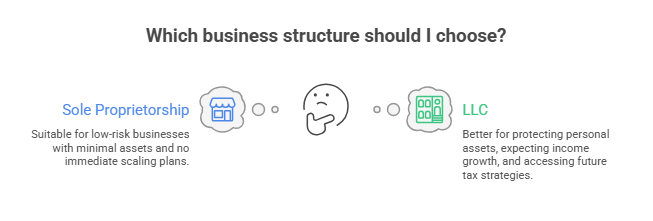
A Sole Proprietorship May Fit If:
- You are operating a low-risk business with minimal exposure.
- You are testing an idea before committing to a formal structure.
- You have limited assets and no immediate plans to scale.
An LLC Is Often the Better Option If:
- You want to protect personal assets.
- You expect income growth or subcontractor relationships.
- You want access to future tax planning strategies.
- You want your business to appear established and credible.
Final Thoughts
Your business setup should empower you, not limit you. If you are unsure whether your current setup still makes sense, now is the time to review it.
Contact Skyline Financial Management today to schedule a consultation with Houston CPA tax preparation Zahra Samji. Let’s make sure your business is structured to protect what you are building and keep more of what you earn.
LLC Vs Sole Proprietorship FAQs
1. Can I transition from a sole proprietorship to an LLC later?
Yes. Many business owners start as sole proprietors and change to an LLC as revenue and risk increase. Timing the switch correctly is important.
2. Does forming an LLC automatically reduce my taxes?
Not by itself. Tax savings usually come from strategic elections, such as S-corporation taxation when income supports it.
3. Do I need an operating agreement if I’m the only owner?
Yes. An operating agreement helps reinforce legal separation and protects the integrity of your LLC.
4. Is an LLC more expensive to maintain every year?
When comparing LLC versus sole proprietorship, it’s true that LLCs come with ongoing state fees. But these costs are often balanced by liability protection and strategic tax planning opportunities.
5. How do I know when my business is ready for an S-Corp election?
This depends on profitability, reasonable salary thresholds, and your long-term plans. We evaluate this individually to avoid costly errors.

